|

Tesla stock jumps 4% after earnings, revenue beats in Q1

Tesla (TSLA) shares bounced over 3% initially afterhours on Wednesday as the electric vehicle (EV) and battery concern run by CEO Elon Musk reported adjusted earnings and revenue that beat Wall Street estimates.

Tesla reported adjusted earnings per share (EPS) of $0.41 on revenue of $22.39 billion. Wall Street analysts had predicted $0.35 in adjusted EPS on $22.2 billion in revenue for the quarter.
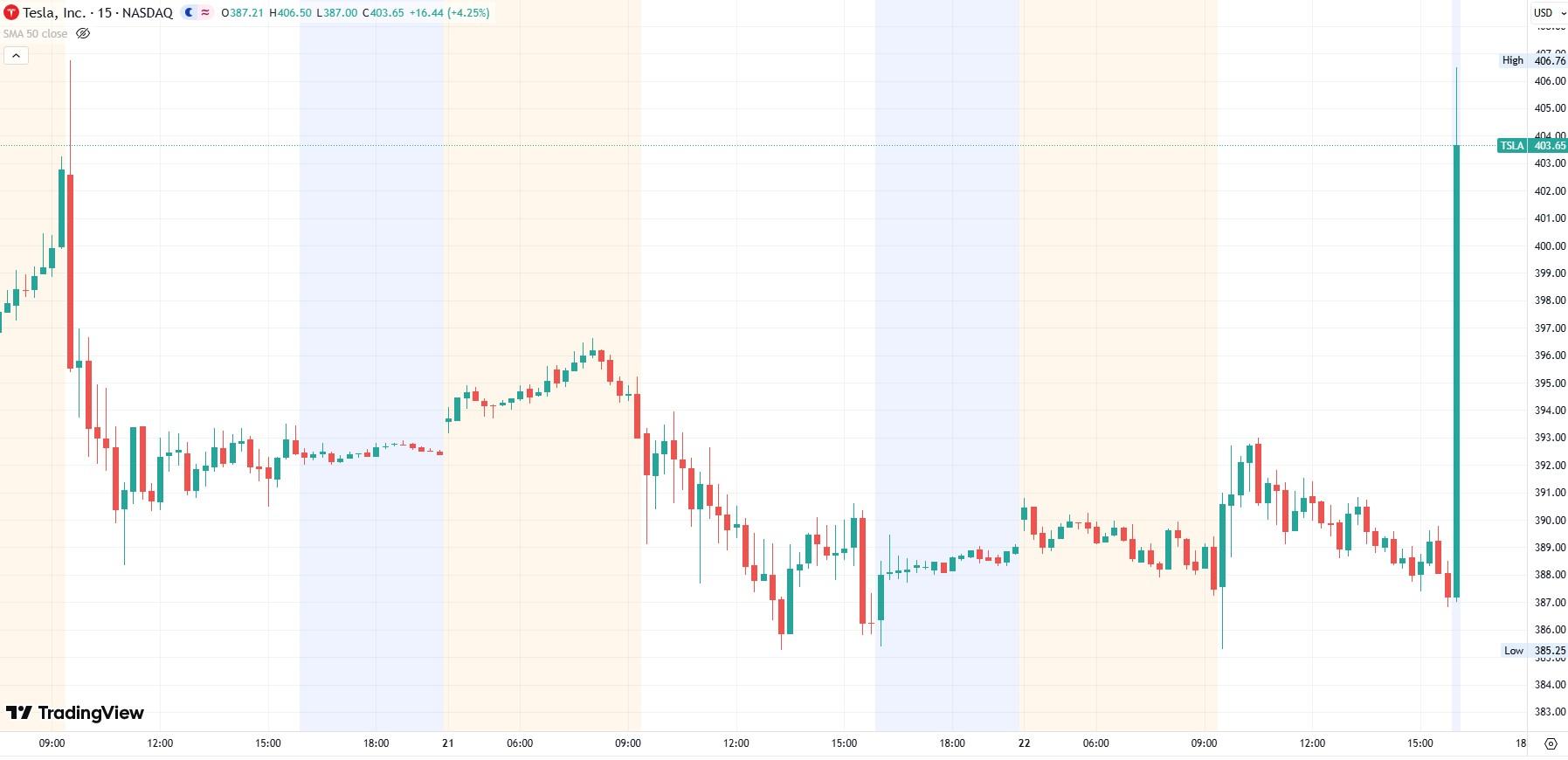
Tesla 15-minute chart
TSLA 15-minute chart for April 22, 2026

Gross margin rises by 100 basis points

Gross margin rose to 21.1%, beating the prior quarter's 20.1% ratio. Additionally, free cash flow arrived at $1.44 billion compared to $1.42 billion in the fourth quarter of 2025. Cash and investments rose $700 million QoQ.

"We continued to make meaningful progress on the build out of the infrastructure and AI software that underpins our Robotaxi and future robotics businesses in Q1," the company said in a statement. "We commenced ramp of additional AI compute, new factories across battery and battery materials, and further prepared lines for start of production of Megapack 3, Cybercab and the Tesla Semi."

Total automotive revenue rose 16% YoY, in line with overall revenues, to $16.2 billion in the quarter. Energy generation and storage revenue on the other hand fell 12% YoY, while services revenue jumped 42% from a year earlier.

Total vehicle deliveries rose 6% YoY to 358K but fell by 60K from the fourth quarter.

Total battery storage deployed, however, fell 15% YoY to 8.8 GWh.

For its Robotaxi segment, Tesla said it had completed over 1.7 million cumulative paid miles driven, and unsupervised Robotax rides were underway in Austin, Dallas and Houston, Texas. Preparations are underway for Robotaxi expansions in Phoenix, Tampa, Miami, Orlando and Las Vegas.

Active FSD subscriptions rose by 180,000 to 1.28 million in the first quarter.

Author

Clay Webster

Clay Webster

FXStreet

Clay Webster grew up in the US outside Buffalo, New York and Lancaster, Pennsylvania. He began investing after college following the 2008 financial crisis.


More from Clay Webster
Share:

Editor's Picks

AUD/USD bulls regain control above 0.6950 amid USD retreat

AUD/USD regains traction and extends the previous day's bounce from the weekly low, aiming for 0.7000 in Asia on Friday. The overnight pullback in US bond yields keeps the US Dollar below an 18-month high, which in turn offers some support to the pair. Meanwhile, hawkish RBA expectations also keep the major underpinned.

USD/JPY holds gains near 158.00 after Japan's weak Household Spending data

USD/JPY clings to gains around 158.00 after data showed on Friday that Japan's Household Spending fell for the ninth straight month, undermining the Japanese Yen. Meanwhile, the US Dollar remains depressed as the overnight fall in US bond yields counters a hawkish Fed and geopolitical uncertainties, could cap any downside in the pair.

Gold remains range-bound below $4,200

Gold has given up some ground after an initial bullish attempt to reach weekly highs, returning to below the $4,200 mark per troy ounce on Friday. The US Dollar’s strong upside momentum, combined with rising US Treasury yields across the curve, seems to keep further gains in the yellow metal under scrutiny.

Has Bitcoin really escaped the macro forces it was built to fight?
Over 17 years ago, Satoshi Nakamoto designed Bitcoin (BTC) on the back of a global financial crisis as an alternative to the global monetary system outside the control of central banks, governments and traditional intermediaries. This raises a key question: has Bitcoin really become independent of the macroeconomic forces it was built to challenge?
The Euro is not the sick man of Europe. France's bond market is
EUR/USD remains under pressure, near the 17-month low of 1.1161 reached on Monday. The pair has lost more than 7% since its yearly peak, as concerns over France's public finances increasingly weigh on the single currency. But behind the weakness of the Euro (EUR), the problem does not necessarily lie with the European economy as a whole.
Has Bitcoin really escaped the macro forces it was built to fight?
Over 17 years ago, Satoshi Nakamoto designed Bitcoin (BTC) on the back of a global financial crisis as an alternative to the global monetary system outside the control of central banks, governments and traditional intermediaries. This raises a key question: has Bitcoin really become independent of the macroeconomic forces it was built to challenge?














