Swiss Franc trades calm against US Dollar, PCE data in focus
- Swiss Franc trades flat against the US Dollar at around 0.8415.
- The Fed is expected to deliver three consecutive interest rate hikes in the near term.
- The revival of global AI stocks rally has also strengthened the US Dollar.


The Swiss Franc (CHF) trades broadly flat against the US Dollar (USD) at around 0.8415 during the late Asian trading session on Tuesday. The Swiss Franc pair has flattened after the rally hits a pause near 0.8444 last week.
The outlook of the pair remains upbeat due to hawkish Federal Reserve (Fed) expectations the revival of global Artificial Intelligence (AI) rally after Nvidia reinstated Jensen Huang as CEO.
Fed seen delivering more hikes as US economy shows it can handle tighter policy
According to economists at TD Securities, the policy backdrop is shifting toward renewed tightening, with the bank now expecting "the Fed to hike three consecutive times starting in December." They argue that "inflation remains above target and is moving in the wrong direction," while "the labor market has stabilized, with some signs of strengthening, and activity data has been robust." In their view, "the economy can handle more restriction, and the Fed is likely to provide it," though they stress that "the evolution of inflation data will determine the extent and pace of hikes later in the cycle."
For fresh cues on inflation, investors await the United States (US) Personal Consumption Expenditure (PCE) Price Index data for October, which is scheduled for Wednesday.
Commerzbank expects the data to underscore persistent price pressures, with “the inflation rate… expected to rise to 3.8% in October, and even without food and energy prices, the inflation rate is expected to be too high at 3.2%.”
On the Swiss Franc front, investors await ZEW Expectations – Survey data for November, which is scheduled for November. In October, the sentiment data deteriorated significantly to -15.3 from a positive figure of 2.6 in September.
USD/CHF Technical Analysis
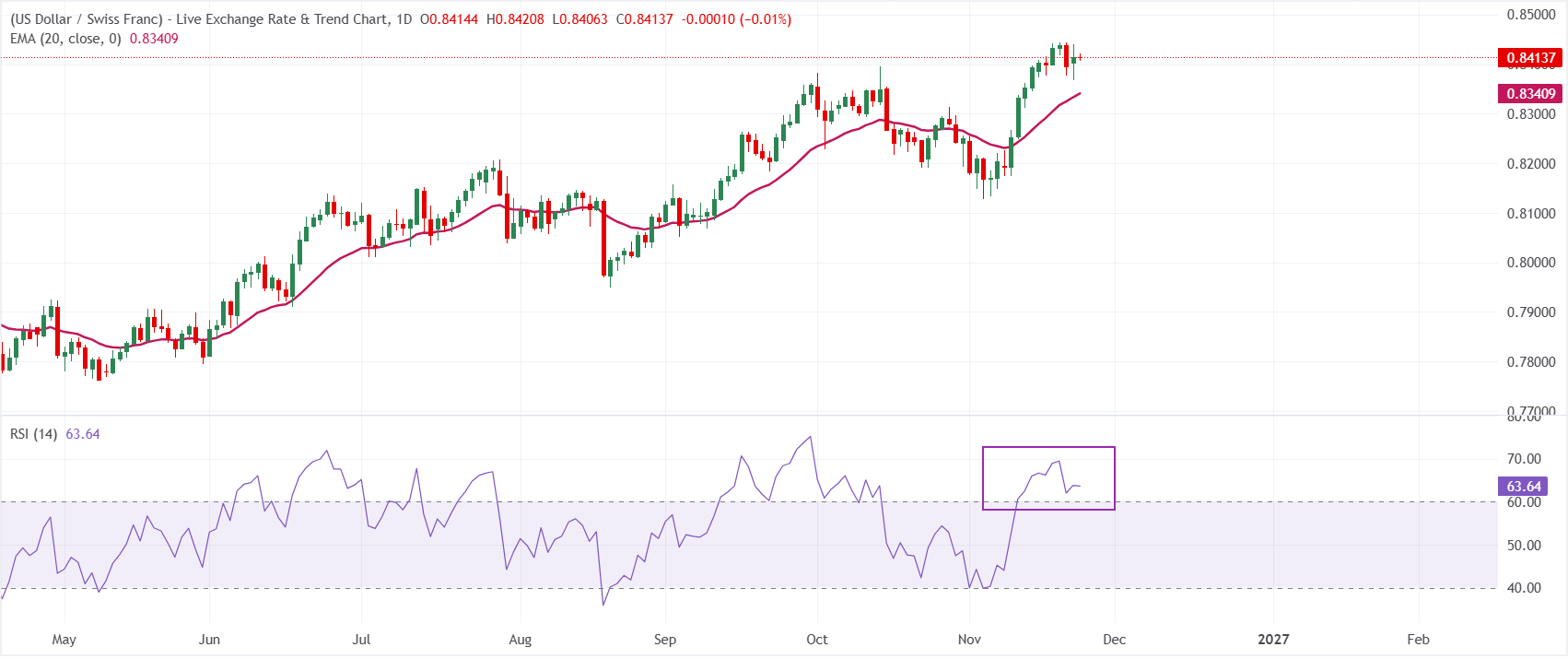
In the daily chart, USD/CHF trades at 0.8414. The pair holds a bullish near-term bias as price remains above the 20-day exponential moving average (EMA) at 0.8341, keeping the recent rebound from the 0.82 area intact. The Relative Strength Index (RSI) at 63.6 stays in positive territory but below overbought thresholds, suggesting buyers still control the tape without signaling exhaustion.
On the downside, immediate support is seen at the 0.8341 area, where the 20-day EMA offers underlying demand, followed by the latest price pivot at 0.8414 as an intraday floor while above it. As long as USD/CHF defends this support zone, the technical structure favors further upside attempts, with any pullbacks likely to be treated as corrective rather than trend-changing.
(The technical analysis of this story was written with the help of an AI tool. Know more.)
Economic Indicator
Personal Consumption Expenditures - Price Index (YoY)
The Personal Consumption Expenditures (PCE), released by the US Bureau of Economic Analysis on a monthly basis, measures the changes in the prices of goods and services purchased by consumers in the United States (US). The YoY reading compares prices in the reference month to a year earlier. Price changes may cause consumers to switch from buying one good to another and the PCE Deflator can account for such substitutions. This makes it the preferred measure of inflation for the Federal Reserve. Generally, a high reading is bullish for the US Dollar (USD), while a low reading is bearish.
Read more.Next release: Wed Nov 25, 2026 13:30
Frequency: Monthly
Consensus: 3.8%
Previous: 3.6%
Source: US Bureau of Economic Analysis
Author
Sagar Dua
FXStreet
Sagar Dua is associated with the financial markets from his college days. Along with pursuing post-graduation in Commerce in 2014, he started his markets training with chart analysis.