|

Stocks move sideways ahead of earnings and economic data

The stock market remained virtually flat yesterday - is this just a pause within the ongoing uptrend?

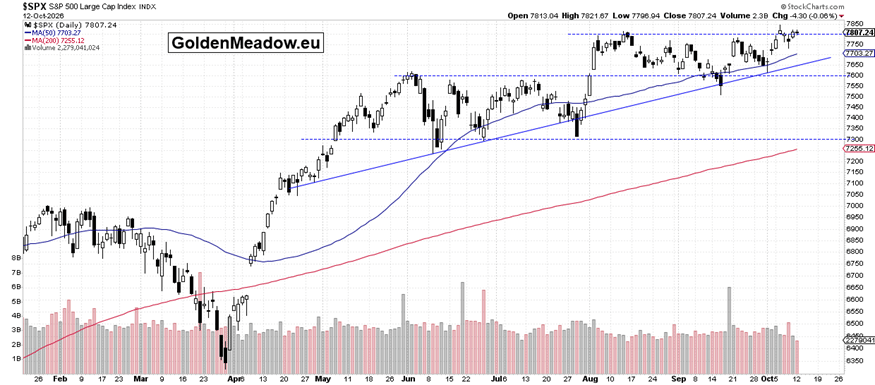
The S&P 500 index lost 0.06% on Monday, remaining near the 7,800 level and extending its short-term consolidation following gains earlier this month. Today, the market is expected to open 0.1% lower, with relatively low volatility despite earnings releases from major banks.

Investor sentiment has improved, as reflected in last Wednesday’s AAII Investor Sentiment Survey, which reported that 40.3% of individual investors are bullish, while 39.0% are bearish.

The S&P 500 index remains near its record high, as shown on the daily chart.
Chart

S&P 500 futures contract: Sideways trading

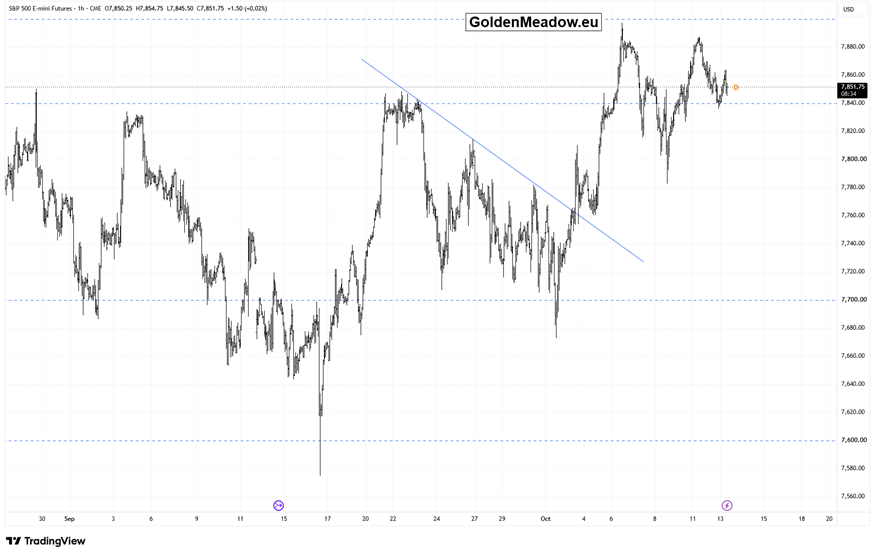
This morning, the S&P 500 futures contract is trading within a consolidation range, extending its recent fluctuations.

Resistance is at 7,880-7,900, while support is at 7,800-7,820, among other levels.
Chart

Market outlook: Uncertainty after reaching a new all-time high

The S&P 500 index is set to open virtually flat today as investors await corporate earnings releases and economic data, including tomorrow’s key Consumer Price Index (CPI) report. For now, it seems to be a flat correction within the broader uptrend.

Here's what I think is most likely:

  • The S&P 500 index is likely to extend its sideways trading as investors await tomorrow’s CPI data and further earnings releases.
  • My Volatility Breakout System is currently long in the market.

What this means for your portfolio

For individual investors, this environment calls for careful position management. While the market continues to advance, the combination of low volatility, seasonal weakness signals, and stretched valuations suggests that defensive positioning may become increasingly important in the weeks ahead.


Want free follow-ups to the above article and details not available to 99%+ investors? Sign up to our free newsletter today!

Author

Paul Rejczak

Paul Rejczak

Gold Price Forecast

Paul Rejczak is a stock market strategist who has been known for the quality of his technical and fundamental analysis since the late nineties.


More from Paul Rejczak
Share:

Editor's Picks

AUD/USD remains depressed near 0.6950 after RBA minutes

AUD/USD attracts follow-through selling during Tuesday’s Asian session, looking to extend the overnight rejection slide from 0.7000, or a two-week top, following the release of RBA meeting Minutes. The US Dollar retains a bullish undertone near its highest level since April 2025 as energy-driven inflation risks keep December Fed rate hike bets firmly on the table. Adding to this, geopolitical risks further underpin the safe-haven USD.

USD/JPY extends retreat below 158.50 as intervention risks loom

USD/JPY is dropping below 158.50 in the Asian session on Tuesday, snapping a two-day winning streak and pulling back from an over two-week top touched the previous day, despite Japan's soft PPI inflation print. Bulls turn cautious amid speculation that authorities will step in to prop up the Japanese Yen, which, in turn, weighs on the pair.

Gold clings to gains just below $4,200

Gold fades Monday’s small pullback and picks up renewed pace, briefly flirting with the key $4,200 mark per troy ounce. The precious metal’s recovery comes in line with the fresh downward trend in the Greenback in combination with shrinking US Treasury yields across the board and easing tensions on the geopolitical front.

Bitcoin rebounds despite cautious sentiment

Bitcoin rebounds over 2%, trading above $83,500 on Tuesday, recovering the previous day’s losses. Persistent geopolitical tensions and mixed signals continue to weigh on risk appetite, keeping investors cautious despite BTC’s recovery.

US – Midterm update: Democratic lead holds three weeks before election

With three weeks until the US midterm election on 3 November, prediction markets are more or less unchanged. Polymarket continues to put the probability of a Democratic sweep at 60-65%. The House is seen as a fairly safe Democratic win, with a probability of around 90%.

Has Bitcoin really escaped the macro forces it was built to fight?
Over 17 years ago, Satoshi Nakamoto designed Bitcoin (BTC) on the back of a global financial crisis as an alternative to the global monetary system outside the control of central banks, governments and traditional intermediaries. This raises a key question: has Bitcoin really become independent of the macroeconomic forces it was built to challenge?















