|

SPY Elliott Wave outlook incomplete bullish cycle supports advance [Video]

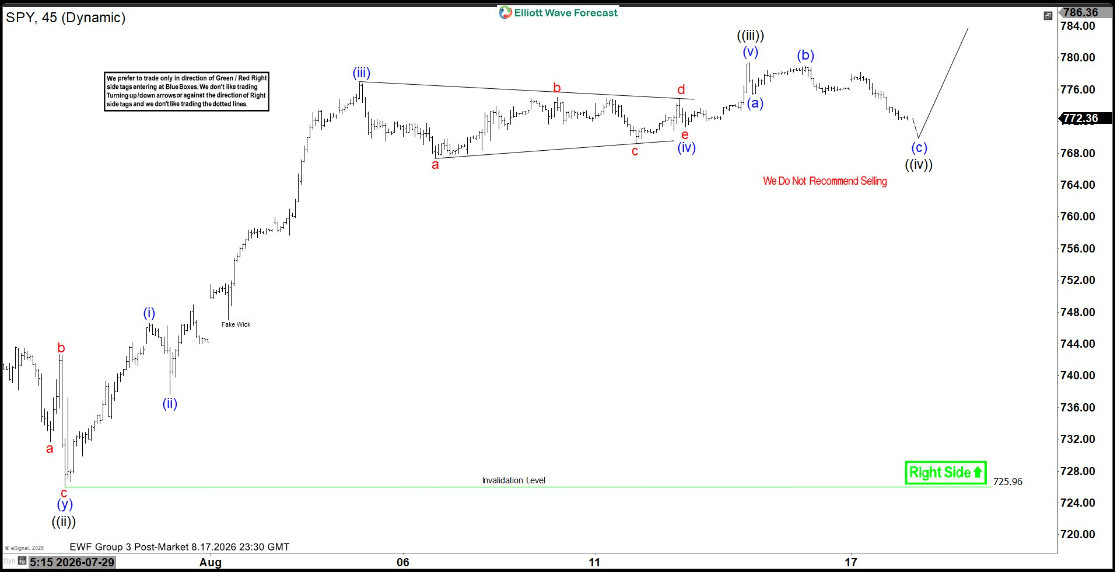
The short‑term Elliott Wave outlook in the S&P 500 ETF (SPY) indicates that the cycle from the June 27 low continues to unfold as an impulse structure. From that low, wave ((i)) concluded at 756.22, followed by a corrective pullback in wave ((ii)) that ended at 725.96. The ETF then advanced in wave ((iii)), which developed as another impulse, as reflected in the 45‑minute chart. Within this sequence, wave (i) terminated at 746.55, while the subsequent dip in wave (ii) found support at 737.68. The rally extended further in wave (iii), reaching 776.85, before a modest retracement in wave (iv) ended at 771.29.

The final leg, wave (v), carried prices to 779.37, thereby completing wave ((iii)) of higher degree. At present, the market is engaged in a corrective phase identified as wave ((iv)). This pullback is expected to unfold in either three or seven swings, serving to correct the cycle that began from the July 30 low. Once this correction is complete, the broader rally should resume.

In the near term, the critical pivot remains at 725.96. As long as this level holds, the expectation is that any pullback will eventually locate support within a three, seven, or eleven‑swing sequence. Such a development would provide the foundation for renewed upside momentum, reinforcing the view that the larger bullish cycle remains intact. This structure highlights the disciplined rhythm of Elliott Wave analysis, where corrections serve as pauses before the prevailing trend continues.

S&P 500 ETF 45 minute Elliott Wave chart
SPY Elliott Wave [Video]
Youtube preview

Author

Elliott Wave Forecast Team

Elliott Wave Forecast Team

ElliottWave-Forecast.com

More from Elliott Wave Forecast Team
Share:

Editor's Picks

AUD/USD climbs toward 0.7000 after strong China data dump

AUD/USD attracts follow-through buyers for the second straight day on Monday, extending last week's recovery toward 0.7000 in Monday's Asian trading. Strong Chniese Q3 GDP and activity data for September strengthen the pair's advance, following RBA Assistant Governor Chris Kent's hawkish remarks.

USD/JPY struggles near 158.00 amid hawkish BoJ, subdued USD

USD/JPY remains defensive near 158.00 in the Asian session on Monday, as the US Dollar remains depressed near a two-week low amid the recent decline in US bond yields. Furthermore, looming intervention risks underpin the Japanese Yen and weigh on the pair amid BoJ Governor Kazuo Ueda's hawkish remarks. However, Fed rate-hike bets and geopolitical uncertainties could limit USD losses and the major.

Gold: $4,200 remains a tough nut to crack for bulls

Gold is struggling to sustain the renewed uptick, remaining below $4,200 in Monday’s Asian trades. The bright metal is torn between dip-buying in the US Dollar and renewed geopolitical optimism, which has sent Oil prices southward.

Week ahead: Stocks seek direction as earnings take centre stage
It has been a challenging week for investors as the hotter US CPI report and the solid start to the earnings season did not produce the expected market movements. With the exception of the aussie, the US dollar is currently posting minimal gains across the FX spectrum, with its post-CPI rally proving short-lived, especially as dovish Fedspeak persists.
Bitcoin rebounds to $82,500 as Ethereum and XRP hold support

Bitcoin, Ethereum, and Ripple show signs of recovery on Monday, following a turbulent week driven by sticky US inflation data and institutional outflows. BTC extends its rebound off the 50-day Exponential Moving Average at $80,607, while ETH and XRP test key support levels after a bearish weekly close.

Everyone's dumping Gold after hot US inflation. Here's why $4,100 could be a floor, not a cliff
Gold (XAU/USD) is recovering from a sharp sell-off triggered by hotter-than-expected United States (US) inflation data released on Wednesday. The precious metal briefly plunged toward $4,073 as investors increased their bets on further Federal Reserve (Fed) interest rate hikes before recovering as US Treasury yields and the US Dollar (USD) reversed their initial gains.