SpaceX surge continues, as Oil falls below $80
SpaceX is still dominating markets on Tuesday, as it rises another 9%, bringing its total gains since last week to 40%. The company is now worth $2.78 trillion, more than Amazon and a mere $200bn below the valuation of Microsoft; it is now the fourth most highly valued company in the world. Both Amazon and Microsoft took decades to reach trillion-dollar valuations, yet SpaceX has taken a matter of days. The rally has been stunning, but these gains are not sustainable. SpaceX’s stock price is now dangerously over-valued at more than 150 times sales.
SpaceX will need to deliver growth quickly if it wants to maintain this stock price, as it is priced for perfection. If it misses growth targets, the market may be unforgiving. However, as always, SpaceX’s value is not straight forward. News that SpaceX is already putting to work the $85bn it raised in its IPO through the purchase of Curser, is telling. This acquisition suggests that SpaceX is betting big on AI generated coding, it also suggests that part of SpaceX’s value is its economic might. That will give the company ability to make strategic acquisitions to boost its AI operations. Thus, the Curser deal, which SpaceX has had the option to buy for several months, could be just the start.
For some analysts, this justifies the surge higher in the stock price on Tuesday. If this is the start of a buying spree for SpaceX, then we could see more upside volatility in the future.
There is no shortage of commentary on SpaceX right now, with some calling for the demise of Elon Musk’s space conglomerate, while others, including Musk himself, see the company as generating revenues of $1 trillion in the coming years. As the share price surges, the risks of buying this stock increase dramatically. One of the most powerful arguments that has been made against SpaceX’s stock price right now is that this elevated entry price for regular traders is also the exit price for venture capitalists, who have made a fortune from this IPO. The underlying message: don’t lose your shirt helping others to get rich.
Some argue that SpaceX is starting to look like gold in Q1. Back then, the gold price surged to $5,400 an ounce, before falling consistently in recent months. The gold price has fallen 6% in the past month, but the parabolic rise in SpaceX’s share price is at a much bigger scale, so the decline could be worse. To put the SpaceX valuation in perspective, it is now worth more than double the price of all the gold held in Fort Knox in the US, which is valued at approximately $1.25 - $1.3 trillion.
The sharp rise in SpaceX for another day is also at odds with the US tech sector, which is selling off sharply on Tuesday. The Nasdaq 100 is lower by more than 1% today, and is being led lower by Intel, Marvell, SanDisk, Broadcom and Nvidia. Chip stocks are taking a breather and are selling off on a broad basis. This comes after a string of positive days and also follows on from a decline in AI infrastructure stocks. The decline in the price of Nvidia, Microsoft, et al this afternoon highlights how the Magnificent 7 mega-cap tech stocks are being rapidly reordered.
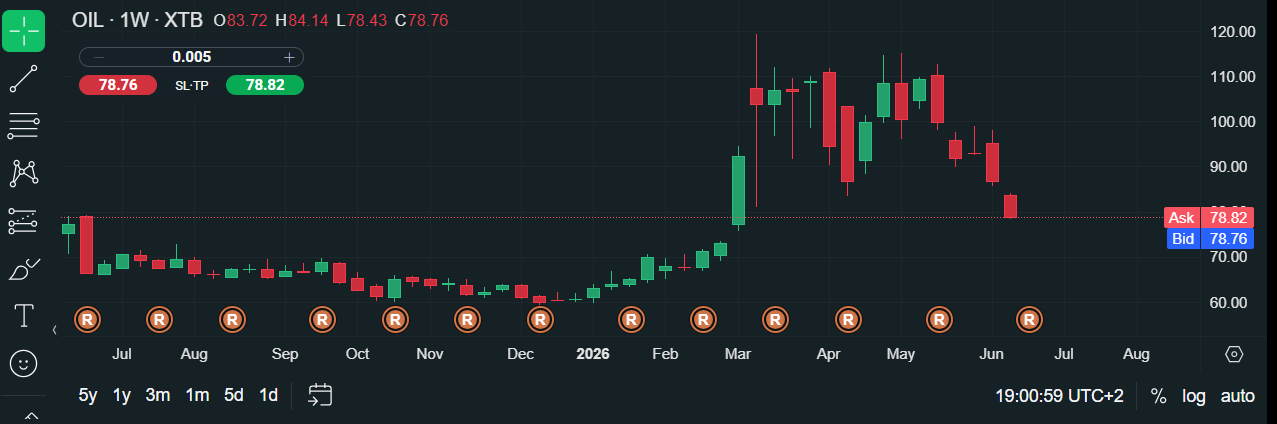
Elsewhere, the oil price is extending declines on Tuesday, and Brent crude is trading below $80 per barrel, as the deal to end the war looks credible. President Trump said that he would send the details to Congress later this week, and that the Strait of Hormuz is already open to traffic. This is boosting the broader market mood and weighing on the energy sector. There is a rotation out of tech into the non-tech/ AI-light sectors of the US stock market, and the Dow Jones is outperforming the Nasdaq on Tuesday and energy is the second worst performing sector after tech. .
Overall, aside from the tech sector, cyclical stocks are performing well, and bond yields are falling as we lead up to tomorrow’s FOMC meeting.
Chart 1: Brent crude oil
Source: XTB
Author

Kathleen Brooks
XTB UK
Kathleen has nearly 15 years’ experience working with some of the leading retail trading and investment companies in the City of London.