Silver rebounds as US sends Iran a 15-point plan to end war
- Silver bounces back as the US Dollar drops; however, its outlook remains uncertain.
- The US sent Iran a 15-point plan to end war.
- Traders will closely monitor the US-Iran talks on Thursday.

Silver price (XAG/USD) recovers its early losses and turns positive to near $73.50 during the Asian trading session on Wednesday. The white metal bounces back strongly as the US Dollar (USD) surrenders its early gains.
The US sent Iran a 15-point plan to end war in the Middle East. Iran indicated that it prefers to engage with US Vice President JD Vance in any renewed diplomatic talks, rather than with special envoy Steve Witkoff or Jared Kushner, highlighting trust issues amid already fragile ceasefire talks. Theoretically, signs of geopolitical tensions remaining heightened tend to increase the safe-haven appeal of precious metals, such as the Silver.
However, precious metals are underperforming as surging energy prices due to Middle East conflicts have weakened speculation that major global central banks will cut interest rates this year. A hawkish stance or an extended pause on interest rates by global central banks bodes poorly for non-yielding assets, such as Silver.
Mediators from Turkey, Egypt and Pakistan are pushing to have a meeting arranged between US and Iranian officials on Thursday, , but both sides remain far apart. Pakistan offered to mediate peace talks between the US and Iran to end the war, an overture that was amplified by US President Donald Trump on social media.
Silver technical analysis
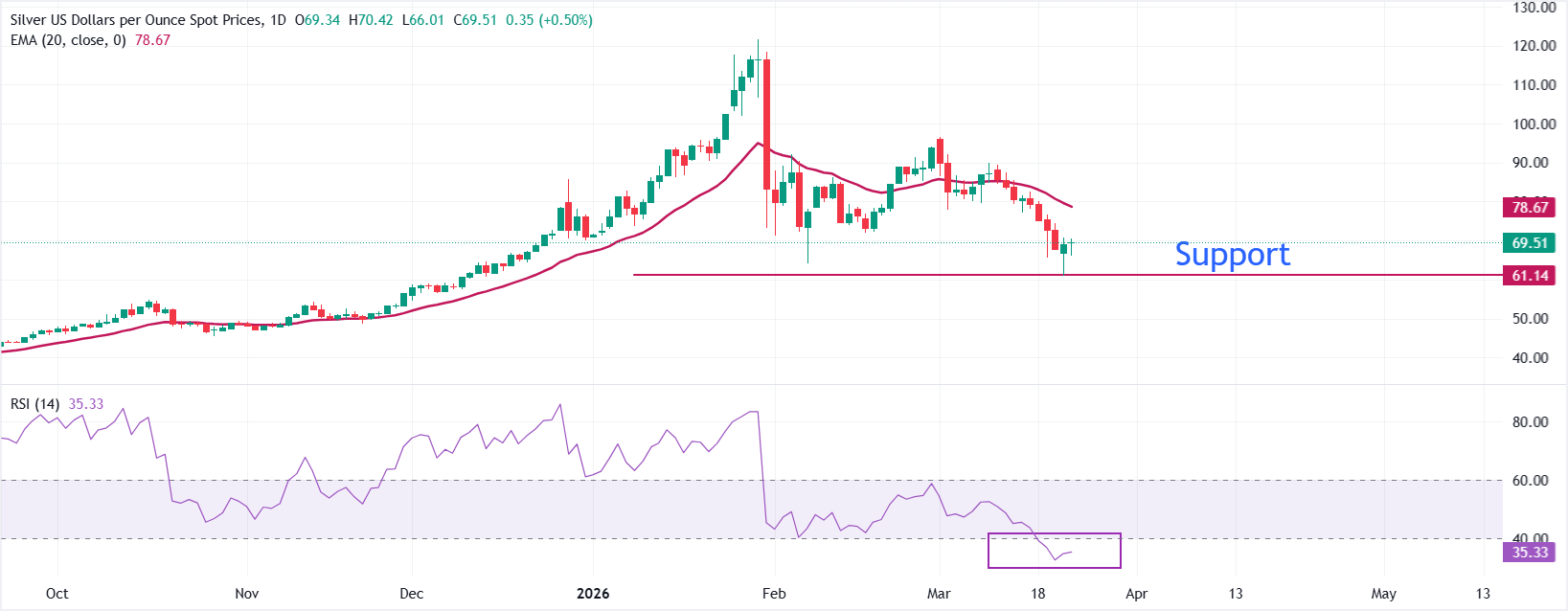
XAG/USD trades higher at around $69.70 during the press time. However, the near-term bias is bearish as spot holds well below the 20-day Exponential Moving Average (EMA), which now tracks near $78.67 and caps recovery attempts. Price has broken a sequence of higher daily closes and is extending away from the 20-day EMA, reinforcing downside pressure.
The 14-day Relative Strength Index (RSI) at 35.33 sits near oversold territory and confirms persistent selling momentum rather than exhaustion.
Initial resistance emerges at the 20-day EMA around $78.67, and a daily close above this level would be needed to ease immediate downside pressure. Above there, the $83.00 region, tied to recent consolidation before the latest breakdown, marks a secondary barrier. On the downside, major support sits near Monday's low at $61.01, with a break exposing the next bearish target toward the October 16 high of $54.86.
Risk sentiment FAQs
In the world of financial jargon the two widely used terms “risk-on” and “risk off'' refer to the level of risk that investors are willing to stomach during the period referenced. In a “risk-on” market, investors are optimistic about the future and more willing to buy risky assets. In a “risk-off” market investors start to ‘play it safe’ because they are worried about the future, and therefore buy less risky assets that are more certain of bringing a return, even if it is relatively modest.
Typically, during periods of “risk-on”, stock markets will rise, most commodities – except Gold – will also gain in value, since they benefit from a positive growth outlook. The currencies of nations that are heavy commodity exporters strengthen because of increased demand, and Cryptocurrencies rise. In a “risk-off” market, Bonds go up – especially major government Bonds – Gold shines, and safe-haven currencies such as the Japanese Yen, Swiss Franc and US Dollar all benefit.
The Australian Dollar (AUD), the Canadian Dollar (CAD), the New Zealand Dollar (NZD) and minor FX like the Ruble (RUB) and the South African Rand (ZAR), all tend to rise in markets that are “risk-on”. This is because the economies of these currencies are heavily reliant on commodity exports for growth, and commodities tend to rise in price during risk-on periods. This is because investors foresee greater demand for raw materials in the future due to heightened economic activity.
The major currencies that tend to rise during periods of “risk-off” are the US Dollar (USD), the Japanese Yen (JPY) and the Swiss Franc (CHF). The US Dollar, because it is the world’s reserve currency, and because in times of crisis investors buy US government debt, which is seen as safe because the largest economy in the world is unlikely to default. The Yen, from increased demand for Japanese government bonds, because a high proportion are held by domestic investors who are unlikely to dump them – even in a crisis. The Swiss Franc, because strict Swiss banking laws offer investors enhanced capital protection.
Author

Vishal Chaturvedi
FXStreet
I am a macro-focused research analyst with over four years of experience covering forex and commodities market. I enjoy breaking down complex economic trends and turning them into clear, actionable insights that help traders stay ahead of the curve.