Silver Price Forecast: XAG/USD holds onto losses below $61 ahead of US Job Openings data
- Silver price is broadly under pressure amid hawkish Fed bets.
- The Fed is highly anticipated to hike interest rates again in October.
- Investors await the US JOLTS Job Openings data for August.
Silver price (XAG/USD) clings to Monday’s losses at around $60.70 during the Asian trading session on Tuesday. The white metal is under pressure as financial markets remain confident that the Federal Reserve (Fed) will deliver more interest rate hikes this year.
Higher interest rates by the Fed boost yields on interest-bearing assets, a scenario that diminishes the appeal of non-yielding assets, such as Silver.
Fed seen delivering more hikes as inflation risks persist and US data stays resilient
According to TD Securities, “an October hike is looking more likely,” with economists arguing that the Fed will be “unlikely to regain its confidence in inflation progress before the October meeting.” With “most participants expecting further tightening,” they contend “it does not make sense to wait until December to hike again.” TD Securities therefore “expect the Fed to hike two more times (October and January),” noting that “inflation remains above target while risks are growing.” At the same time, they judge that “the labor market has stabilized, with some signs of strengthening, and activity data has been robust.” In their view, “the economy can handle more restriction, and the Fed is now providing it,” while “the evolution of inflation data will determine the extent and pace of hikes later in the cycle.”
The CME FedWatch tool shows a 70% chance that the Fed will hike interest rates in the October policy meeting.
Meanwhile, investors await the United States (US) JOLTS Job Openings data for August, which will be published at 14:00 GMT. The Job Openings report is expected to show that employers posted 7.23 million fresh jobs, marginally lower than 7.271 million in July.
On the geopolitical front, the hopes of diplomacy between the US and Iran have slightly improved as both nations are discussing proposals via mediators.
On Monday, Iran's Foreign Minister Abbas Araghchi said, “Tehran discussed proposals with Qatari mediators to present to US.” Araghchi added, “US response to be relayed to Tehran through Qatari mediators.”
Silver Technical Analysis
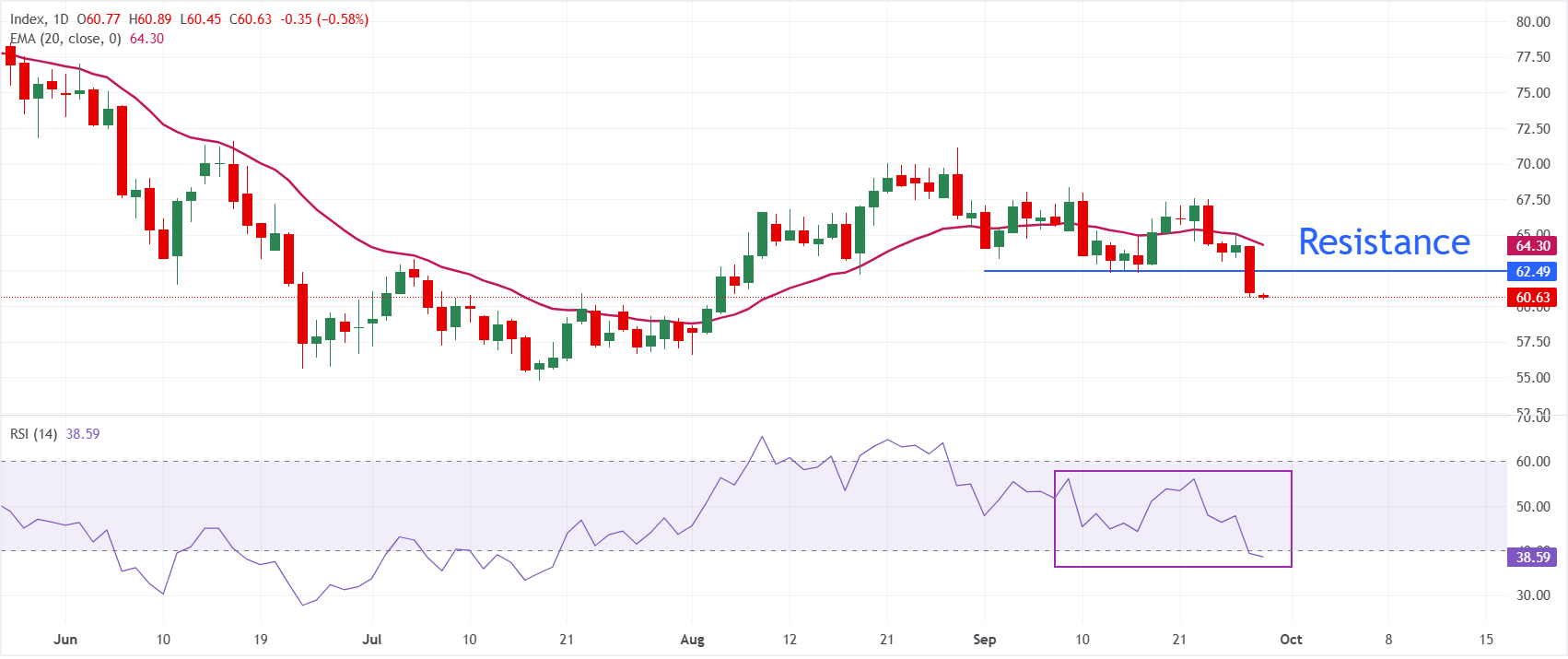
In the daily chart, XAG/USD trades at $60.63, keeping a bearish near-term tone as spot holds well below the 20-period Exponential Moving Average (EMA) at $64.30. The metal remains capped by this overhead dynamic barrier, suggesting that sellers retain control after the recent decline, while the Relative Strength Index (RSI) at 38.6 hovers just above oversold territory, hinting at persistent downside pressure rather than a decisive exhaustion of the move.
On the topside, initial resistance is located near $62.50, followed by the 20-day EMA at $64.30, and a sustained recovery above this level would be needed to ease the current bearish bias and open the way for a more constructive corrective phase. Looking down, the psychological level of $60 is the immediate cushion; below that, the asset could fall to near the August 3 low at $56.57.
(The technical analysis of this story was written with the help of an AI tool. Know more.)
Silver FAQs
Silver is a precious metal highly traded among investors. It has been historically used as a store of value and a medium of exchange. Although less popular than Gold, traders may turn to Silver to diversify their investment portfolio, for its intrinsic value or as a potential hedge during high-inflation periods. Investors can buy physical Silver, in coins or in bars, or trade it through vehicles such as Exchange Traded Funds, which track its price on international markets.
Silver prices can move due to a wide range of factors. Geopolitical instability or fears of a deep recession can make Silver price escalate due to its safe-haven status, although to a lesser extent than Gold's. As a yieldless asset, Silver tends to rise with lower interest rates. Its moves also depend on how the US Dollar (USD) behaves as the asset is priced in dollars (XAG/USD). A strong Dollar tends to keep the price of Silver at bay, whereas a weaker Dollar is likely to propel prices up. Other factors such as investment demand, mining supply – Silver is much more abundant than Gold – and recycling rates can also affect prices.
Silver is widely used in industry, particularly in sectors such as electronics or solar energy, as it has one of the highest electric conductivity of all metals – more than Copper and Gold. A surge in demand can increase prices, while a decline tends to lower them. Dynamics in the US, Chinese and Indian economies can also contribute to price swings: for the US and particularly China, their big industrial sectors use Silver in various processes; in India, consumers’ demand for the precious metal for jewellery also plays a key role in setting prices.
Silver prices tend to follow Gold's moves. When Gold prices rise, Silver typically follows suit, as their status as safe-haven assets is similar. The Gold/Silver ratio, which shows the number of ounces of Silver needed to equal the value of one ounce of Gold, may help to determine the relative valuation between both metals. Some investors may consider a high ratio as an indicator that Silver is undervalued, or Gold is overvalued. On the contrary, a low ratio might suggest that Gold is undervalued relative to Silver.
Author

Sagar Dua
FXStreet
Sagar Dua is associated with the financial markets from his college days. Along with pursuing post-graduation in Commerce in 2014, he started his markets training with chart analysis.















