Silver Price Forecast: XAG/USD holds ground amid setback in US bond yields
- Silver price rises to near $41.30 as US Treasury Yields fall further.
- Hawkish Fed expectations for the January meeting have slightly eased.
- The US core PCE inflation accelerated to 3.3% YoY in October.

Silver price (XAG/USD) trades 0.5% higher to near $41.30 during the European trading session on Thursday. The white metal recovered strongly the previous day after hitting a fresh almost 15-month low at $38.20.
Silver regains ground as yields on United States (US) Treasuries remain lower due to a slight deterioration in hawkish Federal Reserve (Fed) expectations for the January policy meeting.
During the day, 10-year US Treasury Yields hit a fresh over two-month low near 4.80%.
Theoretically, lower US bond yields result in an improvement in the appeal of non-yielding assets, such as Silver.
According to the CME FedWatch tool, traders are certain that the Fed will hike interest rates in the December policy meeting and see an almost 60% chance of delivering another in the January gathering. Hawkish Fed bets for the January meeting have eased from 70.4% seen a week ago.
Fed interest rate hike expectations for January also fail to capitalize on hot United States (US) Personal Consumption Expenditure (PCE) Price Index report for October released on Wednesday. The report showed that the core PCE inflation grew by 3.3% Year-on-Year (YoY), faster than 3.2% estimates and the previous reading of 3.1%.
Silver Technical Analysis
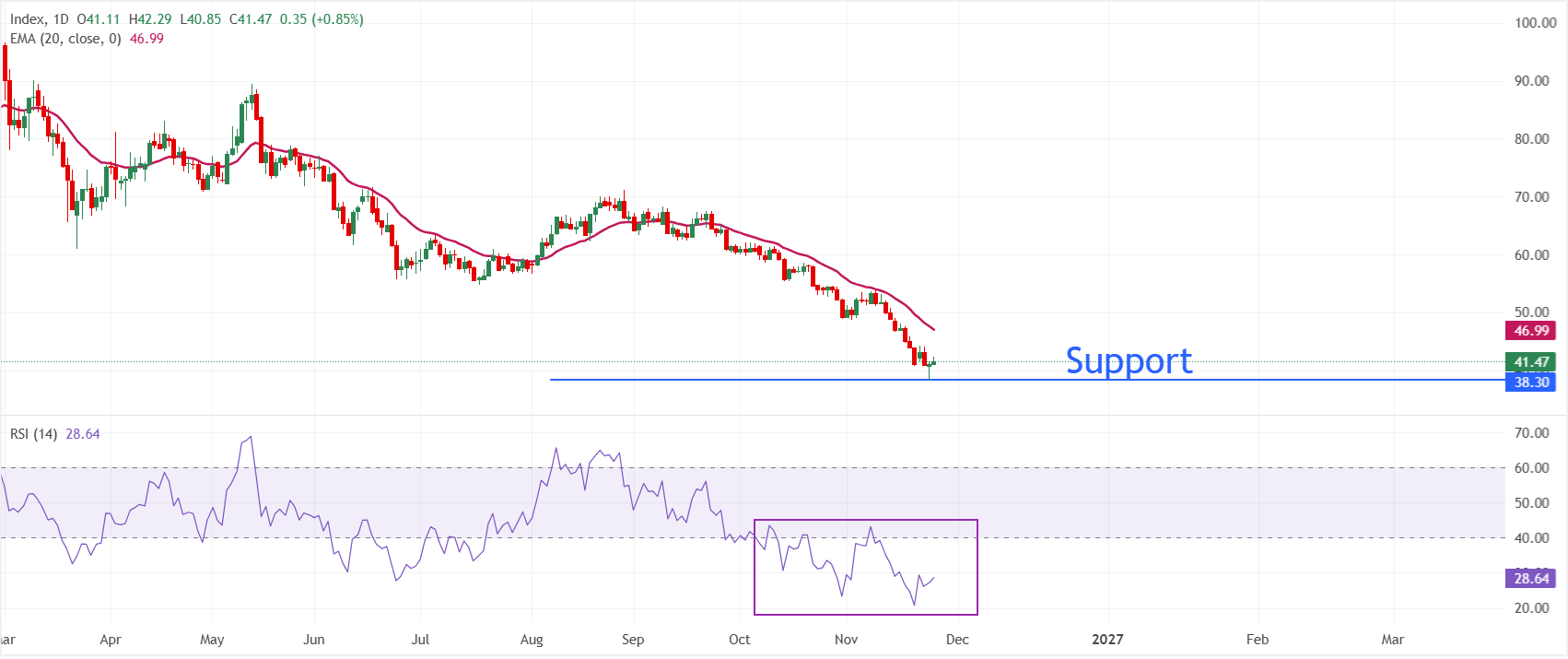
In the daily chart, XAG/USD trades at $41.47, maintaining a bearish near-term bias as it holds well below the 20-period exponential moving average (EMA) at $46.99. The position of price under this key dynamic barrier suggests that rallies remain vulnerable, while the Relative Strength Index (RSI) at 28.66 hovers in oversold territory, hinting that downside momentum could be stretched but not yet decisively reversing.
On the topside, the 20-day EMA at $46.99 is the immediate resistance level that bulls would need to reclaim to ease the current bearish pressure and open the door for a more sustained recovery. On the downside, the November 25 low at $38.20 is the immediate support level.
(The technical analysis of this story was written with the help of an AI tool. Know more.)
Silver FAQs
Silver is a precious metal highly traded among investors. It has been historically used as a store of value and a medium of exchange. Although less popular than Gold, traders may turn to Silver to diversify their investment portfolio, for its intrinsic value or as a potential hedge during high-inflation periods. Investors can buy physical Silver, in coins or in bars, or trade it through vehicles such as Exchange Traded Funds, which track its price on international markets.
Silver prices can move due to a wide range of factors. Geopolitical instability or fears of a deep recession can make Silver price escalate due to its safe-haven status, although to a lesser extent than Gold's. As a yieldless asset, Silver tends to rise with lower interest rates. Its moves also depend on how the US Dollar (USD) behaves as the asset is priced in dollars (XAG/USD). A strong Dollar tends to keep the price of Silver at bay, whereas a weaker Dollar is likely to propel prices up. Other factors such as investment demand, mining supply – Silver is much more abundant than Gold – and recycling rates can also affect prices.
Silver is widely used in industry, particularly in sectors such as electronics or solar energy, as it has one of the highest electric conductivity of all metals – more than Copper and Gold. A surge in demand can increase prices, while a decline tends to lower them. Dynamics in the US, Chinese and Indian economies can also contribute to price swings: for the US and particularly China, their big industrial sectors use Silver in various processes; in India, consumers’ demand for the precious metal for jewellery also plays a key role in setting prices.
Silver prices tend to follow Gold's moves. When Gold prices rise, Silver typically follows suit, as their status as safe-haven assets is similar. The Gold/Silver ratio, which shows the number of ounces of Silver needed to equal the value of one ounce of Gold, may help to determine the relative valuation between both metals. Some investors may consider a high ratio as an indicator that Silver is undervalued, or Gold is overvalued. On the contrary, a low ratio might suggest that Gold is undervalued relative to Silver.
Author
Sagar Dua
FXStreet
Sagar Dua is associated with the financial markets from his college days. Along with pursuing post-graduation in Commerce in 2014, he started his markets training with chart analysis.

















