Silver Price Forecast: Downtrend deepens as RSI enters oversold territory
- Silver tumbles to its lowest level since October 2025 as hawkish Fed expectations keep sellers in control.
- A stronger US Dollar adds to selling pressure, with the RSI slipping into oversold territory.
- Silver trades below its key moving averages, reinforcing the broader bearish outlook.

Silver (XAG/USD) falls more than 4% on Wednesday, slipping to levels last seen in October 2025. Expectations of further Federal Reserve (Fed) interest rate hikes and the resulting rise in the US Dollar (USD) continue to weigh on precious metals, with Gold (XAU/USD) also sliding below $3,800 to its lowest level since September 2025.
At the time of writing, XAG/USD trades around $45, more than 60% below its January record high near $121. The US Dollar Index (DXY), which tracks the Greenback's value against a basket of six major currencies, trades around 103.85, near a 19-month high.
A stronger US Dollar makes Silver more expensive for buyers using other currencies, while higher interest rates make the metal less attractive to hold because it pays no interest. Traders have fully priced in a December rate hike and see around a 70% chance of another increase in January, according to the CME FedWatch Tool. The size of the December move remains up for debate.
Fed Governor Christopher Waller had previously floated a 50-basis-point hike in December. Speaking to CNBC on Wednesday, Waller said the Fed should opt for a half-point move if it isn’t prepared to signal a faster pace of hikes in the coming months. Traders now look to the minutes of the Fed’s October meeting, due at 19:00 GMT.
Technical analysis
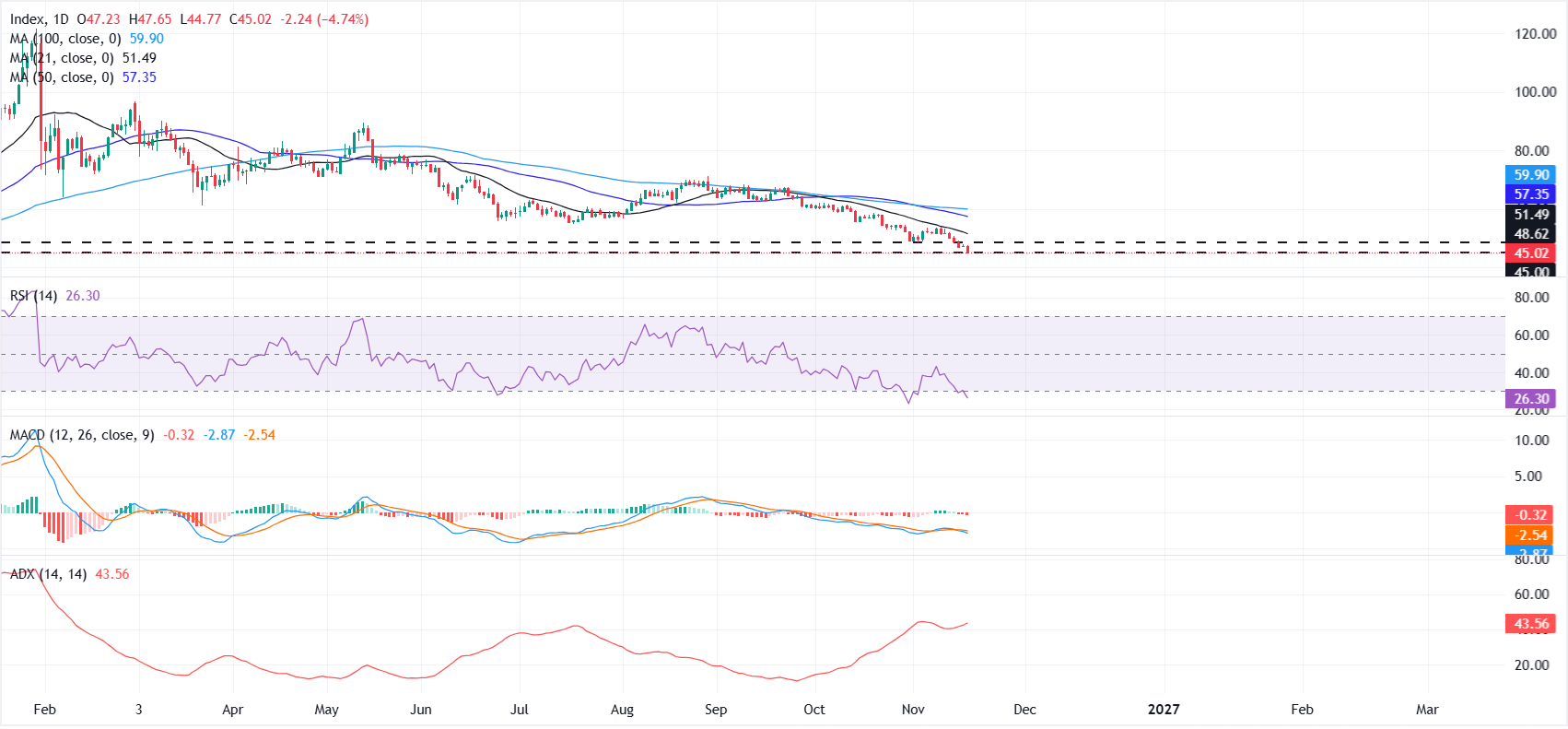
On the daily chart, XAG/USD remains in a downtrend, forming lower highs and lower lows while trading below its key moving averages. The latest leg lower pushes the Relative Strength Index (RSI) into oversold territory, while the Moving Average Convergence Divergence (MACD) remains negative, suggesting sellers hold the upper hand.
On the topside, initial resistance is at $48.62, the previous swing low, followed by the 21-day Simple Moving Average (SMA) at $51.49. The 50-day and 100-day SMAs at $57.35 and $59.90 mark the next resistance zone if the recovery picks up.
On the downside, the $45 psychological level offers immediate support. A sustained break below it could open the door to a deeper decline.
Silver FAQs
Silver is a precious metal highly traded among investors. It has been historically used as a store of value and a medium of exchange. Although less popular than Gold, traders may turn to Silver to diversify their investment portfolio, for its intrinsic value or as a potential hedge during high-inflation periods. Investors can buy physical Silver, in coins or in bars, or trade it through vehicles such as Exchange Traded Funds, which track its price on international markets.
Silver prices can move due to a wide range of factors. Geopolitical instability or fears of a deep recession can make Silver price escalate due to its safe-haven status, although to a lesser extent than Gold's. As a yieldless asset, Silver tends to rise with lower interest rates. Its moves also depend on how the US Dollar (USD) behaves as the asset is priced in dollars (XAG/USD). A strong Dollar tends to keep the price of Silver at bay, whereas a weaker Dollar is likely to propel prices up. Other factors such as investment demand, mining supply – Silver is much more abundant than Gold – and recycling rates can also affect prices.
Silver is widely used in industry, particularly in sectors such as electronics or solar energy, as it has one of the highest electric conductivity of all metals – more than Copper and Gold. A surge in demand can increase prices, while a decline tends to lower them. Dynamics in the US, Chinese and Indian economies can also contribute to price swings: for the US and particularly China, their big industrial sectors use Silver in various processes; in India, consumers’ demand for the precious metal for jewellery also plays a key role in setting prices.
Silver prices tend to follow Gold's moves. When Gold prices rise, Silver typically follows suit, as their status as safe-haven assets is similar. The Gold/Silver ratio, which shows the number of ounces of Silver needed to equal the value of one ounce of Gold, may help to determine the relative valuation between both metals. Some investors may consider a high ratio as an indicator that Silver is undervalued, or Gold is overvalued. On the contrary, a low ratio might suggest that Gold is undervalued relative to Silver.
Author
Vishal Chaturvedi
FXStreet
I am a macro-focused research analyst with over four years of experience covering forex and commodities market. I enjoy breaking down complex economic trends and turning them into clear, actionable insights that help traders stay ahead of the curve.