Record highs, tired legs: The S&P climbs into resistance just as the data avalanche begins

Wall Street has rolled into June the way it left May — at record highs and refusing to flinch. The S&P 500 trades around 7,580 this morning, the Nasdaq just notched its best month of the year (up more than 8% in May), and the mood is unmistakably risk-on. The 60-day US–Iran ceasefire memorandum took the geopolitical knife off the table, oil cratered nearly 17% on the month, and the path of least resistance has been straight up.
But the chart suggests there may still be road left before the index gets there.
What the chart is saying
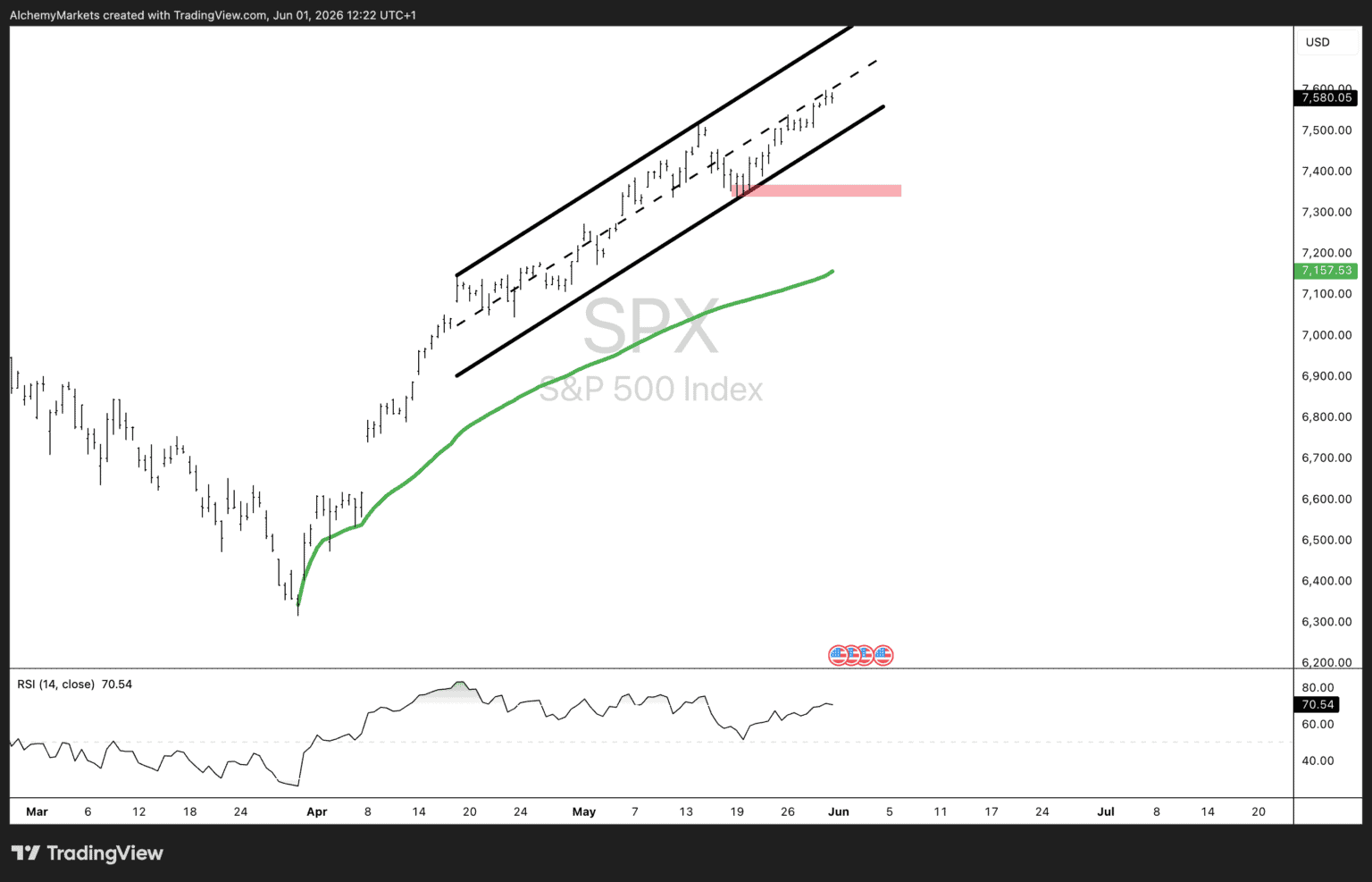
The S&P has spent the entire rally from the early-April lows climbing inside a clean ascending channel, and right now price is tracking the midline — sitting at 7,580, neither overextended at the top nor testing the floor. That’s a constructive spot: with price in the middle of the channel, there’s room to run toward the upper boundary (channel resistance) before the trend meets its natural ceiling. As long as the channel holds, the path of least resistance still points higher.
Underneath, though, momentum is starting to flag. RSI sits at 70.54 and is rolling over — flattening out after the strong May push rather than driving to fresh highs alongside price. It’s not a hard breakdown, but it’s a sign the move is running out of steam and may need a breather or fresh fuel to push that next leg.
On the downside, the structure offers two clear cushions. The rising anchored VWAP off the April low has tracked beneath price the entire advance and is the first dynamic support to watch. Below that, horizontal support around 7,350lines up as the next defensive level — a zone that capped and then supported price through mid-May. As long as those hold, dips look like pauses within an uptrend, not the start of something nastier.
So the picture is a market mid-channel with room above, momentum cooling, and well-defined support beneath — walking into the busiest data week of the month.
The macro backdrop
This is where it gets interesting. The week front-loads everything that matters: ADP private payrolls and ISM Services on Wednesday, jobless claims Thursday, and the headline act — US Nonfarm Payrolls on Friday. With the Fed still in a higher-for-longer crouch and the oil-driven inflation scare only just easing, Friday’s print is the swing factor. A hot number revives the dollar and guts any lingering rate-cut hope; a soft one feeds the goldilocks narrative that’s underwritten this entire grind higher.
There’s also a fresh equity story worth watching: Berkshire Hathaway’s surprise $6.8bn all-cash bid for homebuilder Taylor Morrison — Greg Abel’s first major swing as CEO — is a loud vote of confidence in the US housing cycle turning. It lit up homebuilders pre-market and adds a constructive, rate-sensitive thread beneath the index.
The takeaway
Trend intact, room to the upside, momentum cooling, catalysts incoming. This isn’t a setup to fight the tape — it’s one to respect it while watching the levels. With price mid-channel, there’s scope for a push toward channel resistance if the data cooperates and momentum re-engages. On the flip side, the rising anchored VWAP and horizontal support at 7,350 are the lines bulls want to defend on any pullback. Lose those and the constructive read gets a rethink. Either way, NFP will likely cast the deciding vote.
Author

Zorrays Junaid
Alchemy Markets
Zorrays Junaid has extensive combined experience in the financial markets as a portfolio manager and trading coach. More recently, he is an Analyst with Alchemy Markets, and has contributed to DailyFX and Elliott Wave Forecast in the past.

















