Pound Sterling Price News & Forecast: GBP/USD falls as the US Dollar rebounds after two consecutive sessions of losses

GBP/USD holds losses below 1.3500 due to BoE rate cut bets
GBP/USD edges lower after two days of gains, trading around 1.3480 during the Asian hours on Tuesday. The pair declines as the US Dollar (USD) rebounds from losses recorded over the previous two sessions. Traders will focus on the US ADP Employment Change four-week average later in the day, along with speeches from Federal Reserve officials.
However, the GBP/USD pair could recover if the US Dollar faces renewed pressure, as foreign investors shy away from US assets amid escalating trade uncertainty. According to The Wall Street Journal, US President Donald Trump’s administration is considering fresh national security tariffs on multiple industries after a Supreme Court ruling invalidated several of his second-term levies. The proposed measures would be implemented under Section 232 of the Trade Expansion Act of 1962 and remain separate from the 15% global tariff announced on Saturday. Read more...
GBP/USD treads water near 1.3500 as BoE-Fed divergence debate stalls
GBP/USD spent Monday spinning in place as market participants await a fresh catalyst to break the pair out of its recent range. The BoE's February hold came with a surprisingly dovish 5-4 split, and UK Consumer Price Index (CPI) data last week showed inflation easing to 3.0%, reinforcing the case for earlier rate cuts, with most economists now looking to April or March for the next move. On the US side, the Fed is holding rates at 3.50% to 3.75%, and the January CPI print at 2.4% supports a patient approach, though the Supreme Court's decision to strike down IEEPA tariffs last Friday and Trump's swift pivot to a 15% global tariff under Section 122 have injected fresh uncertainty into the inflation and growth outlook. The new tariff regime also clouds the status of the UK's existing trade deal with the US, adding a layer of political risk for the Pound Sterling. A heavy lineup of Fed speakers on Tuesday, including Governors Waller and Cook, will be closely watched for any shift in tone.
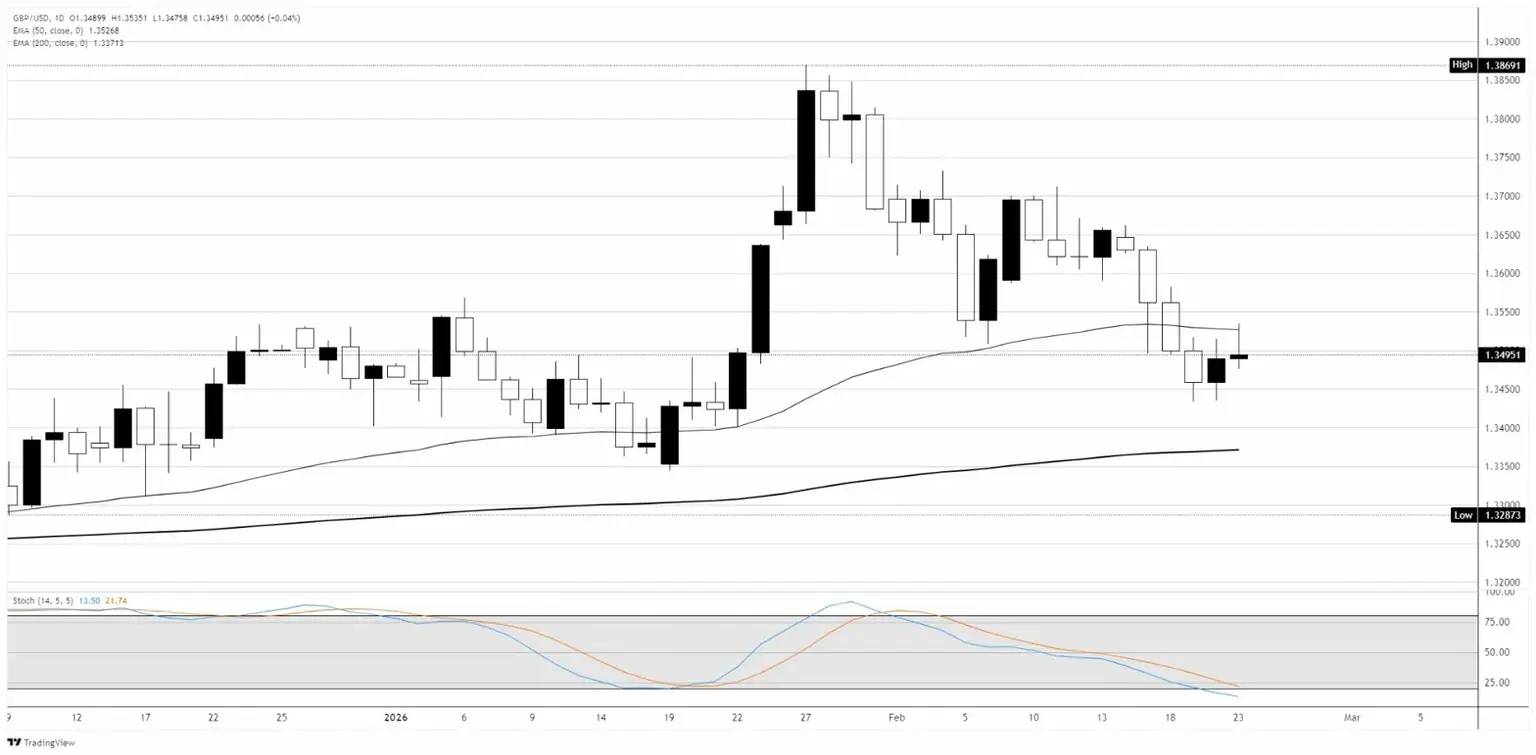
On the daily chart, GBP/USD closed broadly flat on Monday, edging up just 0.04% and settling near 1.3495 in a directionless session. The pair is trading just below the 50-day Exponential Moving Average (EMA) at 1.3523, having slipped beneath it during the pullback from the January high at 1.3869, while the 200-day EMA at 1.3371 remains below it. The broader structure shows a correction from the 1.3869 swing high, with the pair giving back roughly half of the rally from the December low near 1.3287. The Stochastic Oscillator has crossed bearish and is pressing into the oversold zone, suggesting the selling pressure from the February pullback may be nearing exhaustion. Recent candles show small bodies and overlapping ranges near 1.3500, consistent with a market searching for direction. Immediate support sits at the 1.3475 session low and then 1.3371 at the 200-day EMA, while resistance is at 1.3527 (50-day EMA) and then 1.3600; a reclaim of the 50-day EMA would be the first sign of stabilisation, while a break below 1.3371 would shift the structure bearish. Read more...
GBP/USD rises amid trade uncertainty as SCOTUS blocks Trump's tariffs
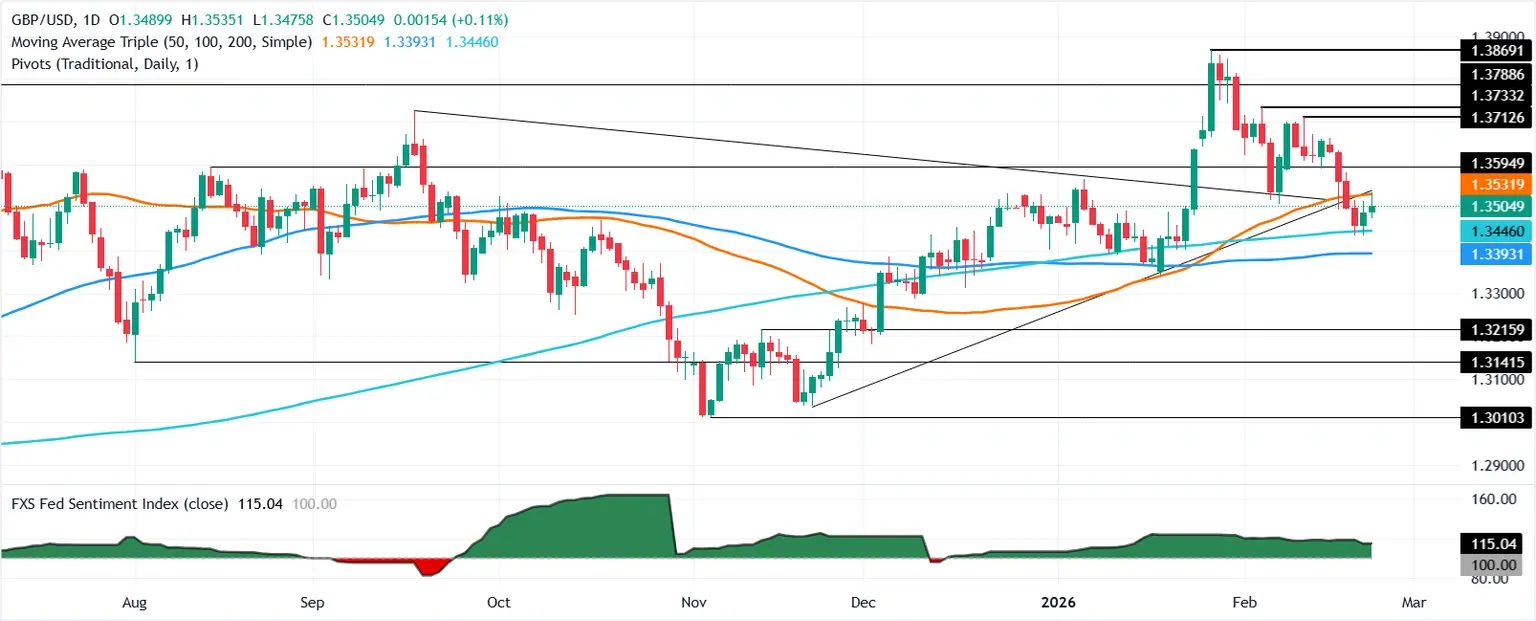
GBP/USD registers gains of 0.31% on Monday after the US Supreme Court rejected President Donald Trump’s tariffs invoked using the International Emergency Economic Powers Act (IEEPA) national emergency. In the meantime, uncertainty about trade policies keeps the US Dollar (USD) on the back foot. The pair trades at 1.3507 after bouncing off daily lows of 1.3475.
Last week, the Supreme Court revealed that duties imposed on national emergency are illegal and reiterated that the US Constitution grants Congress, not the president, the authority to impose taxes and tariffs. Read more...
Author

FXStreet Team
FXStreet
Composed of a group of economic journalists and FX experts, the FXStreet content team produces and oversees all content published on FXStreet. It provides a purely journalistic approach to the Forex market.