|

Pound Sterling Price News and Forecast: GBP/USD rebounds as US Dollar rally fades, UK politics stabilize

British Pound rebounds as US Dollar rally fades, UK politics stabilize

The Pound Sterling (GBP) gains 0.20% against the Greenback on Friday as the latter recoils after hitting year-to-date (YTD) highs, with money markets pricing in a less hawkish Federal Reserve (Fed), despite policymakers stating they will focus on inflation. The GBP/USD pair trades at 1.3217 after reaching a daily low of 1.3180. Read More...
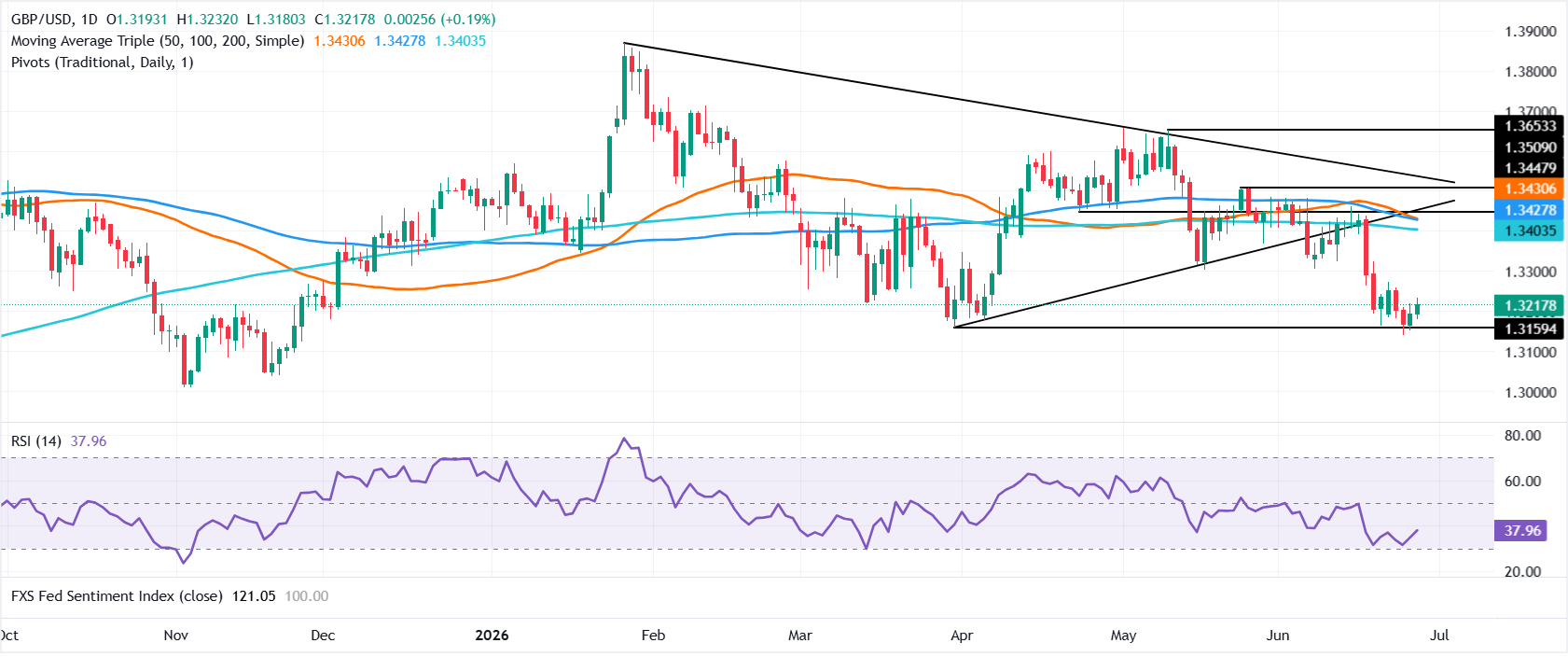
British Pound picks up above 1.3200 with the YTD lows of 1.3140 close by

The British Pound (GBP) is trading higher against the US Dollar (USD) for the second consecutive day on Friday, as the US Dollar’s rally faltered, with Oil prices returning to pre-war levels. The GBP/USD pair has returned to levels above 1.3200, turning positive in the weekly chart, but the broader bearish trend remains in play. Read More...

British Pound struggles to lure buyers amid UK politics as intervention fears support JPY

The GBP/JPY cross struggles to capitalize on the previous day's modest recovery gains and seesaws between tepid gains/minor losses through the early European session on Friday. Spot prices currently trade just below mid-213.00s, nearly unchanged for the day amid mixed fundamental cues. Read More...

Author

FXStreet Team

Composed of a group of economic journalists and FX experts, the FXStreet content team produces and oversees all content published on FXStreet. It provides a purely journalistic approach to the Forex market.


More from FXStreet Team
Share:

Editor's Picks

AUD/USD keeps the red near 0.6950 after weak Aussie jobs data

AUD/USD holds losses near 0.6950 on disappointing Australian jobs data, extending the previous day's retracement slide from the monthly high and hitting a fresh weekly low during Thursday’s Asian session. Meanwhile, declining US bond yields drag the US Dollar away from the April 2025 high, touched after Wednesday's hot US CPI, helping limit losses for the currency pair.

USD/JPY slides back below 158.00 as USD reverses post-CPI gains

USD/JPY extends the previous day's pullback from a three-week high, attracting follow-through selling and sliding below 158.00 during Thursday's Asian session. Traders remain on high alert amid speculation that authorities will step in to prop up the Japanese Yen. The US Dollar, meanwhile, reverses Wednesday's hot CPI-led gains to April 2025 highs as US bond yields retreat on China bond-buying talk, further pressuring the pair.

Gold sticks to gains below $4,150 on weak USD; bulls seem hesitant amid Fed hike bets

Gold clings to modest intraday gains through the early European session amid a broadly weaker US Dollar, snapping a three-day losing streak to a one-week low set on Wednesday. The initial aggressive market reaction to hot US consumer inflation figures faded quickly amid expectations that the Fed may not rush to raise interest rates immediately. This led to a further decline in US bond yields, prompting some follow-through USD profit-taking and supporting the non-yielding bullion.

Bitcoin, XRP analyst sentiment jumps as Solana bulls hit 91%: CryptoQuant

Analyst sentiment on Bitcoin, Ethereum, Solana, BNB and XRP has flipped bullish since July, as the top five cryptocurrencies recovered faster and more strongly than during the 2022-2023 market phase, according to CryptoQuant.

Budget preview: Is Healey impressing the bond market?

There is less than 2 weeks to go before the Chancellor delivers his first budget. Unusually for the UK, the economic and financial backdrop to this budget is upbeat. UK bonds have been rallying, the FTSE 100 is the top performing major stock index this week, and the Pound is also stabilising versus the Dollar.

Has Bitcoin really escaped the macro forces it was built to fight?
Over 17 years ago, Satoshi Nakamoto designed Bitcoin (BTC) on the back of a global financial crisis as an alternative to the global monetary system outside the control of central banks, governments and traditional intermediaries. This raises a key question: has Bitcoin really become independent of the macroeconomic forces it was built to challenge?















