NZD/USD sees minor losses post US CPI data ahead of China’s inflation
- NZD/USD's slight increase reflects mixed market response to higher US CPI and strong labor market data.
- Fed officials' comments on inflation failed to undermine the NZD/USD, which clung to minimal gains.
- Market anticipates potential impact of upcoming US producer prices data and China's economic figures on Kiwi's performance.

The New Zealand Dollar (NZD) registered minor gains of 0.10% on Thursday after seesawing in a volatile session following the release of US inflation data. In addition, unemployment claims rose less than expected, signaling the labor market remains hot. Although data was US Dollar (USD) supportive, the NZD/USD trades at around 0.6226, down 0.10% as the Asian session begins.
The Kiwi at the mercy of data from China
US headline inflation, as measured by the Consumer Price Index (CPI) in December, rose by 3.4% YoY and 0.3% MoM, with both figures exceeding estimates. Excluding food and energy, the so-called core CPI climbed 3.9% YoY or 0.3% MoM, both figures above projections, though the annual rate was below November’s 4%.
On the data, Federal Reserve (Fed) officials led by Cleveland’s Fed President Loretta Mester said that inflation in December signals the “job isn’t done yet,” foreseeing inflation would get to its 2% target next year. Richmond Fed President Thomas Barkin added that although inflation has progressed during last year, he needs more evidence that it would get toward the goal. Recently, Chicago Fed President Austan Goolsbee he is unsure about the Fed’s progress for the Fed to start cutting rates.
Given this fundamental backdrop, investors remain sure the Federal Reserve would cut rates by more than 150 basis points by December of 2024, with Chicago Board of Trade (CBOT) data showing traders expect interest rates in the US to dive toward 3.89%.
In the meantime, claims for unemployment depict the labor market is getting hotter once more, as Initial Jobless Claims for the week ending January 6 increased by 202K, less than 210K projected, and below the prior reading of 203K.
US Treasury yields closed the session with decent losses. The US 10-year note dropped six basis points, pulling the Greenback to red territory as shown by a basket of six currencies, the US Dollar Index (DXY). The DXY is dropping 0.04%, down to 102.31.
On the Kiwi front, the economic agenda is empty, though China’s inflation and trade data could sponsor some volatility in the NZD/USD pair. On the US front, prices paid by producers will be released on Friday, ahead of next week’s further economic data.
NZD/USD Price Analysis: Technical outlook
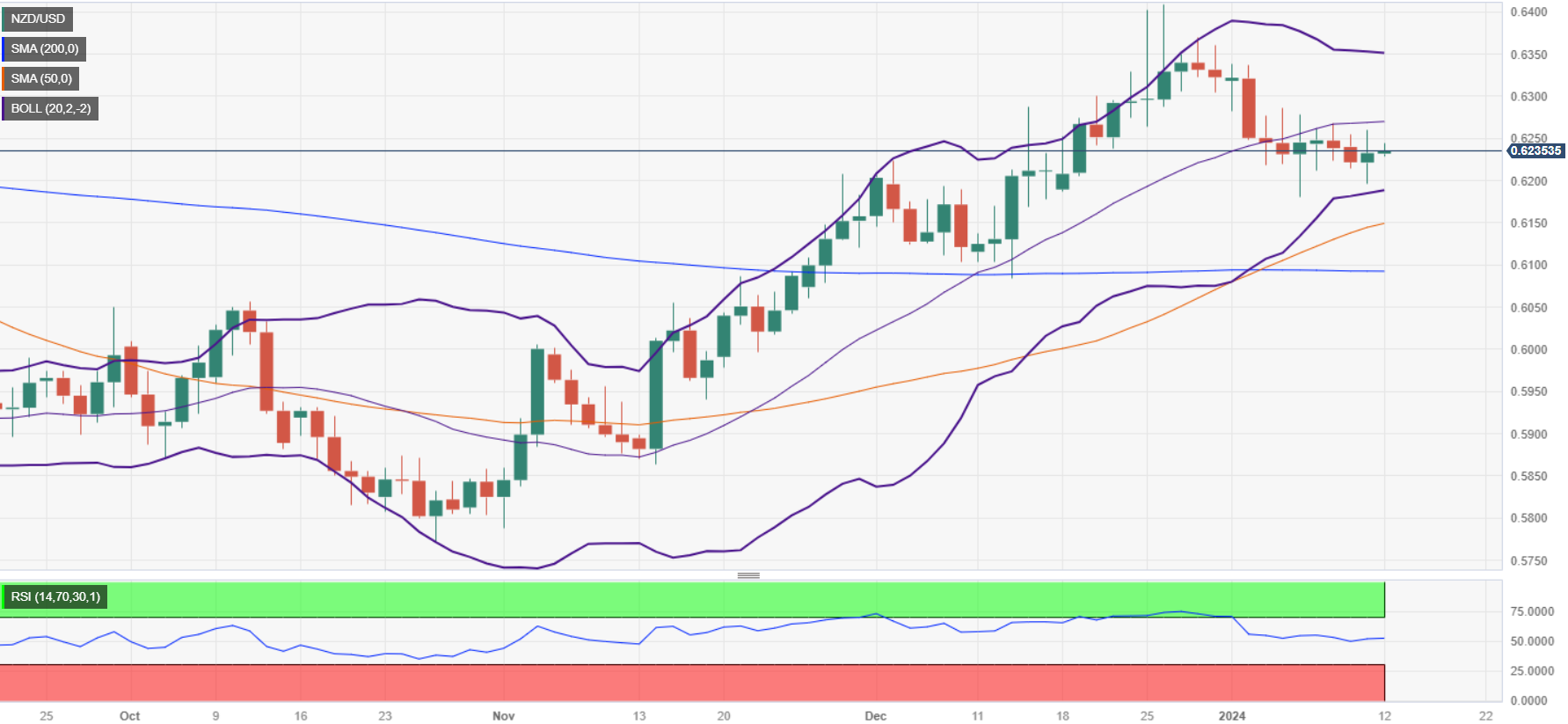
The NZD/USD hovers around 0.6220, remaining glued to that level, unable to crack the 0.6250 or 0.6200 thresholds decisively. Even though the pair could go either way, a ‘golden-cross’ formation favors buyers, which need to reclaim 0.6250 if they are to reclaim the 0.6300 figure. A breach of the latter would expose the December 28 high at 0.6369. On the other hand, if sellers push prices below 0.6200, that would exacerbate further losses. Key support levels lie at 0.6150, followed by the 50-day moving average (DMA) at 0.6133.
Author

Christian Borjon Valencia
FXStreet
Markets analyst, news editor, and trading instructor with over 14 years of experience across FX, commodities, US equity indices, and global macro markets.














