NZD/USD retreats amid high US Treasury yields, despite weakening US Dollar
- NZD/USD's decline influenced by rising US Treasury yields, overshadowing DXY's 0.12% drop in the face of robust US job data.
- US labor market strength impacts currency pair, with swaps market revising Fed rate cut forecasts to 140 basis points by end-2024.
- Focus shifts to upcoming US Nonfarm Payrolls and Unemployment Rate, as the New Zealand economic calendar remains quiet.

The New Zealand Dollar (NZD) is on the defensive against the US Dollar (USD) in the mid-North American session on Thursday, even though the Greenback is under downward pressure following the release of upbeat economic data from the United States. Therefore, the NZD/USD exchanges hands at 0.6225, down by 0.29% after hitting a daily high of 0.6285.
NZD/USD remains pressured as a reaction to US economic data and traders trimming Fed rate cut expectations
The advance in US Treasury bond yields is the main reason for the NZD/USD’s drop for the fifth consecutive day. Nevertheless, it failed to underpin the buck, which, according to the US Dollar Index (DXY), weakens by 0.12% and sits at 102.33 against a basket of six currencies.
In the meantime, data revealed earlier today showed the US jobs market remains robust, even though the JOLTs report suggested vacancies are dropping. Unemployment claims announced by the US Bureau of Labor Statistics (BLS) rose by 202K, less than estimates of 216K and the prior’s number of 220K. Earlier, the ADP Employment Change for December announced that private companies hired more people than expected, with figures climbing 164K vs. 115K foreseen.
Following the release of the data, the swaps market adjusted its expectations to a less accommodative Federal Reserve stance. Traders are forecasting 140 basis points in rate reductions by the end of 2024. This is a decrease of 30 basis points from the 170 basis points in cuts that investors had projected on December 27, as per data from the Chicago Board of Trade (CBOT).
The recent data released today, along with yesterday's publication of the latest Federal Reserve meeting minutes, has influenced traders to think that the US central bank may start to relax its policies sooner rather than later. The minutes revealed a sense of uncertainty among policymakers about the future direction of interest rates, primarily due to the continued risk of higher inflation.
An absent economic docket in New Zealand (NZ) would leave traders adrift to Friday's US economic data, with the announcement of December’s Nonfarm Payrolls, which are expected to dip to 170K, below November’s 199K, and the Unemployment Rate Is estimated to uptick to 3.8% from 3.7%.
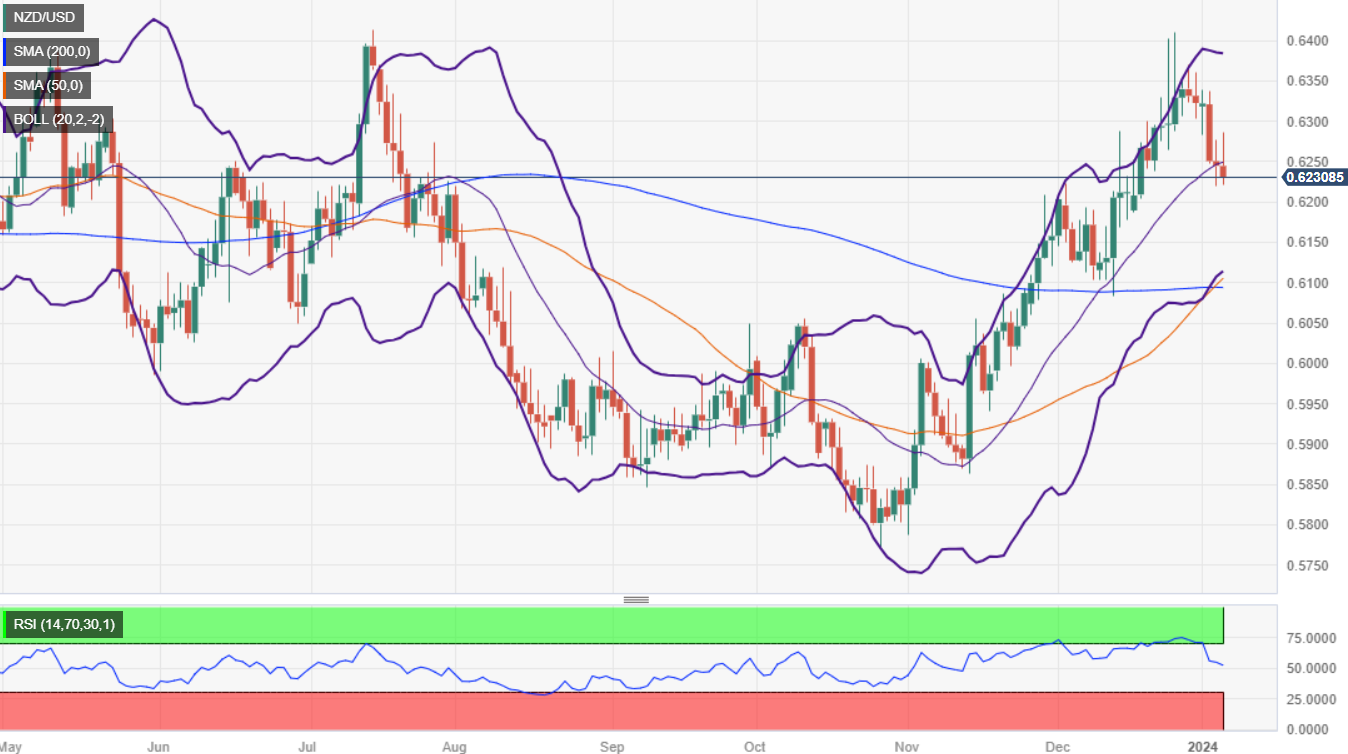
NZD/USD Price Analysis: Technical outlook
The NZD/USD remains neutral to upward bias, and if it remains above the current week’s low of 0.6218, that could pave the way for testing the 0.6300 mark. Once that level is cleared, the next resistance would be December’s 28 high of 0.6369 before challenging the psychological 0.6400 figure. On the flip side, if the pair slides below 0.6200, that could drag prices toward the 200-day moving average (DMA) at 0.6097.
Author

Christian Borjon Valencia
FXStreet
Markets analyst, news editor, and trading instructor with over 14 years of experience across FX, commodities, US equity indices, and global macro markets.