NZD/USD Price Forecast: Recovery hits pause around 0.5870 ahead of US-Iran talks
- NZD/USD retraces to near 0.5845 as antipodeans face pressure ahead of US-Iran negotiations.
- Military attacks in Lebanon have raised concerns over the hopes of a US-Iran permanent ceasefire.
- This week, the RBNZ left its OCR unchanged at 2.25%.
The NZD/USD pair corrects after a four-day winning streak, trading 0.25% lower to near 0.5845 during the early European trading session on Friday. The Kiwi pair faces slight selling pressure as investors turn cautious ahead of negotiations between the United States (US) and Iran regarding the 10-point peace proposal, proposed by Tehran in consideration of a permanent ceasefire.
New Zealand Dollar Price Today
The table below shows the percentage change of New Zealand Dollar (NZD) against listed major currencies today. New Zealand Dollar was the weakest against the Swiss Franc.
| USD | EUR | GBP | JPY | CAD | AUD | NZD | CHF | |
|---|---|---|---|---|---|---|---|---|
| USD | 0.12% | 0.15% | 0.21% | 0.10% | 0.27% | 0.26% | 0.00% | |
| EUR | -0.12% | 0.03% | 0.09% | -0.04% | 0.14% | 0.14% | -0.12% | |
| GBP | -0.15% | -0.03% | 0.09% | -0.05% | 0.12% | 0.11% | -0.16% | |
| JPY | -0.21% | -0.09% | -0.09% | -0.13% | 0.06% | 0.00% | -0.25% | |
| CAD | -0.10% | 0.04% | 0.05% | 0.13% | 0.16% | 0.16% | -0.11% | |
| AUD | -0.27% | -0.14% | -0.12% | -0.06% | -0.16% | -0.01% | -0.28% | |
| NZD | -0.26% | -0.14% | -0.11% | -0.00% | -0.16% | 0.01% | -0.27% | |
| CHF | -0.01% | 0.12% | 0.16% | 0.25% | 0.11% | 0.28% | 0.27% |
The heat map shows percentage changes of major currencies against each other. The base currency is picked from the left column, while the quote currency is picked from the top row. For example, if you pick the New Zealand Dollar from the left column and move along the horizontal line to the US Dollar, the percentage change displayed in the box will represent NZD (base)/USD (quote).
As of writing, S&P 500 futures trade subduedly around 6,825, after a two-day rally, reflecting a calm market mood. The US Dollar Index (DXY), which tracks the Greenback’s value against six major currencies, trades 0.1% higher to near 98.90.
Meanwhile, continued military attacks between Israel and Iran-backed Houthis in Lebanon have raised concerns over hopes of a positive outcome from US-Iran talks in Pakistan over the weekend.
On the domestic front, the Reserve Bank of New Zealand (RBNZ) held its Official Cash Rate (OCR) steady at 2.25% on Wednesday, as expected, and guided that the monetary policy path would remain on the upside. RBNZ Governor Anna Breman said, “Tightening could be at every meeting or every other meeting, it depends,” and added, “Neutral rate is a range with a midpoint at 3.0%.”
In the US, investors await the US Consumer Price Index (CPI) data for March, which will be published at 12:30 GMT.
NZD/USD technical analysis
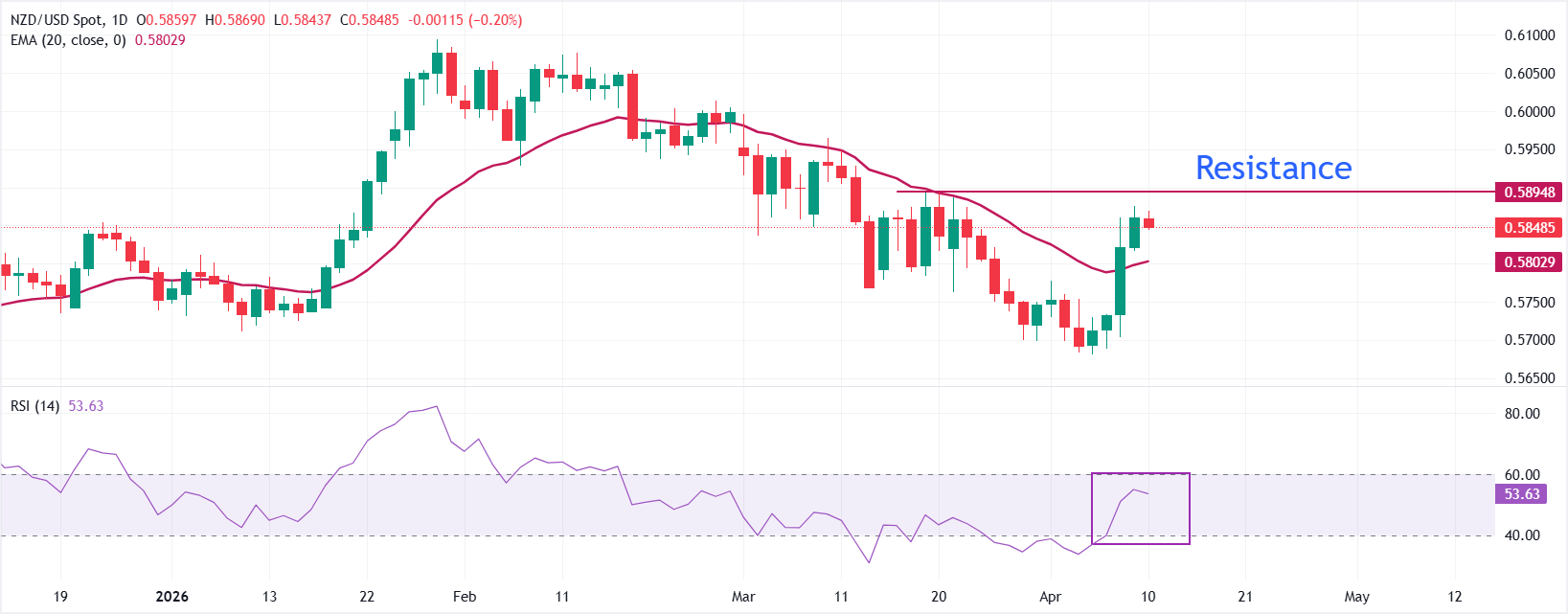
At press time, NZD/USD trades lower at around 0.5845. The daily chart shows a mildly bullish near-term bias, as spot trades above the 20-day Exponential Moving Average (EMA) at 0.5803, suggesting that recent dips would be supported rather than extended.
A quick shift by the 14-day Relative Strength Index (RSI) into the 40.00-60.00 zone from the area below 40.00, indicates the onset of a bullish reversal rather than just a pullback move.
On the downside, initial support is aligned with the 20-day EMA at 0.5803, where a daily close below would weaken the constructive tone and open the door to a deeper retracement toward the April 3 high of 0.5754. As long as buyers defend this moving average on pullbacks, the path of least resistance favors further recovery attempts toward the March 19 high at 0.5893. A decisive break above 0.5893 would open the door for further advancement towards the March 10 high of 0.5965.
(The technical analysis of this story was written with the help of an AI tool.)
Economic Indicator
RBNZ Interest Rate Decision
The Reserve Bank of New Zealand (RBNZ) announces its interest rate decision after each of its seven scheduled annual policy meetings. If the RBNZ is hawkish and sees inflationary pressures rising, it raises the Official Cash Rate (OCR) to bring inflation down. This is positive for the New Zealand Dollar (NZD) since higher interest rates attract more capital inflows. Likewise, if it reaches the view that inflation is too low it lowers the OCR, which tends to weaken NZD.
Read more.Last release: Wed Apr 08, 2026 02:00
Frequency: Irregular
Actual: 2.25%
Consensus: 2.25%
Previous: 2.25%
Source: Reserve Bank of New Zealand
The Reserve Bank of New Zealand (RBNZ) holds monetary policy meetings seven times a year, announcing their decision on interest rates and the economic assessments that influenced their decision. The central bank offers clues on the economic outlook and future policy path, which are of high relevance for the NZD valuation. Positive economic developments and upbeat outlook could lead the RBNZ to tighten the policy by hiking interest rates, which tends to be NZD bullish. The policy announcements are usually followed by interim Governor Christian Hawkesby's press conference.
Author

Sagar Dua
FXStreet
Sagar Dua is associated with the financial markets from his college days. Along with pursuing post-graduation in Commerce in 2014, he started his markets training with chart analysis.