NZD/USD holds firm as softer USD and easing yields support the Kiwi
- The NZD/USD rebounds as the US Dollar weakens on lower Treasury yields and fading safe-haven demand.
- Geopolitical headlines remain mixed, with Middle East tensions still underpinning uncertainty, but no fresh escalation boosting risk sentiment.
- Markets reassess Fed outlook amid political pressure and shifting rate expectations, weighing on the Greenback and supporting higher-beta currencies.

The NZD/USD pair is trading with a firmer tone on Tuesday, hovering near the 0.5910 region as the US Dollar (USD) struggles to extend its recent strength. A modest pullback in United States (US) Treasury yields is undermining the Greenback, allowing the Kiwi to recover despite lingering geopolitical risks.
Market sentiment remains fragile but has shown slight improvement as investors process recent developments in the Middle East. Headlines indicating that Iran's Foreign Minister, Abbas Araqchi, has stated that the United States has requested negotiations, while Iran assesses the proposal, have alleviated immediate concerns about escalation. This has reduced safe-haven demand for the US Dollar (USD), providing support for risk-sensitive currencies.
At the same time, expectations surrounding US monetary policy are evolving. Ongoing political pressure on the Federal Reserve to lower interest rates, coupled with a more hawkish approach in forward guidance, has led markets to reevaluate the future path of interest rates. This shift is contributing to a softer tone for the USD, even as US economic data remains relatively resilient.
NZD/USD Technical outlook
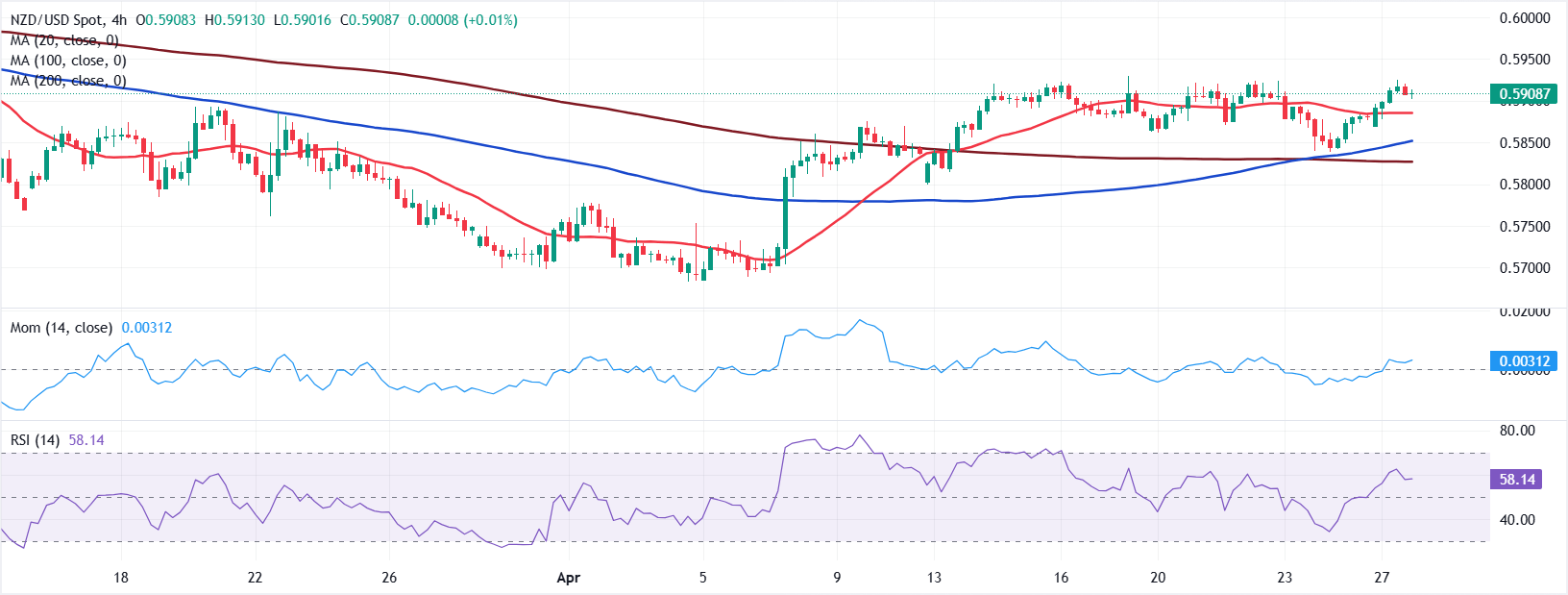
The 4-hour chart shows NZD/USD is neutral-to-bullish, as the pair holds above all its moving averages, with a flat 20-period Simple Moving Average (SMA) providing support at around 0.5890. The 100 SMA crossed above the 200 SMA, both below the shorter one, providing additional support in case of further retracements. Technical indicators, in the meantime, remain within positive levels, but lack directional momentum. Still, indicators suggest that sellers remain out of the picture. Additional gains could be expected on a run beyond 0.5930, the April monthly high.
Author

Agustin Wazne
FXStreet
Agustin Wazne joined FXStreet as a Junior News Editor, focusing on Commodities and covering Majors.














