Nobody was ever paying the British Pound for its hawks
- GBP/USD holds near 1.3550, more than a cent beneath the August high.
- BoE Bank Rate at 3.75%, with three of nine members voting to hike.
- September Fed hike pricing near 65%, up from roughly 35% on Thursday.

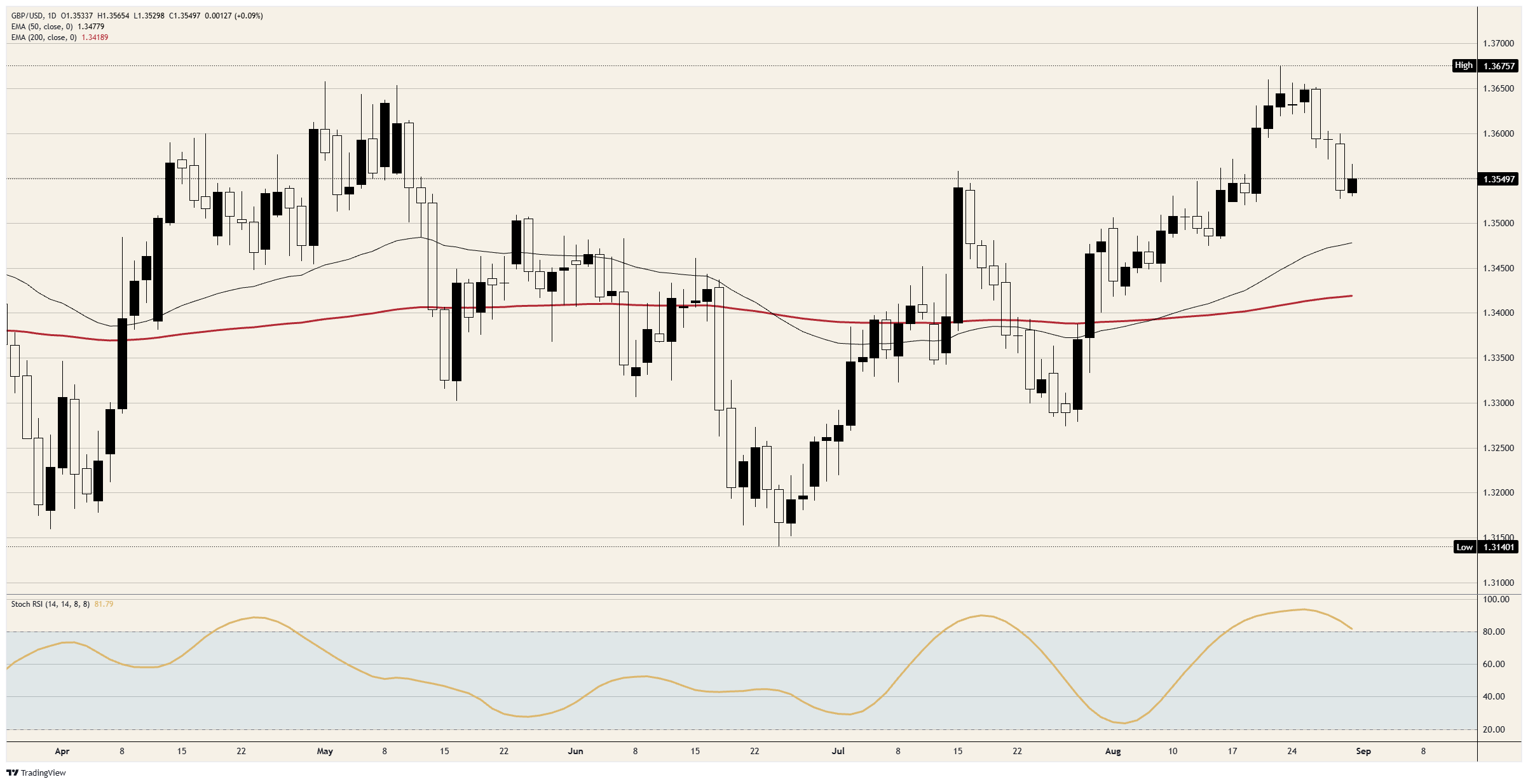
GBP/USD trades near 1.3550 on Monday, a fraction higher on the session after three consecutive declines took the pair more than a cent off the six-month high just short of 1.3700. Price still sits well clear of a 50-day Exponential Moving Average (EMA) a shade beneath 1.3500 and a 200-day near 1.3400. The daily Stochastic Relative Strength Index (Stoch RSI) has rolled over from above 90 and reads near 82.
The slide halted on an empty calendar, not on a bid
Monday delivered nothing from the United Kingdom and nothing scheduled from the United States, and the pair duly did nothing, ranging inside thirty-five pips and finding buyers only where sellers had run out. That is worth separating from a genuine reversal. A currency that stops going down on a day with no catalyst has not found support so much as found a gap in the fixture list.
What did happen on Monday was fought in the Gulf. American forces struck Iranian rocket launchers on Larak Island on Sunday, Tehran answered against US bases in Jordan, and Crude Oil rose more than 2% with longer-dated Treasury yields following. For Sterling that is a second-order input, though it is an unhelpful one for a country whose July Consumer Price Index (CPI) inflation is already running at 2.9%.
Three dissenters and nothing to show for them
The Bank of England (BoE) held Bank Rate at 3.75% on July 30 by a vote of six to three, with the three preferring 4.00% and the hawkish bloc growing by one. The accompanying central projection has inflation peaking around 3.2% in the fourth quarter. On paper that is a hawkish setup with a live minority attached to it. It also came with the last full forecast round before November, so the September meeting arrives with no new projections for that minority to lean on.
It has been in place for a month and the September 17 meeting is still priced for a hold. Sterling's August advance was not built on any of it. The rally ran while the Dollar had no story of its own, and the moment the Dollar acquired one it turned around, which tells you which side of the pair was doing the work.
Sterling has spent most of the summer as a passenger dressed up as a hawk, and the costume comes off whenever the Dollar has something of its own to say. The three dissents are real and the inflation problem behind them is real, but neither has been the marginal price-setter in this pair since the spring.
The Dollar's leg moved in a single afternoon
Friday's Jackson Hole keynote from the Federal Reserve chair reset September without a data point behind it. Aggregated futures probabilities now put an increase at the September 16 decision near 65%, October at 92%, and December close to evenly split between one increase and two. The July 29 vote had already gone nine to three with three dissenters wanting a hike, so the committee had the votes and was short only the framing.
Both currencies now carry a three-vote hawkish minority. Only one of them is attached to a meeting the market expects to deliver. The Pound's dissenters have had a month to be priced and have not shifted the September expectation an inch, while the Dollar's moved roughly thirty points of probability in an afternoon once the chair endorsed them. That asymmetry, not the fiscal picture and not the inflation gap, is what is pulling this pair lower.
Tuesday belongs entirely to the other currency
Nothing lands from the United Kingdom until the Monetary Policy Report hearings on Thursday, where the committee answers questions rather than reads a statement, and the Governor's speech at 08:50 GMT on Friday, less than four hours before August payrolls. Sterling gets one day to author a move and then hands itself straight back.
The American docket restarts on Tuesday at 14:00 GMT with the Institute for Supply Management (ISM) Manufacturing Purchasing Managers Index (PMI) against a 55.2 consensus and 55.6 prior, prices paid at 72 against 71.1, and Job Openings and Labor Turnover Survey (JOLTS) openings at 7.3 million. Private payrolls follow on Wednesday at 47K, jobless claims and ISM Services on Thursday, and Friday brings Nonfarm Payrolls at a 58K consensus against a 23K contraction, with unemployment at 4.1% and average hourly earnings at 0.3% MoM.
Levels
Resistance: 1.3600 is the level the pair lost and the first line back, with the August high just short of 1.3700 above it and 1.3750 beyond that on a break.
Support: 1.3500 is the shelf that matters and has the 50-day EMA sitting immediately beneath it, which makes a clean break through the round number expensive to reverse. Below that cluster, 1.3450 and the 200-day near 1.3400 are the next marks.
Bias: Bearish. A lower high, an oscillator unwinding from above 90, and a week where every scheduled catalyst before Thursday belongs to the Dollar all point the same way, and 1.3500 is the obvious destination. Invalidation on a daily close above 1.3600.
GBP/USD daily chart
Pound Sterling FAQs
The Pound Sterling (GBP) is the oldest currency in the world (886 AD) and the official currency of the United Kingdom. It is the fourth most traded unit for foreign exchange (FX) in the world, accounting for 12% of all transactions, averaging $630 billion a day, according to 2022 data. Its key trading pairs are GBP/USD, also known as ‘Cable’, which accounts for 11% of FX, GBP/JPY, or the ‘Dragon’ as it is known by traders (3%), and EUR/GBP (2%). The Pound Sterling is issued by the Bank of England (BoE).
The single most important factor influencing the value of the Pound Sterling is monetary policy decided by the Bank of England. The BoE bases its decisions on whether it has achieved its primary goal of “price stability” – a steady inflation rate of around 2%. Its primary tool for achieving this is the adjustment of interest rates. When inflation is too high, the BoE will try to rein it in by raising interest rates, making it more expensive for people and businesses to access credit. This is generally positive for GBP, as higher interest rates make the UK a more attractive place for global investors to park their money. When inflation falls too low it is a sign economic growth is slowing. In this scenario, the BoE will consider lowering interest rates to cheapen credit so businesses will borrow more to invest in growth-generating projects.
Data releases gauge the health of the economy and can impact the value of the Pound Sterling. Indicators such as GDP, Manufacturing and Services PMIs, and employment can all influence the direction of the GBP. A strong economy is good for Sterling. Not only does it attract more foreign investment but it may encourage the BoE to put up interest rates, which will directly strengthen GBP. Otherwise, if economic data is weak, the Pound Sterling is likely to fall.
Another significant data release for the Pound Sterling is the Trade Balance. This indicator measures the difference between what a country earns from its exports and what it spends on imports over a given period. If a country produces highly sought-after exports, its currency will benefit purely from the extra demand created from foreign buyers seeking to purchase these goods. Therefore, a positive net Trade Balance strengthens a currency and vice versa for a negative balance.
Author

Joshua Gibson
FXStreet
Joshua joins the FXStreet team as an Economics and Finance double major from Vancouver Island University with twelve years' experience as an independent trader focusing on technical analysis.