Mexican Peso rises on soft US jobs data, intervention speculation
- Weak NFP and revisions drag Dollar lower across FX.
- USMCA uncertainty keeps trade-risk premium alive for Peso.
- Fed officials keep inflation focus despite softer labor data.

The Mexican Peso advanced, boosted by a weaker-than-expected US jobs report that weighed on the US Dollar, which was also undermined by a rumored intervention in FX markets by Japanese authorities. At the time of writing, the USD/MXN trades at 17.48, down 0.43%.
USD/MXN drops gains as soft US jobs data pressures Greenback
Early in the North American session on Thursday, the US Bureau of Labour Statistics (BLS) revealed employment figures. June Nonfarm Payrolls were weaker than expected, dipping from 129K to 57K, beneath forecasts. Worth noting that May and April figures were downward revised, trimming the number of jobs created in both months by -74K.
At the same time, the Unemployment Rate edged lower from 4.3$% to 4.22%, attributed to a slide in labour force participation.
Consequently, the Greenback extended its losses. The US Dollar Index (DXY), which tracks the performance of the American currency against six other currencies, is down 0.55% at 100.85.
In Mexico, news that US President Donald Trump doesn’t want to extend the USMCA free trade agreement prompted a reaction from Economy Minister Marcelo Ebrard. He said that the US opted not to extend the deal and that the agreement will undergo non-stop annual reviews for 10 years.
A Bloomberg article read, “The potential disruptions and the broad economic impact are stark. USMCA boosted economic activity among the three countries, which combined represent nearly a third of the world’s gross domestic product. Intraregional trade surpassed $1.6 trillion in 2024, up from $1 trillion when the agreement went into place in 2020.”
On Wednesday, the three countries could’ve signed a 16-year extension, but Washington wants changes to a deal they negotiated 6 years ago.
On Wednesday, auto industry officials in the US called for a swift resolution to restore duty-free trade with Canada and Mexico, arguing that tariffs disadvantage them relative to Japanese and South Korean car makers.
Aside from this, Federal Reserve officials made public comments. Mary Daly from the San Francisco Fed observed signs of strength in the US economy and mentioned that increased prices are driven by tariffs and oil shocks. She described current policy as “slightly restrictive" but noted that the Fed must sometimes combat inflation.
On Wednesday, Fed Chair Kevin Warsh stated that inflation expectations had decreased slightly over the past four weeks but reaffirmed that the central bank’s main focus remains on “price stability.”
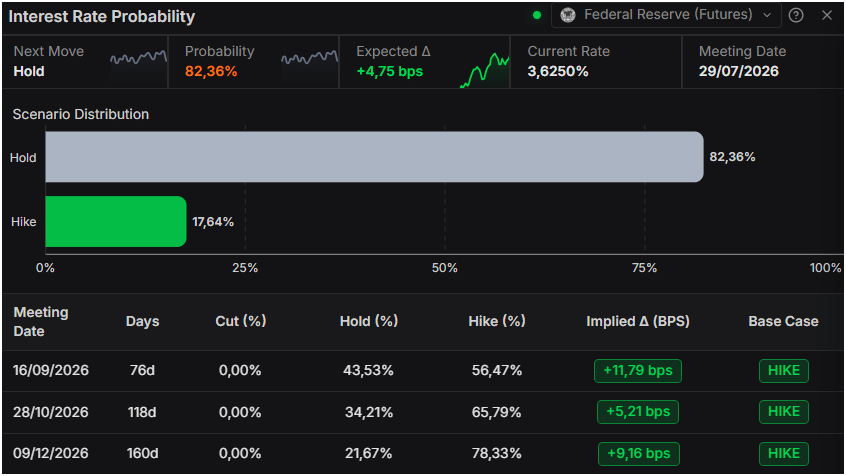
Money markets are still pricing in a 66% chance of a rate hike at the September 16 meeting, with investors expecting nearly 17 basis points of tightening, according to Prime Terminal data
USD/MXN Price Forecast: Technical outlook
In the daily chart, USD/MXN trades around 17.4818, retaining a mildly bullish near-term tone as spot holds above the cluster of simple moving averages (SMA) from the triple set, with the latest reading near 17.3656 acting as underlying demand. The pair is pressing into a zone defined by two descending resistance trend lines drawn from 18.1651 and the longer-term 21.0808 peak, while the Relative Strength Index (14) at 53.6 stays just above neutral, hinting at steady but not overstretched upside momentum.
On the topside, immediate resistance is located along the nearer downward trend line off 18.1651, with a secondary cap coming from the longer-term descending line originating at 21.0808, both reinforcing the idea of a gradually falling supply barrier above current price. On the downside, initial support sits at the triple simple moving average area around 17.3656, and as long as USD/MXN holds above this base, dips would likely be seen as corrective within the current constructive bias.
(The technical analysis of this story was written with the help of an AI tool.)
Mexican Peso FAQs
The Mexican Peso (MXN) is the most traded currency among its Latin American peers. Its value is broadly determined by the performance of the Mexican economy, the country’s central bank’s policy, the amount of foreign investment in the country and even the levels of remittances sent by Mexicans who live abroad, particularly in the United States. Geopolitical trends can also move MXN: for example, the process of nearshoring – or the decision by some firms to relocate manufacturing capacity and supply chains closer to their home countries – is also seen as a catalyst for the Mexican currency as the country is considered a key manufacturing hub in the American continent. Another catalyst for MXN is Oil prices as Mexico is a key exporter of the commodity.
The main objective of Mexico’s central bank, also known as Banxico, is to maintain inflation at low and stable levels (at or close to its target of 3%, the midpoint in a tolerance band of between 2% and 4%). To this end, the bank sets an appropriate level of interest rates. When inflation is too high, Banxico will attempt to tame it by raising interest rates, making it more expensive for households and businesses to borrow money, thus cooling demand and the overall economy. Higher interest rates are generally positive for the Mexican Peso (MXN) as they lead to higher yields, making the country a more attractive place for investors. On the contrary, lower interest rates tend to weaken MXN.
Macroeconomic data releases are key to assess the state of the economy and can have an impact on the Mexican Peso (MXN) valuation. A strong Mexican economy, based on high economic growth, low unemployment and high confidence is good for MXN. Not only does it attract more foreign investment but it may encourage the Bank of Mexico (Banxico) to increase interest rates, particularly if this strength comes together with elevated inflation. However, if economic data is weak, MXN is likely to depreciate.
As an emerging-market currency, the Mexican Peso (MXN) tends to strive during risk-on periods, or when investors perceive that broader market risks are low and thus are eager to engage with investments that carry a higher risk. Conversely, MXN tends to weaken at times of market turbulence or economic uncertainty as investors tend to sell higher-risk assets and flee to the more-stable safe havens.
Author

Christian Borjon Valencia
FXStreet
Markets analyst, news editor, and trading instructor with over 14 years of experience across FX, commodities, US equity indices, and global macro markets.

















