Looking ahead to the 2026 Q2 earnings season

Here are the key points
- The overall earnings picture remains strong and broad-based. We saw that in the last earnings season, when companies not only comfortably beat consensus estimates but also provided reassuring reads on the economy despite elevated energy costs and other risks. We also saw positive momentum on the revisions front, with estimates for the current and upcoming quarters rising.
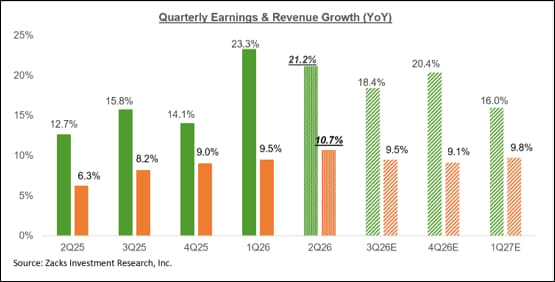
- Total Q2 earnings for the S&P 500 index are currently expected to be up +21.2% from the same period last year on +10.7% higher revenues, with 11 of the 16 Zacks sectors expected to enjoy positive earnings growth.
- Q2 earnings estimates have been steadily going up since the quarter got underway, with the current +21.2% up from +18% at the start of April. Estimates have increased for 5 of the 16 Zacks sectors, including Tech, Energy, Basic Materials, Utilities, and Business Services.
- The Tech sector has been a critical growth pillar since 2023 Q3, and it is expected to continue playing that role in 2026 Q2, with earnings growth +42%. Excluding the Tech sector’s substantial contribution, Q2 earnings growth for the rest of the S&P 500 index would be +11.3% (vs. +21.2% otherwise).
The revisions trend remains positive
The overall earnings picture continues to be of all-around strength and a steadily improving outlook. This favorable earnings backdrop is evident in the revisions trend, as seen in how expectations for 2026 Q2 have evolved in recent weeks.
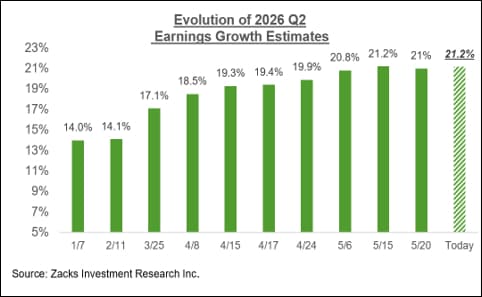
We should note that Q2 estimates have modestly declined in recent days, even though the overall revisions trend remains positive.
The sectors enjoying positive estimate revisions since the start of April include Energy, Tech, Basic Materials, Industrials, Utilities, and Business Services. But Q2 estimates in the aggregate would be modestly down since the start of the period had it not been for the increase in Energy and Tech sector estimates.
The Tech sector has been enjoying positive estimate revisions for more than a year now, so the sector’s positive revisions trend is basically more of the same. We have discussed in this space the positive revisions that the Mag 7 group has been experiencing. The Energy sector’s improved earnings outlook is a direct result of the Iran war, as is the upgraded earnings outlook for parts of the Basic Materials sector, particularly the Chemicals industry.
Take, for example, the evolution of Q2 EPS estimates for Dow (DOW), LyondellBasell Industries (LYB), Methanex (MEOH), and others. For Dow and LyondellBasell, the Zacks Consensus EPS estimates for Q2 have more than doubled over the past month, while the same for Methanex has increased by more than 30%.
On the negative side, Q2 estimates have come under renewed pressure since the start of the period for the Transportation, Autos, Medical, and Consumer Discretionary sectors.
The chart below shows S&P 500 expectations for 2026 Q2 in terms of what was achieved in the preceding four periods and what is currently expected for the following three quarters.
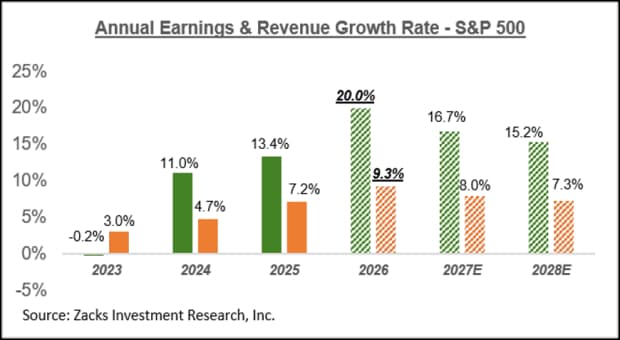
The chart below shows the overall earnings picture for the S&P 500 index on an annual basis.
Want the latest recommendations from Zacks Investment Research? Download 7 Best Stocks for the Next 30 Days. Click to get this free report
Author

Zacks
Zacks Investment Research
Zacks Investment Research provides unbiased investment research and tools to help individuals and institutional investors make confident investing decisions.

















