Japan's Katayama says Japan will take "decisive action" against speculative FX moves
- Katayama doubles down on Yen defense as 157.00 emerges as the new Tokyo line

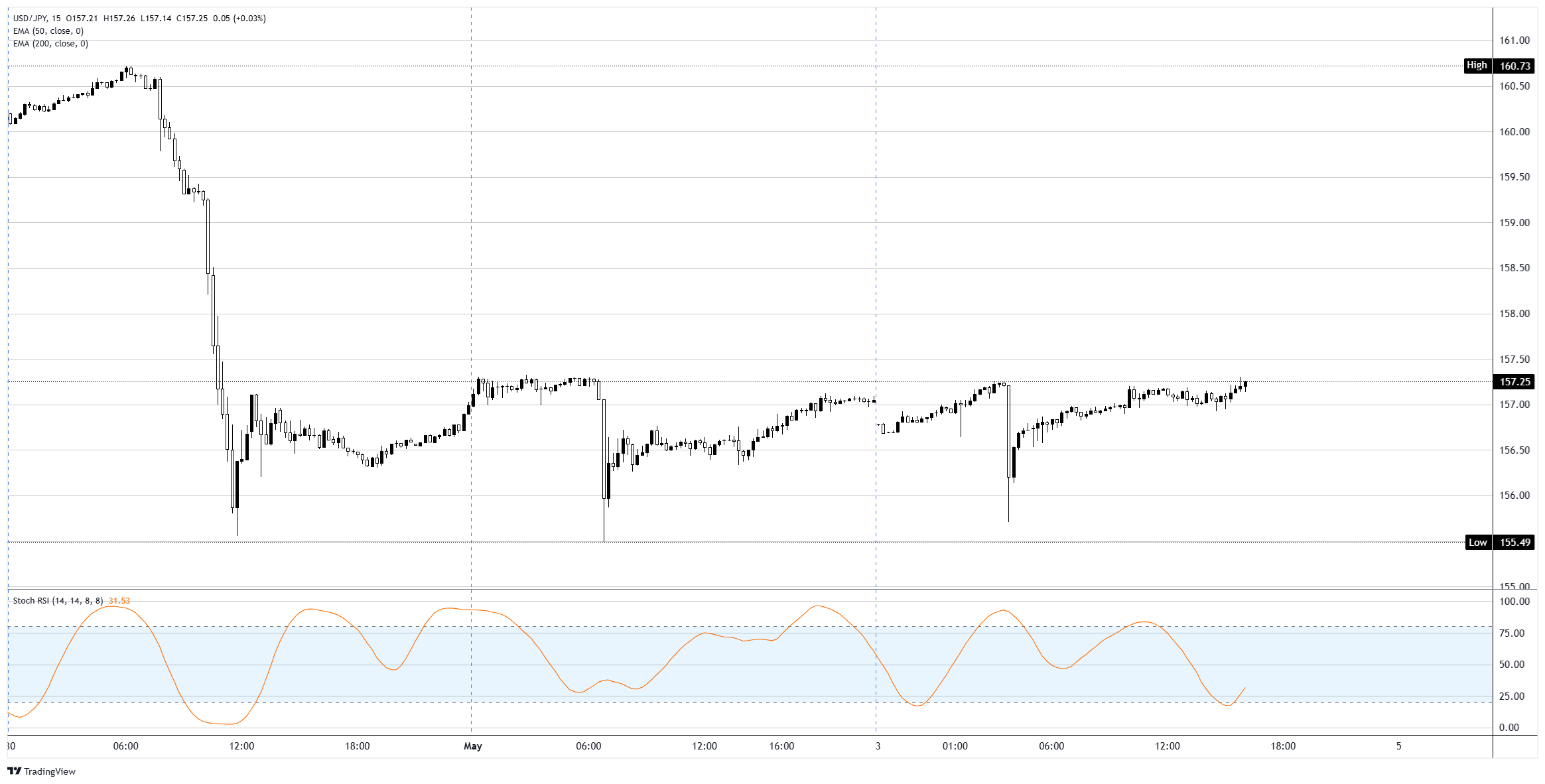
Japan's Finance Minister Satsuki Katayama returned to the verbal channel on Monday, signaling Tokyo's readiness to take decisive action against speculative foreign exchange moves under last September's bilateral agreement with the US, just two trading days after the Ministry of Finance (MoF) and Bank of Japan (BoJ) confirmed Yen-buying intervention on April 30. The fresh warning landed as USD/JPY drifted around 157.00, having recovered roughly half of the intervention-driven decline from the 160.73 high but stalling repeatedly in the 157.00-157.50 zone since Friday.
Supply chains enter the rhetoric
Katayama also flagged risks to Japan's vast Asian supply chains, a notable expansion of how Tokyo is framing Yen weakness. The message effectively links currency policy to industrial policy, recasting intervention as a defense of Japanese manufacturing competitiveness rather than narrow exchange rate management. With Iran-driven Oil prices keeping import costs elevated and the Strait of Hormuz blockade still active, the supply chain framing gives Tokyo broader political cover to keep spending, particularly through this week's thin Golden Week liquidity that Katayama herself flagged Thursday as a potential follow-up window.
The 157.00 question
Price action since Thursday tells its own story. USD/JPY clawed back nearly half of the intervention move within 24 hours but has been turned away from the 157.50 area on every attempt, with sporadic intraday spikes lower into the 155.50 zone hinting that authorities remain active beneath the surface. With Katayama leaning back into decisive action language so soon after Thursday's headline strike, the question now is whether 157.50 has quietly replaced 162.00 as Tokyo's line in the sand, and how quickly speculators will test it.
Katayama highlights:
Japan will take decisive action against speculative FX moves, based on agreement with US last year.
Japan has vast supply chains in Asia, which are facing disruption fears.
USD/JPY 15-minute chart
Japanese Yen FAQs
The Japanese Yen (JPY) is one of the world’s most traded currencies. Its value is broadly determined by the performance of the Japanese economy, but more specifically by the Bank of Japan’s policy, the differential between Japanese and US bond yields, or risk sentiment among traders, among other factors.
One of the Bank of Japan’s mandates is currency control, so its moves are key for the Yen. The BoJ has directly intervened in currency markets sometimes, generally to lower the value of the Yen, although it refrains from doing it often due to political concerns of its main trading partners. The BoJ ultra-loose monetary policy between 2013 and 2024 caused the Yen to depreciate against its main currency peers due to an increasing policy divergence between the Bank of Japan and other main central banks. More recently, the gradually unwinding of this ultra-loose policy has given some support to the Yen.
Over the last decade, the BoJ’s stance of sticking to ultra-loose monetary policy has led to a widening policy divergence with other central banks, particularly with the US Federal Reserve. This supported a widening of the differential between the 10-year US and Japanese bonds, which favored the US Dollar against the Japanese Yen. The BoJ decision in 2024 to gradually abandon the ultra-loose policy, coupled with interest-rate cuts in other major central banks, is narrowing this differential.
The Japanese Yen is often seen as a safe-haven investment. This means that in times of market stress, investors are more likely to put their money in the Japanese currency due to its supposed reliability and stability. Turbulent times are likely to strengthen the Yen’s value against other currencies seen as more risky to invest in.
Author

Joshua Gibson
FXStreet
Joshua joins the FXStreet team as an Economics and Finance double major from Vancouver Island University with twelve years' experience as an independent trader focusing on technical analysis.