Japanese Yen bulls have the upper hand amid trade war fears, hawkish BoJ
- The Japanese Yen continues to draw support from the BoJ's hawkish interest rate hike on Friday.
- The divergent BoJ-Fed outlook and narrowing US-Japan yield differential favor the JPY bulls.
- Fed rate cut bets could act as a headwind for the buck and further cap gains for the USD/JPY pair.


The Japanese Yen (JPY) stalls intraday downtick and remains on the front foot against its American counterpart for the third consecutive day on Monday. The White House said that Colombia has agreed to accept illegal migrants returned from the US, which turned out to be a key factor that exerted some downward pressure on the safe-haven JPY. Apart from this, the emergence of some US Dollar (USD) dip-buying pushed the USD/JPY pair above the 156.00 mark.
Investors, however, remain concerned about persistent uncertainty surrounding US President Donald Trump's trade policies. This, along with the Bank of Japan's (BoJ) hawkish outlook, acts as a tailwind for the JPY. Furthermore, bets that the Federal Reserve (Fed) will cut rates twice this year should cap the USD gains. Apart from this, the recent narrowing of the US-Japan rate differential lends support to the JPY and contributes to keeping a lid on the USD/JPY pair.
Japanese Yen continues to be underpinned by Trump's tariff theat and BoJ rate hike bets
- US President Donald Trump imposed 25% tariffs on all imports from Colombia after the latter refused to allow two US military planes carrying deported migrants to land in the country.
- Trump warned that the tariffs will increase to 50% by next week on further noncompliance, fueling trade war concerns and boosting demand for the traditional safe-haven Japanese Yen.
- Adding to this, the Wall Street Journal (WSJ) reported that momentum is growing among Trump’s advisers to place 25% tariffs on Mexico and Canada as soon as February 1.
- The White House confirmed on Monday that Colombia has agreed to all of Trump’s terms, including unrestricted acceptance of all illegal aliens from Colombia returned from the US.
- The anti-risk flow, along with Federal Reserve rate cut bets, drags the US Treasury bond yields lower, narrowing the US-Japan yield differential and lending additional support to the JPY.
- The Bank of Japan decided to raise interest rates by 25 basis points, the biggest rate hike since February 2007, from 0.25% to 0.50%, or the highest since the 2008 global financial crisis.
- The BoJ reiterated that it would continue to raise the policy rate and adjust the degree of monetary accommodation if the outlook presented at the January policy meeting is realized.
- The BoJ does not expect consumer inflation to drop under its 2% target anytime soon and forecast slower growth, though it signaled that rising wages could fuel a ‘virtuous cycle’ of growth.
- Data released on Friday showed that Japan's core consumer inflation accelerated to the fastest annual pace in 16 months during December, pointing to broadening inflationary pressure.
- Annual spring wage negotiations kicked off in Japan, with the leaders of the top business lobby and labor unions agreeing on the need to maintain the momentum for pay hikes.
- Traders now look to Monday's US economic docket – featuring Durable Goods Orders, the Conference Board's Consumer Confidence Index and the Richmond Manufacturing Index.
USD/JPY needs to break below short-term ascending channel support for bears to retain control
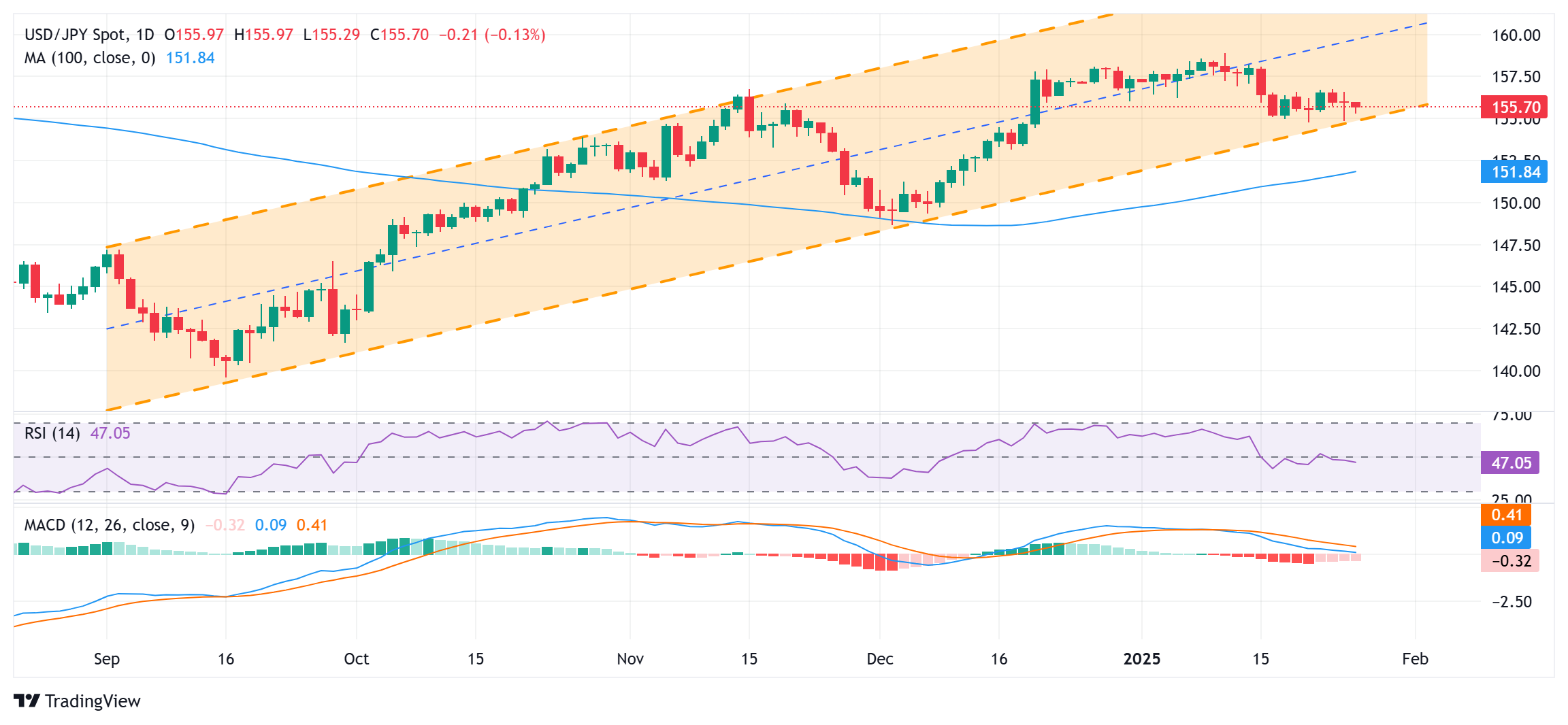
From a technical perspective, any subsequent fall might continue to find support near the lower boundary of a multi-month-old ascending channel, currently pegged near the 155.25 region. This is closely followed by the 155.00 psychological mark and the 154.80-154.75 support, which if broken decisively will be seen as a fresh trigger for bearish traders. Given that oscillators on the daily chart have just started gaining negative traction, the USD/JPY pair might then accelerate the fall towards the 154.00 round figure en route to mid-153.00s and the 153.00 mark.
On the flip side, any attempted recovery might now confront some resistance near the 156.00 mark. The next relevant hurdle is pegged near the 156.75 supply zone. Some follow-through buying, leading to subsequent strength beyond the 157.00 mark, should pave the way for a move towards the 157.55 area en route to the 158.00 mark. The USD/JPY could eventually climb to the 158.35-158.40 region before aiming to retest the multi-month peak, around the 159.00 neighborhood touched on January 10.
Fed FAQs
Monetary policy in the US is shaped by the Federal Reserve (Fed). The Fed has two mandates: to achieve price stability and foster full employment. Its primary tool to achieve these goals is by adjusting interest rates. When prices are rising too quickly and inflation is above the Fed’s 2% target, it raises interest rates, increasing borrowing costs throughout the economy. This results in a stronger US Dollar (USD) as it makes the US a more attractive place for international investors to park their money. When inflation falls below 2% or the Unemployment Rate is too high, the Fed may lower interest rates to encourage borrowing, which weighs on the Greenback.
The Federal Reserve (Fed) holds eight policy meetings a year, where the Federal Open Market Committee (FOMC) assesses economic conditions and makes monetary policy decisions. The FOMC is attended by twelve Fed officials – the seven members of the Board of Governors, the president of the Federal Reserve Bank of New York, and four of the remaining eleven regional Reserve Bank presidents, who serve one-year terms on a rotating basis.
In extreme situations, the Federal Reserve may resort to a policy named Quantitative Easing (QE). QE is the process by which the Fed substantially increases the flow of credit in a stuck financial system. It is a non-standard policy measure used during crises or when inflation is extremely low. It was the Fed’s weapon of choice during the Great Financial Crisis in 2008. It involves the Fed printing more Dollars and using them to buy high grade bonds from financial institutions. QE usually weakens the US Dollar.
Quantitative tightening (QT) is the reverse process of QE, whereby the Federal Reserve stops buying bonds from financial institutions and does not reinvest the principal from the bonds it holds maturing, to purchase new bonds. It is usually positive for the value of the US Dollar.
Author
Haresh Menghani
FXStreet
Haresh Menghani is a detail-oriented professional with 10+ years of extensive experience in analysing the global financial markets.