Japanese Yen recovers further from multi-week low against USD; eyes US PCE for fresh impetus
- The Japanese Yen attracts some buyers following the release of a strong Tokyo CPI print.
- The BoJ’s hawkish stance and the risk-off mood further underpin the safe-haven JPY.
- The US PCE Price Index due later this Friday should provide fresh impetus to USD/JPY.

The Japanese Yen (JPY) adds to strong Tokyo consumer inflation data-inspired gains and recovers further from a four-week low touched against its American counterpart earlier this Friday. The prevalent risk-off environment and bets that the Bank of Japan (BoJ) will continue raising interest rates turn out to be key factors underpinning the safe-haven JPY. The JPY bulls, meanwhile, seem rather unaffected by worries that US President Donald Trump's auto tariffs could impact key Japanese exports.
Meanwhile, the growing acceptance that the Federal Reserve (Fed) will resume its rate-cutting cycle soon amid worries about tariffs-driven US economic slowdown marks a big divergence in comparison to hawkish BoJ expectations. This further lends support to the lower-yielding JPY. That said, a modest US Dollar (USD) uptick, following the overnight pullback from a multi-week high, could limit losses for the USD/JPY pair ahead of the US Personal Consumption Expenditure (PCE) Price Index.
Japanese Yen retains intraday positive bias amid BoJ rate hike bets and global flight to safety
- US President Donald Trump on Wednesday unveiled a 25% tariff on imported cars and light trucks to take effect on April 3. This fuels concerns that the levies would have a far-reaching impact on Japan's auto industry, which accounts for roughly 3% of gross domestic product.
- Data released earlier this Friday showed that the headline Consumer Price Index (CPI) in Tokyo rose 2.9% in March from 2.8% previous. Moreover, Tokyo Core CPI, which excludes volatile fresh food prices, climbed to 2.4% during the reported month from 2.2% in February.
- Adding to this, a core reading that excludes both volatile fresh food and energy prices grew from 1.9% in the prior month to 2.2% in March. This is now above the Bank of Japan's annual 2% target and backs the case for further interest rate hikes by the Japanese central bank.
- BoJ Summary of Opinions from the March meeting revealed a consensus to continue raising rates if the economy and prices move in line with the forecast. The board, however, viewed that the policy must be kept steady for the time being as the downside risks to the economy have heightened due to the US tariff policy.
- The global risk sentiment took a hit in reaction to Trump's auto tariffs and worries that reciprocal tariffs next week will dent US growth. This overshadowed an upward revision of the US Q4 GDP, which showed that the economy grew at a 2.4% annualized pace vs 2.3% in the previous estimate.
- Richmond President Thomas Barkin warned on Thursday that the economic uncertainty driven by the Trump administration's trade policy could dampen consumer and business spending, and will force the central bank into a wait-and-see approach rather than the proactive stance most investors are hoping for.
- Boston Fed President Susan Collins noted that the US central bank's challenge at this point is to choose between maintaining a tight policy stance or trying to run ahead of data that might be souring in the future. Given the outlook, Collins expects the Fed to hold rates steady for longer.
- Investors now look forward to the release of the US Personal Consumption Expenditure (PCE) Price Index, which could offer fresh cues about the Fed's future interest rate-cut path. This, in turn, will drive the US Dollar and provide some meaningful impetus to the USD/JPY pair.
USD/JPY technical setup warrants caution for bears; the 150.00 psychological mark holds the key
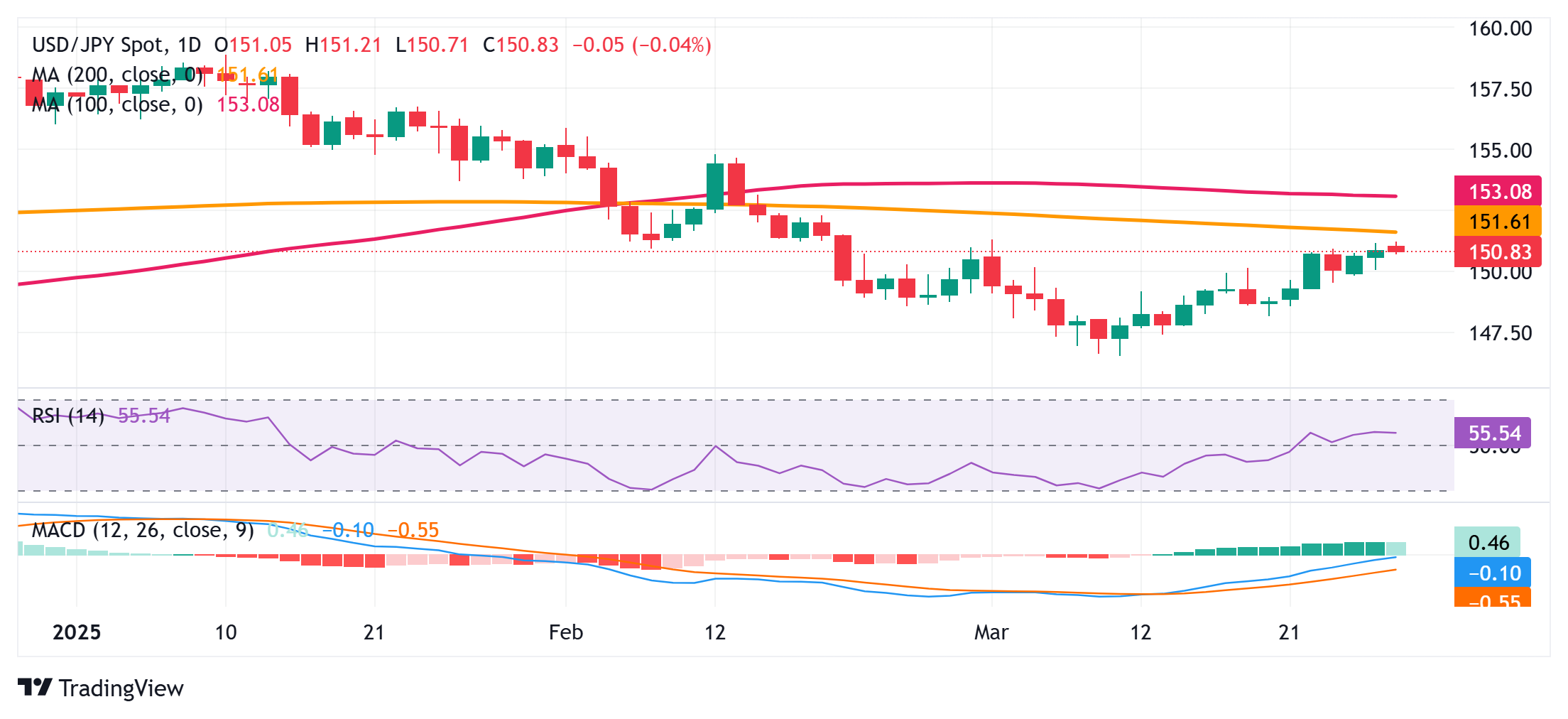
From a technical perspective, the intraday pullback from the vicinity of the monthly peak warrants caution before placing fresh bullish bets around the USD/JPY pair and positioning for further gains. Meanwhile, oscillators on the daily chart have just started gaining positive traction and support prospects for the emergence of some dip-buying near the 150.00 psychological mark. Some follow-through selling below the 149.85-149.80 region, however, would negate the positive bias and drag spot prices to the 149.25 support zone en route to the 149.00 round figure and the next relevant support near the 148.65 region.
On the flip side, a move beyond the monthly peak, around the 151.30 area, might confront some resistance near a technically significant 200-day Simple Moving Average (SMA), currently pegged near the 151.65 region. A sustained strength beyond the latter will be seen as a fresh trigger for bulls and allow the USD/JPY pair to reclaim the 152.00 mark. The positive momentum could extend further to the 152.45-152.50 region before spot prices aim to challenge the 100-day SMA, around the 153.00 round figure.
Economic Indicator
Personal Consumption Expenditures - Price Index (YoY)
The Personal Consumption Expenditures (PCE), released by the US Bureau of Economic Analysis on a monthly basis, measures the changes in the prices of goods and services purchased by consumers in the United States (US). The YoY reading compares prices in the reference month to a year earlier. Price changes may cause consumers to switch from buying one good to another and the PCE Deflator can account for such substitutions. This makes it the preferred measure of inflation for the Federal Reserve. Generally, a high reading is bullish for the US Dollar (USD), while a low reading is bearish.
Read more.Next release: Fri Mar 28, 2025 12:30
Frequency: Monthly
Consensus: 2.5%
Previous: 2.5%
Source: US Bureau of Economic Analysis
Author

Haresh Menghani
FXStreet
Haresh Menghani is a detail-oriented professional with 10+ years of extensive experience in analysing the global financial markets.