Japanese Yen breaks through 155.00 against USD for the first time since July 30
- The Japanese Yen drops to a fresh multi-month low on Wednesday and remains vulnerable.
- The BoJ rate-hike uncertainty overshadows a stronger Japanese PPI and undermines the JPY.
- Elevated US bond yields weigh on the JPY further amid a bullish USD, and ahead of US CPI.

The Japanese Yen (JPY) remains depressed against its American counterpart for the third straight day on Wednesday, pushing the USD/JPY pair above the 155.00 psychological mark or a fresh multi-month top during the early European session. Despite a rise in Japan's Producer Price Index (PPI), investors seem convinced that a fragile minority government in Japan could make it difficult for the Bank of Japan (BoJ) to hike interest rates again. Adding to this, worries that US President-elect Donald Trump's promised tariffs turn out to be another factor undermining the JPY.
Meanwhile, expectations that Trump's expansionary policies could boost inflation and restrict the Federal Reserve (Fed) from easing more aggressively remain supportive of elevated US Treasury bond yields. This, in turn, assists the US Dollar (USD) to stand firm near its highest level since April and contributes to driving flows away from the lower-yielding JPY. That said, intervention fears, along with the cautious market mood, could limit losses for the safe-haven JPY and cap the USD/JPY pair ahead of the release of the crucial US consumer inflation figures later today.
Japanese Yen remains vulnerable near multi-month low amid BoJ uncertainty and bullish USD
- The Bank of Japan's preliminary report released this Wednesday revealed that Japan's Producer Price Index (PPI) rose by 3.4% in October compared to the same time period last year and increased by 0.2% on a monthly basis.
- The higher-than-estimated readings could possibly lead to an uptick in demand-driven inflation, though they were offset by worries that higher producer prices stemming from a weaker Japanese Yen could impact household spending.
- This comes on top of the political uncertainty in Japan and further raises doubts about the Bank of Japan's ability to tighten its monetary policy, which continues to undermine the JPY and acts as a tailwind for the USD/JPY pair.
- Earlier this week, the BoJ Summary of Opinions from the October meeting showed that policymakers were divided on rate hike timing, adding a layer of uncertainty amid US President-elect Donald Trump's expected protectionist tariffs.
- The US Dollar consolidates its recent gains to the highest level since April amid hopes that Trump's expansionary policies will boost inflation and limit the scope for the Federal Reserve to ease its monetary policy more aggressively.
- Richmond Fed President Tom Barkin noted on Tuesday that while inflation appears to be coming down, it might still get stuck above the central bank's target and that the labor market might be fine or might continue to weaken from here.
- Separately, Minneapolis Fed President Neel Kashkari said that while the US central bank has many reasons to feel confident about its long-running battle with transitory inflation, it still may be too soon to declare outright victory.
- According to the CME Group's FedWatch Tool, traders are currently pricing in a less than 60% chance of a 25-basis-points rate cut and see around a 40% probability for an on-hold decision at the next FOMC meeting in December.
- The yield on the benchmark 10-year US government bond remains close to a multi-month peak touched after Trump's victory in the US presidential election, offering support to the USD and undermining the lower-yielding JPY.
- The USD bulls, however, take a pause for a breather and keenly await the release of the US inflation report, which is expected to show that the headline Consumer Price Index (CPI) rose by 2.6% over the 12 months to October.
USD/JPY seems poised to appreciate further, sutained move above the 155.00 mark awaited
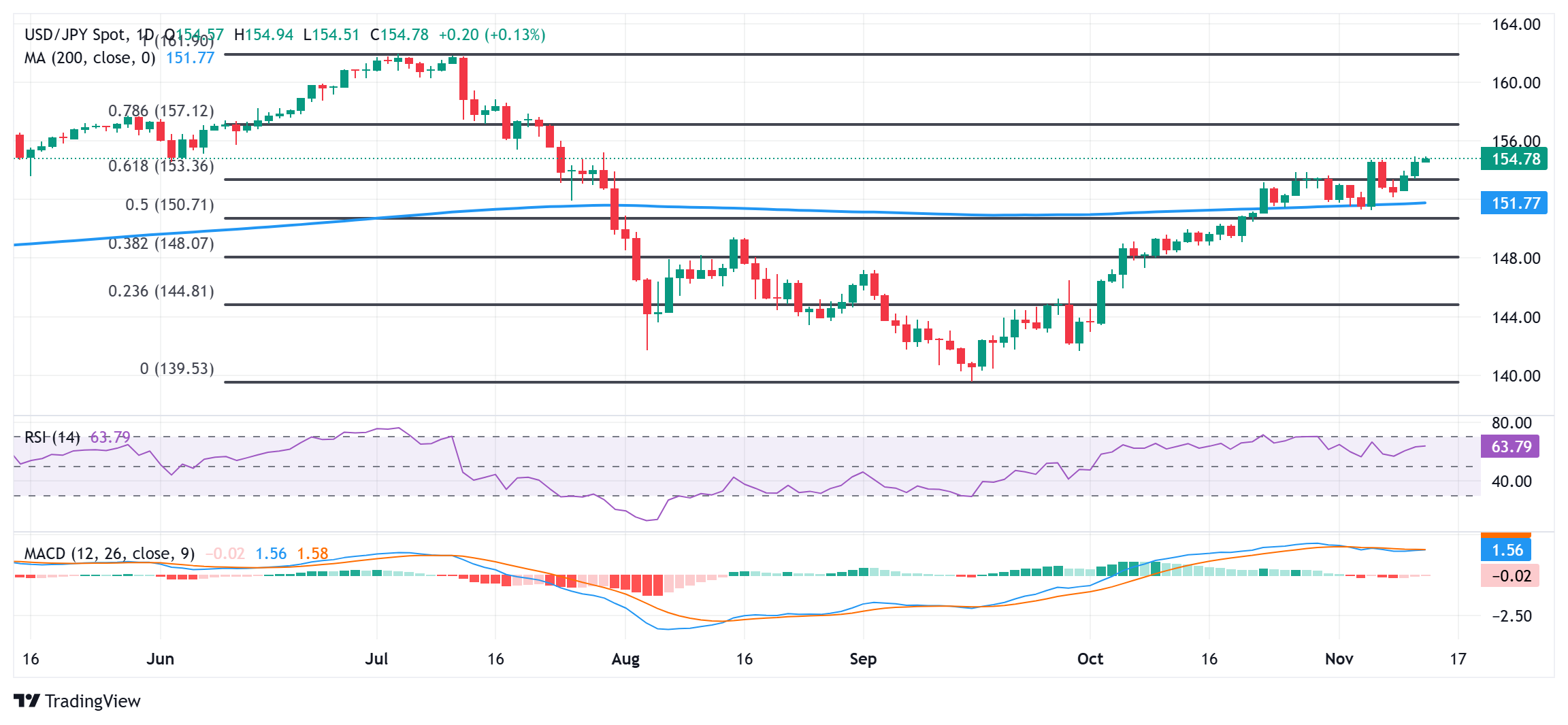
From a technical perspective, the USD/JPY pair continues with its struggle to make it through the 155.00 round figure. The said handle should now act as a key pivotal point, which if cleared decisively should pave the way for additional gains. Given that oscillators on the daily chart are holding comfortably in positive territory and are still away from being in the overbought zone, spot prices might then surpass the July swing high, around the 155.20 area, and aim to reclaim the 156.00 mark. The momentum could extend further towards the 156.60 intermediate hurdle en route to the 156.90-157.00 region.
On the flip side, any meaningful corrective pullback now seems to find decent support near the 154.00 round figure ahead of the overnight swing low, around the 153.40 area. Any further decline could be seen as a buying opportunity near the 153.00 mark, which, in turn, should help limit losses for the USD/JPY pair near the 152.65-152.60 horizontal support. A convincing break below the latter could drag spot prices below the 152.00 mark and expose the very important 200-day Simple Moving Average (SMA) resistance breakpoint, around the 151.60-151.55 region. The latter should act as a strong near-term base, which if broken decisively might shift the bias in favor of bearish traders.
Economic Indicator
Consumer Price Index (YoY)
Inflationary or deflationary tendencies are measured by periodically summing the prices of a basket of representative goods and services and presenting the data as The Consumer Price Index (CPI). CPI data is compiled on a monthly basis and released by the US Department of Labor Statistics. The YoY reading compares the prices of goods in the reference month to the same month a year earlier.The CPI is a key indicator to measure inflation and changes in purchasing trends. Generally speaking, a high reading is seen as bullish for the US Dollar (USD), while a low reading is seen as bearish.
Read more.Next release: Wed Nov 13, 2024 13:30
Frequency: Monthly
Consensus: 2.6%
Previous: 2.4%
Source: US Bureau of Labor Statistics
The US Federal Reserve has a dual mandate of maintaining price stability and maximum employment. According to such mandate, inflation should be at around 2% YoY and has become the weakest pillar of the central bank’s directive ever since the world suffered a pandemic, which extends to these days. Price pressures keep rising amid supply-chain issues and bottlenecks, with the Consumer Price Index (CPI) hanging at multi-decade highs. The Fed has already taken measures to tame inflation and is expected to maintain an aggressive stance in the foreseeable future.
Author

Haresh Menghani
FXStreet
Haresh Menghani is a detail-oriented professional with 10+ years of extensive experience in analysing the global financial markets.