Japanese Yen holds near 162 as intervention risk remains
- Fed hike pricing keeps USD/JPY supported near yearly highs.
- Lower Treasury yields and intervention talk cap upside momentum.
- BoJ minutes show faster-hike pressure building inside the board.

The Japanese Yen (JPY) registers minimal losses against the US Dollar (USD) on Wednesday amid mixed risk appetite, with global equities fluctuating between gains and losses, while investors continue to monitor developments in the Middle East. The USD/JPY pair trades at around 161.75, poised to consolidate for the third straight day, below the yearly high of 161.93 posted on Monday.
USD/JPY steadies as Fed hike bets meet intervention fears
USD/JPY remains bullish after the Federal Reserve (Fed) confirmed its commitment to deliver 2% inflation, as reflected also in the dot plot in the Summary of Economic Projections (SEP). US data has been US Dollar supportive, with a healthy labor market and sticky inflation above the 3% threshold. The focus turns to the release of the Fed’s preferred inflation measure, the Core Personal Consumption Expenditures (PCE) Price Index, on Thursday.
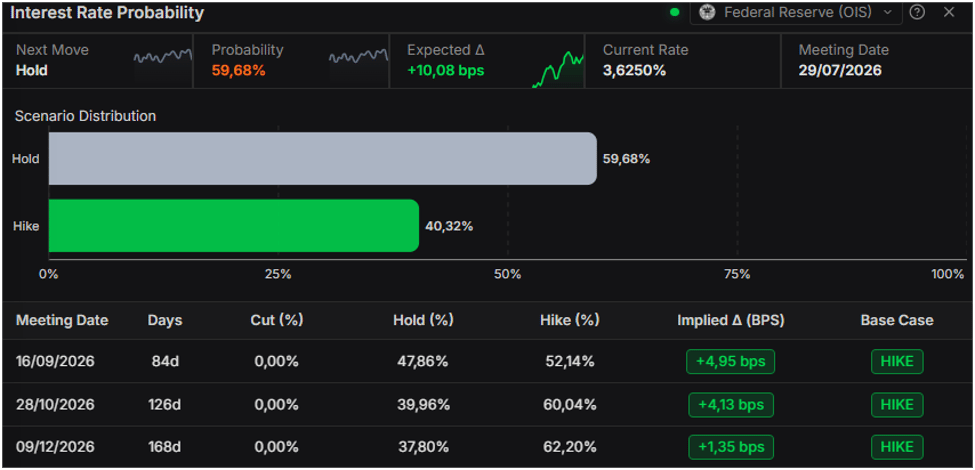
As of writing, money markets are expecting at least 20 basis points of tightening towards the end of the year. This means there’s an 82% chance of a rate hike in December and a 60% chance of a hold at the July meeting, according to Prime Terminal data.
Meanwhile, developments in the Middle East are weighing on Oil prices, pushing US Treasury bond yields lower, as the US 10-year T-note is plunging nearly 10 basis points down at 4.406%.
US New Home Sales in May fell unexpectedly due to higher mortgage rates, the US Census Bureau reported, with sales dropping -7.3% in seasonally adjusted figures.
In Japan, Finance Minister Satsuki Katayama said she spoke with US Treasury Secretary Scott Bessent this week amid growing fears of a possible intervention by Japanese authorities.
In Japan, the Producer Price Index for services rose by 3.3% in May, the Bank of Japan (BoJ) reported, which also released its latest meeting minutes.
The BoJ Summary of Opinions showed that some members called for faster rate hikes, with one member eyeing a rate hike once every few months. Another member suggested that interest rates are below the neutral level and should be raised to neutral “as soon as possible.”
USD/JPY Price Forecast: Technical outlook
In the daily chart, USD/JPY trades at 161.79, keeping a clear bullish bias as spot holds comfortably above the triple simple moving average around 159.28 and well over the rising trend-line supports drawn from 139.89 and 152.10. The structure suggests the broader uptrend remains intact, although the Relative Strength Index (14) at 72.02 has pushed into overbought territory, hinting that upside momentum is strong but increasingly vulnerable to a corrective pause rather than a fresh acceleration.
On the downside, initial protection is seen at the 160.00 horizontal line, ahead of the clustered dynamic support provided by the triple simple moving average near 159.28. A deeper pullback would look toward the rising trend-line floors around 157.41 and 157.09, where buyers would be expected to re-emerge while price holds above these levels, keeping the broader bullish structure in place.
(The technical analysis of this story was written with the help of an AI tool.)
Japanese Yen FAQs
The Japanese Yen (JPY) is one of the world’s most traded currencies. Its value is broadly determined by the performance of the Japanese economy, but more specifically by the Bank of Japan’s policy, the differential between Japanese and US bond yields, or risk sentiment among traders, among other factors.
One of the Bank of Japan’s mandates is currency control, so its moves are key for the Yen. The BoJ has directly intervened in currency markets sometimes, generally to lower the value of the Yen, although it refrains from doing it often due to political concerns of its main trading partners. The BoJ ultra-loose monetary policy between 2013 and 2024 caused the Yen to depreciate against its main currency peers due to an increasing policy divergence between the Bank of Japan and other main central banks. More recently, the gradually unwinding of this ultra-loose policy has given some support to the Yen.
Over the last decade, the BoJ’s stance of sticking to ultra-loose monetary policy has led to a widening policy divergence with other central banks, particularly with the US Federal Reserve. This supported a widening of the differential between the 10-year US and Japanese bonds, which favored the US Dollar against the Japanese Yen. The BoJ decision in 2024 to gradually abandon the ultra-loose policy, coupled with interest-rate cuts in other major central banks, is narrowing this differential.
The Japanese Yen is often seen as a safe-haven investment. This means that in times of market stress, investors are more likely to put their money in the Japanese currency due to its supposed reliability and stability. Turbulent times are likely to strengthen the Yen’s value against other currencies seen as more risky to invest in.
Author

Christian Borjon Valencia
FXStreet
Markets analyst, news editor, and trading instructor with over 14 years of experience across FX, commodities, US equity indices, and global macro markets.