IWM: head & shoulders measured move complete, now the 10-year yield holds the key

The iShares Russell 2000 ETF (NYSE Arca: IWM) tracks the performance of approximately 2,000 small-cap U.S. companies, making it one of the most widely followed barometers of domestic economic health and risk appetite. After completing a textbook Head & Shoulders pattern, IWM is now at a critical price zone. The direction of the 10-year Treasury yield may be the deciding factor in what comes next.
Head & shoulders plays out
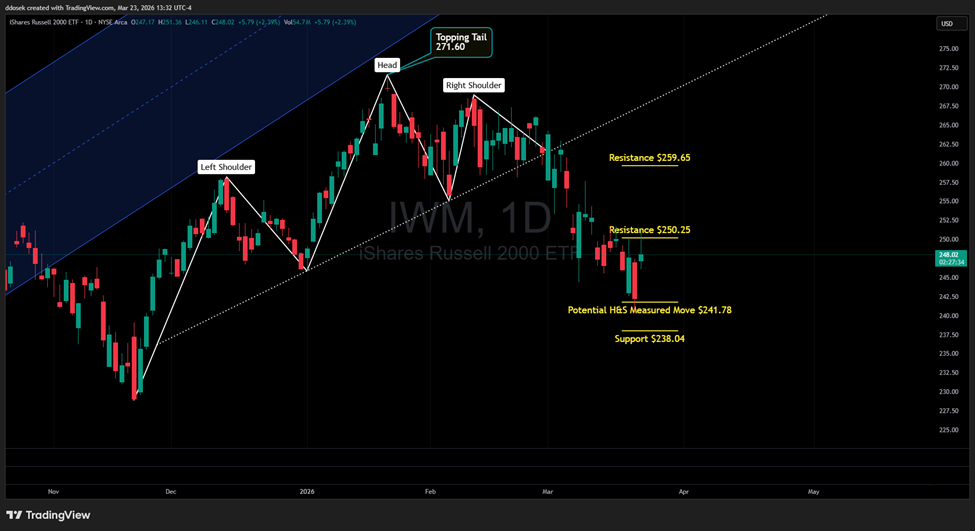
Since December 2025, a well-defined Head & Shoulders topping pattern developed on the IWM daily chart, complete with a Left Shoulder, a Head that printed a topping tail at $271.60, and a Right Shoulder forming a lower high. Last Friday, the pattern completed its measured move, tagging the downside target of $241.78 — a technically precise and meaningful confirmation that the pattern played out exactly as the chart projected.
Today, IWM is bouncing 2.39% and testing the first resistance level at $250.25. This level is now former support turned resistance. How price behaves here in the coming sessions will set the tone for the near term.
The 10-Year yield: The macro wildcard
What makes the IWM setup particularly compelling — and complex — is the direct relationship between small-cap stocks and the 10-year Treasury yield. Unlike large-cap companies with diversified global revenue streams and fortress balance sheets, many of the small-cap businesses within the Russell 2000 rely heavily on debt financing to fund operations. When the 10-year yield rises, borrowing costs increase, profit margins get squeezed, and the fundamental backdrop for these companies deteriorates.
If the 10-year yield continues to push higher, it will act as a headwind for IWM, increasing the probability that today's bounce fades and price revisits the $241.78 measured move level. Should the yield remain elevated for an extended period, the pressure could build further — putting the November 2025 lows at $229.11 squarely back in play.
Resistance levels capping the upside
For the bulls to regain control, IWM must work through two key resistance levels:
● $250.25 — The immediate resistance being tested today. A clean daily close above this level with follow-through would be the first sign that the bounce has legs.
● $259.65 — The next and more significant resistance zone. Clearing this level would begin to shift the technical narrative away from the completed Head & Shoulders and back toward a potential recovery.
The bottom line
IWM has executed its Head & Shoulders measured move with precision. The bounce today is encouraging on the surface, but the 10-year yield remains the critical macro variable to monitor. As long as yields stay elevated, the fundamental and technical pressure on small caps remains intact. Watch the $250.25 resistance closely today, and keep $241.78 and $229.11 on the downside radar if the bond market refuses to cooperate.
Author

Drew Dosek
Verified Investing
Passionate technical and cycle analyst committed to empowering traders through data-driven insights.