Indian Rupee remains weak due to sudden FCNR (B) closure, higher oil prices
- The Indian Rupee hits a fresh three-week low near 95.85 against the US Dollar.
- US-Iran ceasefire expiration has boosted oil prices.
- Investors shift their focus to the FOMC minutes.

The Indian Rupee (INR) trades with caution against the US Dollar (USD) on Tuesday. The USD/INR is close to its fresh three-week high of 95.85 despite potential Reserve Bank of India (RBI) intervention.
According to a Reuters report, the RBI likely intervened in the foreign exchange market for an eighth consecutive session on Tuesday, four traders told Reuters, as elevated oil prices kept up pressure on the South Asian currency. Traders also said that state-run banks were spotted offering dollars, most likely on behalf of the RBI.
Markets see downside risks to INR
Financial markets believe that the early closure of the zero-swap facility for foreign currency non-resident (bank), or FCNR (B), deposits by a month, and higher oil prices will remain major headwinds for the Indian Rupee.
Strategists at OCBC note that the Indian Rupee “softened to a two-week low, with USD/INR closing around 95.60, as higher oil prices and the early closure of RBI’s FCNR(B) swap window weighed on sentiment.” They highlight that “the FCNR(B) window will now close on 31 Aug, one month earlier than planned, after the broader FX-inflow measures drew nearly USD57bn, including more than USD52bn via non-resident deposits.”
There is another school of thought that believes the early FCNR closure signifies that the RBI has raised sufficient foreign-currency inflows and now has greater room to support the rupee without continuing to incentivise additional dollar mobilisation, Business Standard reported.
OCBC views “importer USD demand and oil" to remain the key drags, though potential RBI-linked USD sell-flows and a broadly softer USD should help limit disorderly moves in the currency.
Oil prices rally as US-Iran ceasefire expires
In the early session on Tuesday, the MCX Crude Oil contract expiring on August 19 trades 1.1% higher to near Rs. 8,150, the highest level seen in two weeks.
Currencies from economies, such as India, which rely heavily on oil imports to meet their energy needs, tend to underperform in a high-oil-price environment.
Energy prices have rallied further as United States (US) President Donald Trump said on Monday that he is not interested in renewing the expiring agreement with Iran, according to a Bloomberg report. This has prompted fears that Iran and the US could restart military attacks against each other, a scenario that could escalate concerns regarding a prolonged energy supply disruption. Trump added that the US still has leverage over Iran, citing the US naval blockade on Iranian seaports.
US FOMC minutes awaited
Financial markets keenly await the release of the Federal Open Market Committee (FOMC) minutes for the July policy meeting on Wednesday to get fresh cues regarding US inflation and the economic outlook.
Hints regarding the US interest rate outlook are unlikely as Fed Chairman Kevin Warsh remained committed to “no forward guidance” on policy rates.
According to the CME FedWatch tool, traders have scaled back the possibility of a Fed interest rate hike at the September meeting.
USD/INR Technical Analysis
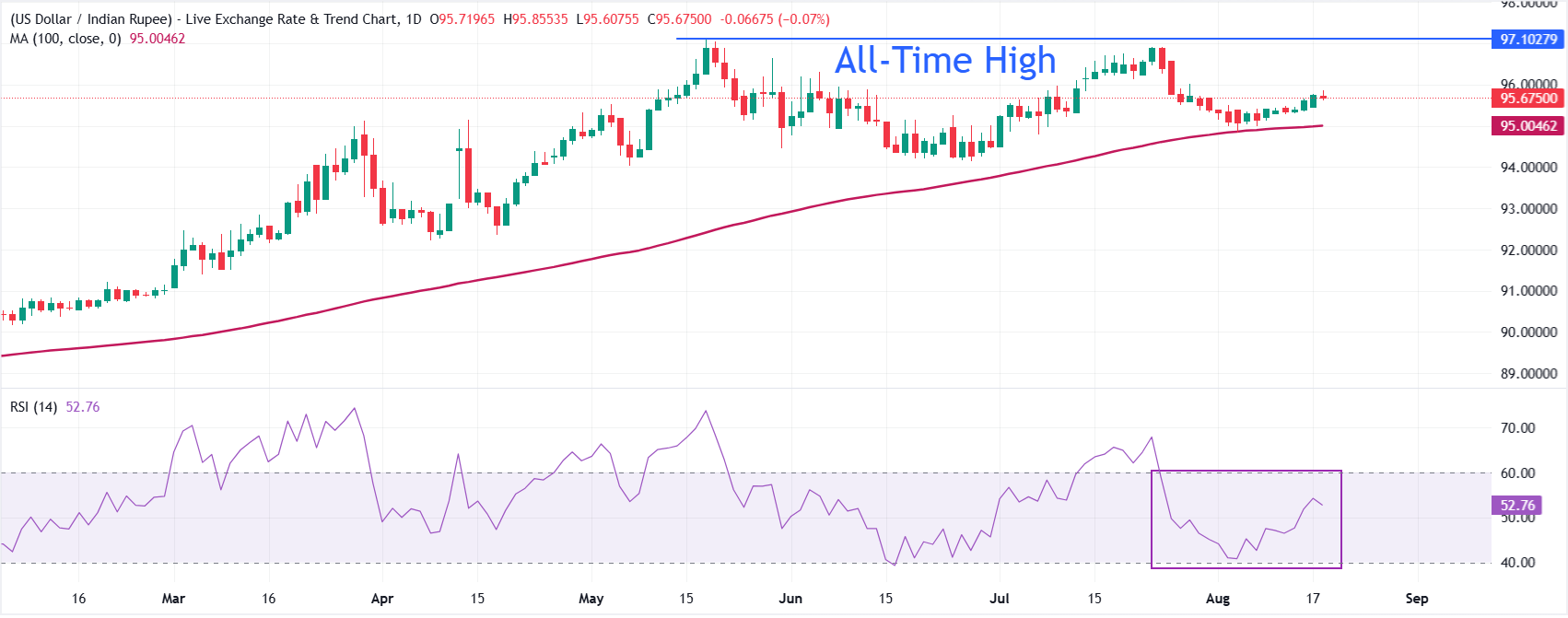
USD/INR trades at around 95.68, holding above the 100-day simple moving average (SMA) at 95.0046, keeping the near-term bias moderately bullish as price consolidates near recent highs.
The Relative Strength Index (14) at 52.8 sits just above neutral, hinting at steady but not overstretched upside pressure.
On the downside, the 100-day SMA around 95.00 is a strong demand area. Looking up, the pair needs a decisive break above 96.00 to revisit the all-time high near 97.10.
(The technical analysis of this story was written with the help of an AI tool. Know more.)
Economic Indicator
FOMC Minutes
FOMC stands for The Federal Open Market Committee that organizes 8 meetings in a year and reviews economic and financial conditions, determines the appropriate stance of monetary policy and assesses the risks to its long-run goals of price stability and sustainable economic growth. FOMC Minutes are released by the Board of Governors of the Federal Reserve and are a clear guide to the future US interest rate policy.
Next release: Wed Aug 19, 2026 18:00
Frequency: Irregular
Consensus: -
Previous: -
Source: Federal Reserve
Minutes of the Federal Open Market Committee (FOMC) is usually published three weeks after the day of the policy decision. Investors look for clues regarding the policy outlook in this publication alongside the vote split. A bullish tone is likely to provide a boost to the greenback while a dovish stance is seen as USD-negative. It needs to be noted that the market reaction to FOMC Minutes could be delayed as news outlets don’t have access to the publication before the release, unlike the FOMC’s Policy Statement.
Author

Sagar Dua
FXStreet
Sagar Dua is associated with the financial markets from his college days. Along with pursuing post-graduation in Commerce in 2014, he started his markets training with chart analysis.