Gold tumbles over 2% as stalled Iran talks lift US Dollar and yields
- Gold drops sharply as Iran talks stalled and haven demand faded.
- A firmer US Dollar and higher Treasury yields added pressure on bullion prices.
- Strong US data and surging oil reinforced a higher-for-longer Fed view.

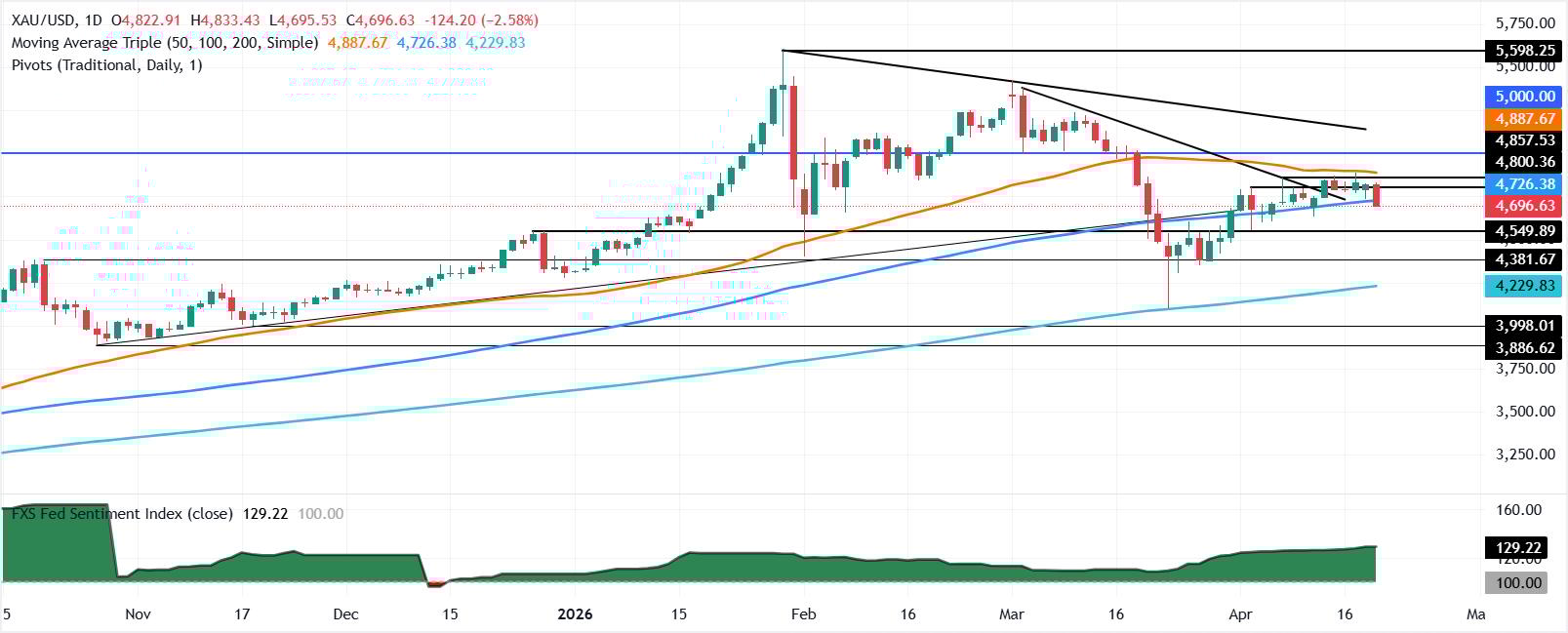
Gold (XAU/USD) price tumbles by more than 2% on Tuesday amid a lack of confirmation of a second round of talks between the US and Iran in Pakistan. Conversely, Crude Oil prices edged higher, a tailwind for the Greenback given its positive correlation with WTI. At the time of writing, the XAU/USD pair trades at $4,720 after hitting a daily peak of $4,833.
Bullion sinks as strong US data and rising Oil curb Fed bets
Peace talks between Washington and Tehran seem to have stalled. The US delegation, led by Vice President Vance, the envoy Steve Wytkoff, and Jared Kushner, remains in Washington, according to a White House official. At the same time, the Iranian Foreign Ministry Spokesperson told Fars that there’s no definitive decision to participate in the negotiations with Washington.
Tehran demands the lifting of the US blockade. On the other hand, US President Donald Trump demands that Iran accept US demands to end the blockade and the war.
Data in the US revealed that Retail Sales beat expectations, jumping 1.7% in March from 0.7%, supported by higher fuel costs and tax refund-driven spending. Annual growth held steady at 4%. Earlier, the ADP four-week average increased to 54.8K from 39K, reinforcing the narrative of a resilient US labor market.
The Fed Chair nominee, Kevin Warsh, was grilled by the US Senate at his hearing. He said he favors a “regime change” at the Fed, including a new approach to controlling inflation, and that he does not support forward guidance. When asked about the US central bank’s independence, he said it is “essential” and that President Trump never asked him to commit to any rate decision.
In the meantime, the Greenback is recovering during Tuesday’s session as depicted by the US Dollar Index (DXY). The DXY, which measures the buck’s value against six currencies, is up 0.43% at 98.47, reaching a six-day high of 98.57.
US Treasury yields are also surging, with the 10-year benchmark note yielding 4.305%, up by nearly five basis points, a headwind for Gold, which usually fares better amid a lower interest rate environment.
The closure of the Strait of Hormuz keeps WTI prices underpinned, with the US crude Oil benchmark up more than 5.50% at $90.77 per barrel.
Ahead of the US economic docket, jobless claims and S&P Global Flash PMIs for April will be released on Thursday.
XAU/USD technical outlook: Breakdown risks build as RSI turns bearish
From a technical perspective, Gold turned sideways during the week after failing to clear key resistance at the 50-day Simple Moving Average (SMA) at $4,889 and support at $4,700. Worth noting that XAU/USD breached the key technical 100-day SMA at $4,712, exposing the $4,700 milestone.
The Relative Strength Index (RSI) turned bearish, which could exacerbate bullion’s drop to test the 20-day SMA at $4,679 ahead of the April 2 daily low of $4,555. On the other hand, if Gold reclaims $4,750, it opens the door to a recovery to $4,800.
Gold FAQs
Gold has played a key role in human’s history as it has been widely used as a store of value and medium of exchange. Currently, apart from its shine and usage for jewelry, the precious metal is widely seen as a safe-haven asset, meaning that it is considered a good investment during turbulent times. Gold is also widely seen as a hedge against inflation and against depreciating currencies as it doesn’t rely on any specific issuer or government.
Central banks are the biggest Gold holders. In their aim to support their currencies in turbulent times, central banks tend to diversify their reserves and buy Gold to improve the perceived strength of the economy and the currency. High Gold reserves can be a source of trust for a country’s solvency. Central banks added 1,136 tonnes of Gold worth around $70 billion to their reserves in 2022, according to data from the World Gold Council. This is the highest yearly purchase since records began. Central banks from emerging economies such as China, India and Turkey are quickly increasing their Gold reserves.
Gold has an inverse correlation with the US Dollar and US Treasuries, which are both major reserve and safe-haven assets. When the Dollar depreciates, Gold tends to rise, enabling investors and central banks to diversify their assets in turbulent times. Gold is also inversely correlated with risk assets. A rally in the stock market tends to weaken Gold price, while sell-offs in riskier markets tend to favor the precious metal.
The price can move due to a wide range of factors. Geopolitical instability or fears of a deep recession can quickly make Gold price escalate due to its safe-haven status. As a yield-less asset, Gold tends to rise with lower interest rates, while higher cost of money usually weighs down on the yellow metal. Still, most moves depend on how the US Dollar (USD) behaves as the asset is priced in dollars (XAU/USD). A strong Dollar tends to keep the price of Gold controlled, whereas a weaker Dollar is likely to push Gold prices up.
Author

Christian Borjon Valencia
FXStreet
Markets analyst, news editor, and trading instructor with over 14 years of experience across FX, commodities, US equity indices, and global macro markets.


![How Wall Street rigs the game [Video]](https://editorial.fxsstatic.com/images/i/market-chaos-01.jpg)