Gold surges past $4,850 as Hormuz reopening crushes the US Dollar
- Gold jumped as Iran reopened the Strait of Hormuz, easing global inflation fears.
- A weaker US Dollar and lower Treasury yields added support to bullion.
- Traders now price greater Fed easing as Oil prices tumble sharply.
Gold (XAU/USD) price rallies on Friday ahead of the weekend, breaking past the $4,850 level and rising more than 1.50%, as the US-Iran conflict seems to be de-escalating after Iran reopened the Strait of Hormuz, easing inflationary pressures worldwide. Energy prices tumble, with WTI, the US crude oil benchmark, down more than 9%, while the US Dollar falls to a seven-week low.
Bullion rallies as falling Oil revives Fed cut hopes for 2026
Middle East news remains the focus for market participants, who tend to react strongly to headlines suggesting the conflict may end. The source was different: the Iranian Foreign Minister Abbas Araghchi posted on X that the Strait was open to all commercial vessels during the remaining 10-day truce agreed between Israel and Lebanon, via Reuters.
After this, Trump posted, “IRAN HAS JUST ANNOUNCED THAT THE STRAIT OF IRAN IS FULLY OPEN AND READY FOR PASSAGE.”
Despite this, a senior Iranian official recently told Reuters that significant differences remain between Tehran and Washington, including nuclear issues. He warned that keeping the Strait of Hormuz open is contingent on the terms of an Iran-US ceasefire.
Following the headlines, WTI extended its losses, and as of writing, it has fallen more than 9.50% to $81.74 per barrel.
The drop in Oil prices prompted traders to price in 14 basis points of Federal Reserve (Fed) easing towards the end of the year, according to LSEG Workspace data.
Fed's Waller turns hawkish; Daly sees neutral rates at 3%
Fed Governor Christopher Waller said he favors holding rates steady if the war leads to high inflation and a weak labor market. San Francisco Fed Mary Daly was dovish, saying that policy is “slightly restrictive,” with the near-neutral rate being 3%, and adding that she could leave rates steady. However, she noted that if inflation rises, she would support a rate hike, while if the Iran war ends quickly, it would open the door to cutting discussions.
The US Dollar Index (DXY), which measures the greenback against a basket of currencies, fell to a seven-week low, down 0.17% to 98.01. The buck extended its losses following Iran’s headline about the Strait, amid rising hopes for a solution to the conflict.
The US 10-year Treasury yield touched its lowest level since mid-March, last seen down 7 basis points to 4.246%.
Gold technical outlook: Banned from clearing $4,900, to consolidate around $4,850-$4,900
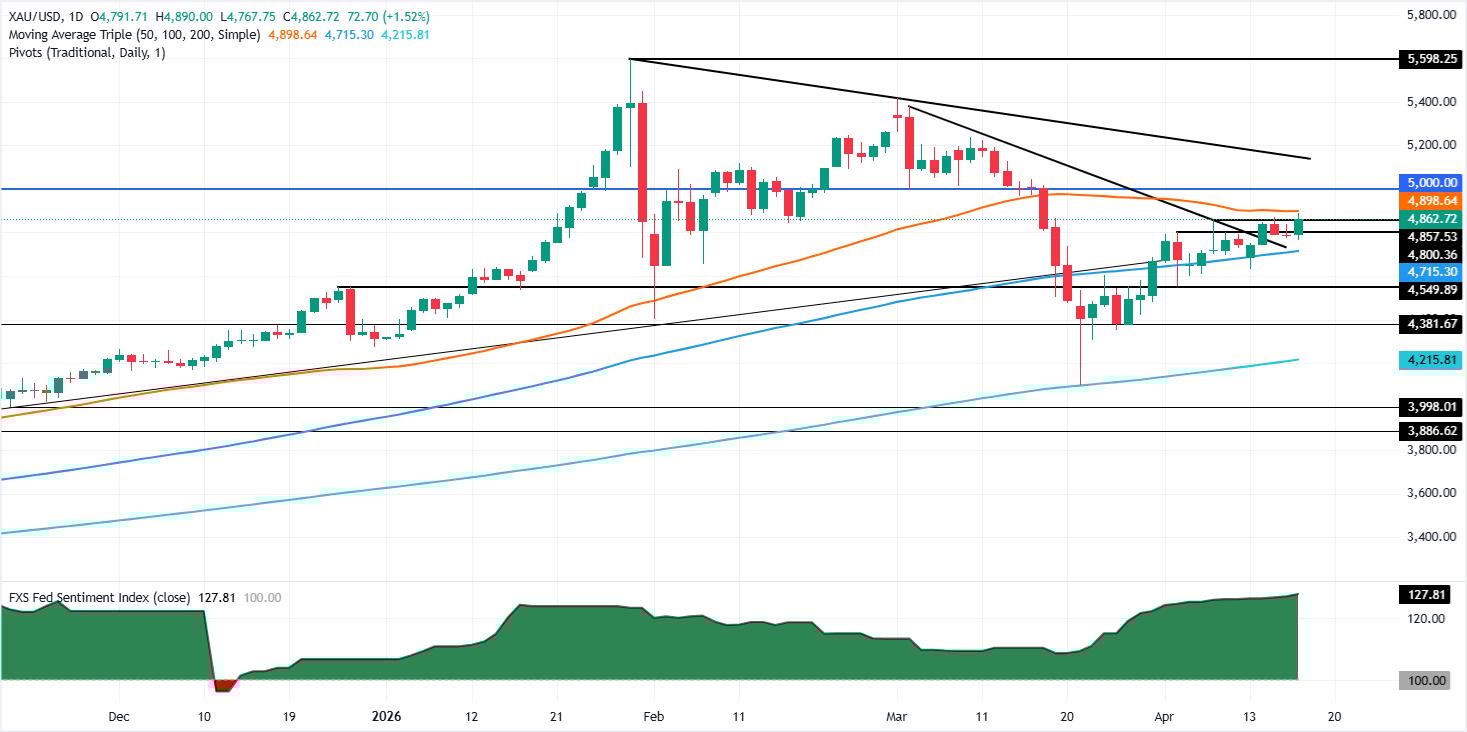
Gold faces key resistance after bouncing off daily lows at $4,767, yet it failed to decisively clear the 50-day Simple Moving Average (SMA) at $4,899. At the time of writing, XAU/USD retreated below the April 8 high of $4,857, opening the door to a pullback.
Momentum is positive, as indicated by the Relative Strength Index (RSI), and is clearing the latest peak, an indication of further upside.
For a bullish resumption, Gold must clear $4,900, followed by $4,950, ahead of the $5,000 figure. Conversely, a drop below $4,750 and a move towards the 100-day SMA at $4,699 is on the cards. Further downside is seen, with the next demand zone at the 20-day SMA at $4,549.
Gold FAQs
Gold has played a key role in human’s history as it has been widely used as a store of value and medium of exchange. Currently, apart from its shine and usage for jewelry, the precious metal is widely seen as a safe-haven asset, meaning that it is considered a good investment during turbulent times. Gold is also widely seen as a hedge against inflation and against depreciating currencies as it doesn’t rely on any specific issuer or government.
Central banks are the biggest Gold holders. In their aim to support their currencies in turbulent times, central banks tend to diversify their reserves and buy Gold to improve the perceived strength of the economy and the currency. High Gold reserves can be a source of trust for a country’s solvency. Central banks added 1,136 tonnes of Gold worth around $70 billion to their reserves in 2022, according to data from the World Gold Council. This is the highest yearly purchase since records began. Central banks from emerging economies such as China, India and Turkey are quickly increasing their Gold reserves.
Gold has an inverse correlation with the US Dollar and US Treasuries, which are both major reserve and safe-haven assets. When the Dollar depreciates, Gold tends to rise, enabling investors and central banks to diversify their assets in turbulent times. Gold is also inversely correlated with risk assets. A rally in the stock market tends to weaken Gold price, while sell-offs in riskier markets tend to favor the precious metal.
The price can move due to a wide range of factors. Geopolitical instability or fears of a deep recession can quickly make Gold price escalate due to its safe-haven status. As a yield-less asset, Gold tends to rise with lower interest rates, while higher cost of money usually weighs down on the yellow metal. Still, most moves depend on how the US Dollar (USD) behaves as the asset is priced in dollars (XAU/USD). A strong Dollar tends to keep the price of Gold controlled, whereas a weaker Dollar is likely to push Gold prices up.
Author

Christian Borjon Valencia
FXStreet
Markets analyst, news editor, and trading instructor with over 14 years of experience across FX, commodities, US equity indices, and global macro markets.
















