Gold struggles despite softer USD as higher-for-longer interest rate bets weigh
- Gold dips below $4,700 despite a softer US Dollar as macro headwinds persist.
- The metal struggles despite a softer US Dollar as interest rate expectations dominate ahead of central bank meetings.
- Technically, XAU/USD remains capped below key moving averages, keeping the near-term bias neutral to slightly bearish.

Gold (XAU/USD) trades with a mild downside bias on Monday despite a weaker US Dollar (USD), as macro headwinds stemming from the ongoing US-Iran war keep gains in check. At the time of writing, XAU/USD is trading around $4,669, down about 0.84% on the day after hitting an intraday peak of $4,730.
Market sentiment improved somewhat following a report by Axios, citing a US official and two sources familiar with the matter, which said Iran has presented a new proposal to the United States to reopen the Strait of Hormuz and end the war, while leaving nuclear negotiations for a later stage.
The development follows US President Donald Trump canceling a planned visit to Islamabad by envoys Jared Kushner and Steve Witkoff, saying that the Iranians had “offered a lot, but not enough.”
The Greenback came under pressure following the Axios report, while Washington has yet to respond. Markets remain hopeful that talks could resume as Tehran steps up diplomatic efforts to end the war.
The US Dollar Index (DXY), which tracks the Greenback’s value against a basket of six major currencies, is trading around 98.40, down about 0.13% on the day.
However, Gold is struggling to capitalize on the weaker US Dollar as interest rate expectations continue to dominate price action, with attention now turning to major central bank policy meetings later this week, including the Federal Reserve (Fed), the European Central Bank (ECB), the Bank of England (BoE), and the Bank of Japan (BoJ).
All are widely expected to keep rates unchanged as the recent surge in Oil prices has revived inflation concerns and heightened risks to economic growth. Recent economic data also point to a pickup in inflation across major economies since the onset of the war, largely driven by higher gasoline prices.
Against this backdrop, markets expect central banks to keep borrowing costs higher for longer, which is acting as a key headwind for the non-yielding metal despite its traditional role as an inflation hedge and safe-haven asset.
Traders are now awaiting clearer signals on the rate path from policymakers, particularly from the Fed, as the war poses risks to both sides of its dual mandate — inflation and employment. Any hawkish signal could further weigh on Gold, as higher interest rates increase the opportunity cost of holding the non-yielding asset.
Looking ahead, traders will closely monitor developments in the US-Iran war, particularly any progress toward reopening the Strait of Hormuz. A decision to restore shipping through the key waterway could push Oil prices lower and help ease inflation concerns. Until then, Gold’s upside may remain limited.
However, the downside is likely to stay contained as traders avoid aggressive selling amid persistent geopolitical uncertainty, while the broader uptrend remains intact despite some loss of momentum in technical indicators.
Technical analysis: XAU/USD struggles below key SMAs
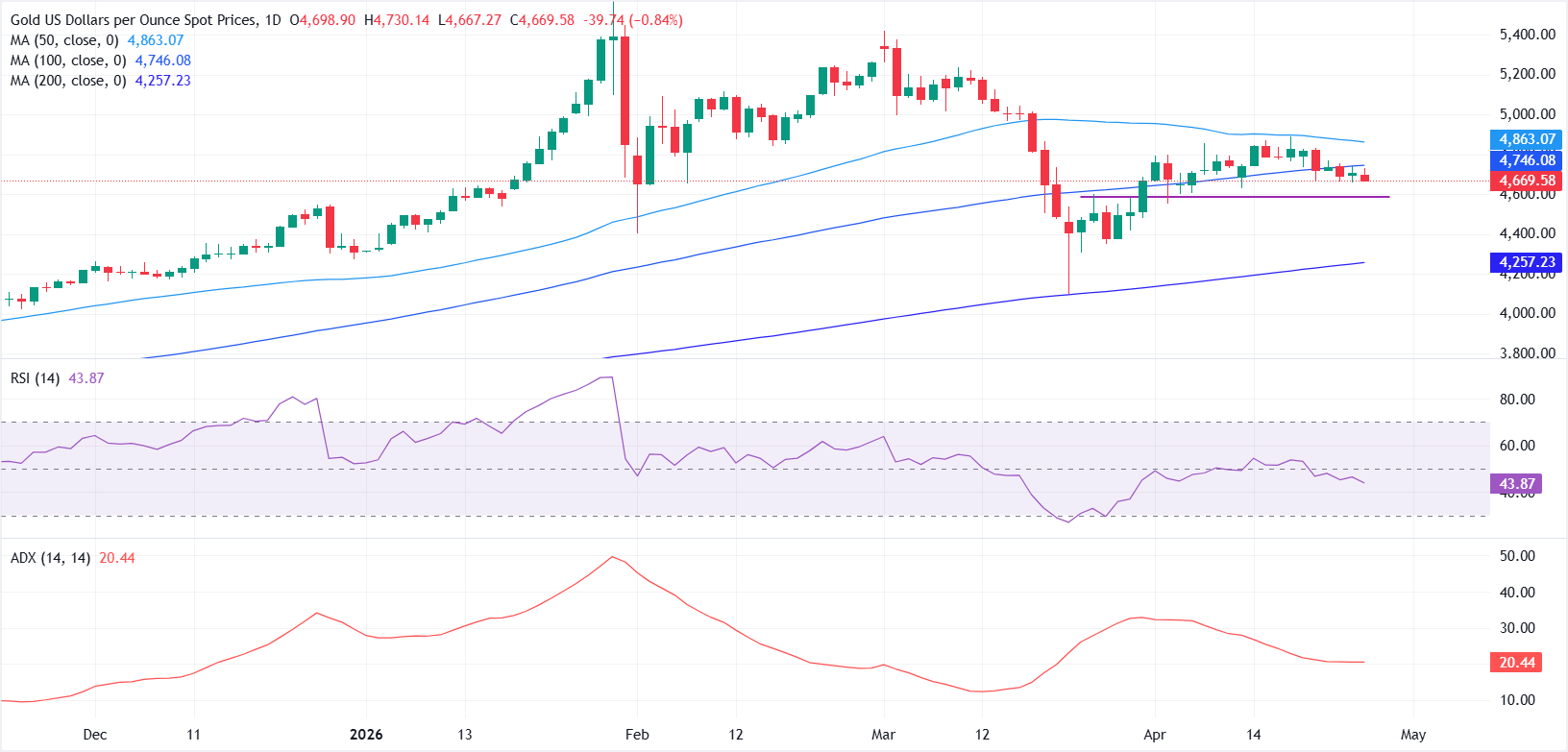
In the daily chart, XAU/USD is maintaining a capped tone as spot holds above the 200-day Simple Moving Average (SMA) at $4,257 but remains below the 100-day and the 50-day SMA.
This configuration suggests that while the broader uptrend is still underpinned by long-term support, the near-term rebound is constrained by overhead moving-average resistance, with the Relative Strength Index (RSI) around 43 and a low Average Directional Index (ADX) near 20 hinting at weak, directionless momentum.
On the top side, initial resistance is located at the 100-day SMA near $4,746, with a sustained break exposing the 50-day SMA around $4,863. On the downside, the $4,650-$4,600 area serves as the initial support zone, followed by the 200-day SMA near $4,257, where a clear violation would likely strengthen the bearish bias and open the door to a deeper correction.
(The technical analysis of this story was written with the help of an AI tool.)
Central banks FAQs
Central Banks have a key mandate which is making sure that there is price stability in a country or region. Economies are constantly facing inflation or deflation when prices for certain goods and services are fluctuating. Constant rising prices for the same goods means inflation, constant lowered prices for the same goods means deflation. It is the task of the central bank to keep the demand in line by tweaking its policy rate. For the biggest central banks like the US Federal Reserve (Fed), the European Central Bank (ECB) or the Bank of England (BoE), the mandate is to keep inflation close to 2%.
A central bank has one important tool at its disposal to get inflation higher or lower, and that is by tweaking its benchmark policy rate, commonly known as interest rate. On pre-communicated moments, the central bank will issue a statement with its policy rate and provide additional reasoning on why it is either remaining or changing (cutting or hiking) it. Local banks will adjust their savings and lending rates accordingly, which in turn will make it either harder or easier for people to earn on their savings or for companies to take out loans and make investments in their businesses. When the central bank hikes interest rates substantially, this is called monetary tightening. When it is cutting its benchmark rate, it is called monetary easing.
A central bank is often politically independent. Members of the central bank policy board are passing through a series of panels and hearings before being appointed to a policy board seat. Each member in that board often has a certain conviction on how the central bank should control inflation and the subsequent monetary policy. Members that want a very loose monetary policy, with low rates and cheap lending, to boost the economy substantially while being content to see inflation slightly above 2%, are called ‘doves’. Members that rather want to see higher rates to reward savings and want to keep a lit on inflation at all time are called ‘hawks’ and will not rest until inflation is at or just below 2%.
Normally, there is a chairman or president who leads each meeting, needs to create a consensus between the hawks or doves and has his or her final say when it would come down to a vote split to avoid a 50-50 tie on whether the current policy should be adjusted. The chairman will deliver speeches which often can be followed live, where the current monetary stance and outlook is being communicated. A central bank will try to push forward its monetary policy without triggering violent swings in rates, equities, or its currency. All members of the central bank will channel their stance toward the markets in advance of a policy meeting event. A few days before a policy meeting takes place until the new policy has been communicated, members are forbidden to talk publicly. This is called the blackout period.
Author

Vishal Chaturvedi
FXStreet
I am a macro-focused research analyst with over four years of experience covering forex and commodities market. I enjoy breaking down complex economic trends and turning them into clear, actionable insights that help traders stay ahead of the curve.