Gold clings to two-week highs as US Dollar stabilizes
- Gold consolidates after rallying to a two-week high of $3,378 on Friday, driven by Fed Chair Powell’s dovish Jackson Hole remarks.
- Powell called the outlook a “challenging situation,” with softening jobs and tariff-driven inflation, reinforcing bets on a September rate cut.
- Traders eye a busy US economic calendar, with Friday’s PCE inflation report in focus.

Gold (XAU/USD) kicks off the week on a softer footing after touching a two-week high on Friday, following Federal Reserve (Fed) Chair Jerome Powell’s dovish remarks at the Jackson Hole Symposium that fueled a broad rally in precious metals. At the time of writing, the metal is trimming earlier losses and edging higher during the American session, consolidating near recent peaks around $3,373.
Powell gave his final annual speech at the Jackson Hole Symposium last Friday, where he emphasized the Fed’s cautious approach to monetary policy in a shifting economic environment. “The stability of the unemployment rate and other labour market measures allows us to proceed carefully as we consider changes to our policy stance. Nonetheless, with policy in restrictive territory, the baseline outlook and the shifting balance of risks may warrant adjusting our policy stance,” Powell said. His remarks highlighted the Fed’s balancing act. Tariff-driven price pressures could be a one-off shock, but he signaled that weakening job growth and an already restrictive policy stance are becoming the bigger concern. This shift reinforced market bets that interest rate cuts remain on the table for the coming months, even as inflation risks linger.
Markets interpreted Powell’s tone as a clear dovish shift, prompting a sharp repricing of rate-cut expectations. According to Reuters, major brokerages including Barclays and BNP Paribas now expect a 25-basis-point (bps) cut in September, with some projecting another reduction in December. The CME FedWatch Tool now shows an 87% probability of a September rate cut, up from about 71% before Powell’s speech. In response, Treasury yields slipped, Wall Street rallied, and the US Dollar retreated from two-week highs, providing a tailwind for Gold.
Market movers: Markets eye key US economic data after Powell’s dovish tilt
- The US Dollar Index (DXY), which tracks the Greenback against a basket of six major peers, stabilizes after falling nearly 1% on Friday as rate cut expectations fueled broad Dollar selling. The index is hovering around 98.00 at the time of writing on Monday, attempting to reclaim lost ground.
- US Treasury yields also stabilize across the curve in the aftermath of Powell’s Jackson Hole speech. The benchmark 10-year yield holds near 4.27%, steady after falling nearly 10 basis points on Friday. The 30-year yield is seen around 4.94%, up 2 basis points, while the US 10-year TIPS hovers near 1.86%.
- New Home Sales in July edged down 0.6% to 652K, just above market expectations of 630K but slightly below June’s level. Importantly, the June sales change was revised sharply higher to 4.1% from the initially reported 0.6%, showing housing demand was stronger than first estimated before easing modestly last month.
- Fed Chair Powell described the near-term outlook as a “challenging situation,” with upside inflation risks offset by weakening employment signals. He stressed that policy is closer to neutral than a year ago, allowing the central bank to proceed carefully. Upcoming August jobs and inflation data will be critical inputs before the September FOMC meeting.
- Powell noted that job growth has slowed sharply to just 35,000 per month over the past three months, while Gross Domestic Product (GDP) growth cooled to 1.2% in the first half of the year. At the same time, higher tariffs are now clearly pushing up consumer prices, with core Personal Consumption Expenditures (PCE) inflation expected to accelerate to 2.9% in July from previous 2.8%.
- Geopolitical tensions stay in focus after Russia accused Ukraine of drone strikes on a nuclear power plant in Kursk, even as Washington signaled Moscow may be open to concessions in peace talks. Adding to the diplomatic dimension, German Vice Chancellor Lars Klingbeil said Berlin will join efforts to provide security guarantees for Kyiv, stressing that Ukraine must lead any negotiation process.
- A busy US economic calendar lies ahead. Monday brings US New Home Sales alongside remarks from New York Fed President John Williams. On Tuesday, attention turns to Durable Goods Orders and Consumer Confidence. Thursday features the weekly Initial Jobless Claims, plus preliminary readings of GDP and PCE. The highlight comes Friday, with the final report on PCE inflation — the Fed’s preferred inflation gauge — together with the University of Michigan survey on Consumer Sentiment and 1-year and 5-year inflation expectations.
Technical analysis: XAU/USD clings to two-week highs, bulls eye $3,400
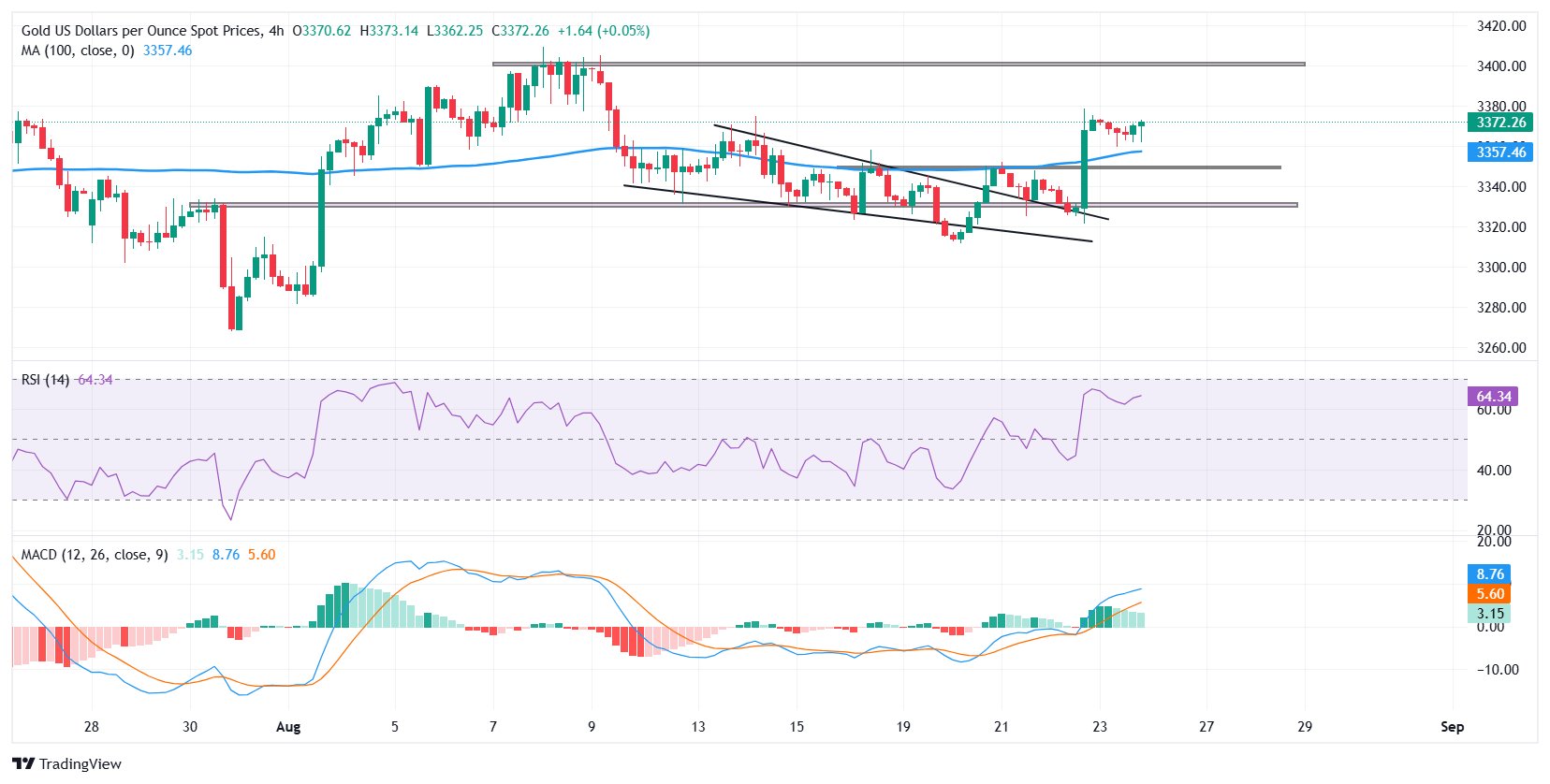
XAU/USD confirmed a breakout from the falling wedge pattern on the 4-hour chart last week, retested the broken resistance, and then surged to a two-week high of $3,378 on Friday. The move validated the bullish reversal structure and highlighted renewed buying interest after a period of consolidation. At the time of writing, the metal is trading near $3,370, holding above the 100-period moving average at $3,357, which is acting as immediate support.
Momentum indicators remain supportive of the bullish bias. The Relative Strength Index (RSI) is holding around 61, showing that upward momentum is intact without entering overbought conditions. The Moving Average Convergence Divergence (MACD) histogram is positive, and the widening gap between the MACD blue line and red signal line suggests that bullish momentum still has room to extend.
Overall, gold’s breakout-retest sequence keeps the technical outlook tilted to the upside, with the bias remaining bullish above $3,350. Sustained gains over $3,380 would reinforce momentum toward $3,400 and beyond, while a drop below $3,350 would risk pulling the metal back into a broader consolidation phase.
Gold FAQs
Gold has played a key role in human’s history as it has been widely used as a store of value and medium of exchange. Currently, apart from its shine and usage for jewelry, the precious metal is widely seen as a safe-haven asset, meaning that it is considered a good investment during turbulent times. Gold is also widely seen as a hedge against inflation and against depreciating currencies as it doesn’t rely on any specific issuer or government.
Central banks are the biggest Gold holders. In their aim to support their currencies in turbulent times, central banks tend to diversify their reserves and buy Gold to improve the perceived strength of the economy and the currency. High Gold reserves can be a source of trust for a country’s solvency. Central banks added 1,136 tonnes of Gold worth around $70 billion to their reserves in 2022, according to data from the World Gold Council. This is the highest yearly purchase since records began. Central banks from emerging economies such as China, India and Turkey are quickly increasing their Gold reserves.
Gold has an inverse correlation with the US Dollar and US Treasuries, which are both major reserve and safe-haven assets. When the Dollar depreciates, Gold tends to rise, enabling investors and central banks to diversify their assets in turbulent times. Gold is also inversely correlated with risk assets. A rally in the stock market tends to weaken Gold price, while sell-offs in riskier markets tend to favor the precious metal.
The price can move due to a wide range of factors. Geopolitical instability or fears of a deep recession can quickly make Gold price escalate due to its safe-haven status. As a yield-less asset, Gold tends to rise with lower interest rates, while higher cost of money usually weighs down on the yellow metal. Still, most moves depend on how the US Dollar (USD) behaves as the asset is priced in dollars (XAU/USD). A strong Dollar tends to keep the price of Gold controlled, whereas a weaker Dollar is likely to push Gold prices up.
Author

Vishal Chaturvedi
FXStreet
I am a macro-focused research analyst with over four years of experience covering forex and commodities market. I enjoy breaking down complex economic trends and turning them into clear, actionable insights that help traders stay ahead of the curve.