Gold steadies as USD slips, Fed hike bets cap upside
- Gold rebounds from sub-$4,500 lows as US Dollar eases.
- Fed hike bets keep traders cautious following hot inflation data last week.
- Lower Oil prices weaken the Greenback amid Iran sanctions headlines.

Gold (XAU/USD) price steadies on Monday after reaching a daily low beneath $4,500, as the US Dollar is on the back foot amid fears that the energy shock spurred by the Middle East conflict could trigger a second wave of inflation. Consequently, global bond yields—which are falling in the day—remain near their highest levels of the year.
XAU/USD stabilizes as softer Dollar offsets elevated Treasury yields
The XAU/USD pair trades at $4,541 flat, while the US Dollar Index (DXY), which measures the buck’s performance against a basket of six currencies, drops 0.20% to 99.06.
Sentiment remains mixed, with US equities swinging between positive/negative in the day. The US 10-year Treasury note yield rose to its highest level in nearly two years, at 4.631%, before turning flat at 4.595%, a tailwind for Gold prices.
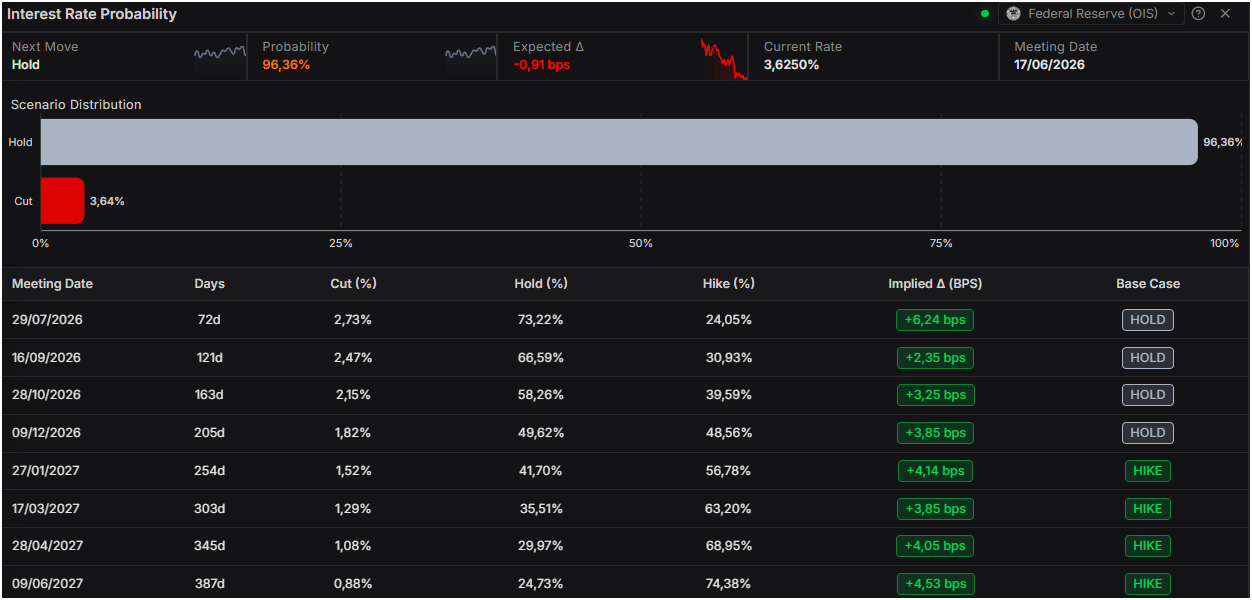
Money markets had begun to price in a 50% chance that the Federal Reserve (Fed) will raise rates in December 2026, rather than ease policy, according to Prime Terminal data.
Over the weekend, US President Donald Trump said the clock is ticking for Iran, while Bloomberg reported that Washington agreed to lift sanctions on Iranian Oil during the negotiation period, pushing West Texas Intermediate (WTI) prices lower. Consequently, the Greenback turned negative on the day due to its positive correlation with Oil prices.
The US economic docket is absent on Monday, yet traders continue to digest hot inflation data revealed last week. This week, the schedule will feature the ADP Employment Change 4-week average, housing data, the last FOMC meeting minutes, Initial Jobless Claims, Flash PMIs, speeches by Federal Reserve officials and Kevin Warsh sworn in as the Fed Chair at the White House, according to Fox Business reports.
XAU/USD technical outlook: Gold consolidates near $4,550, poised for further downside
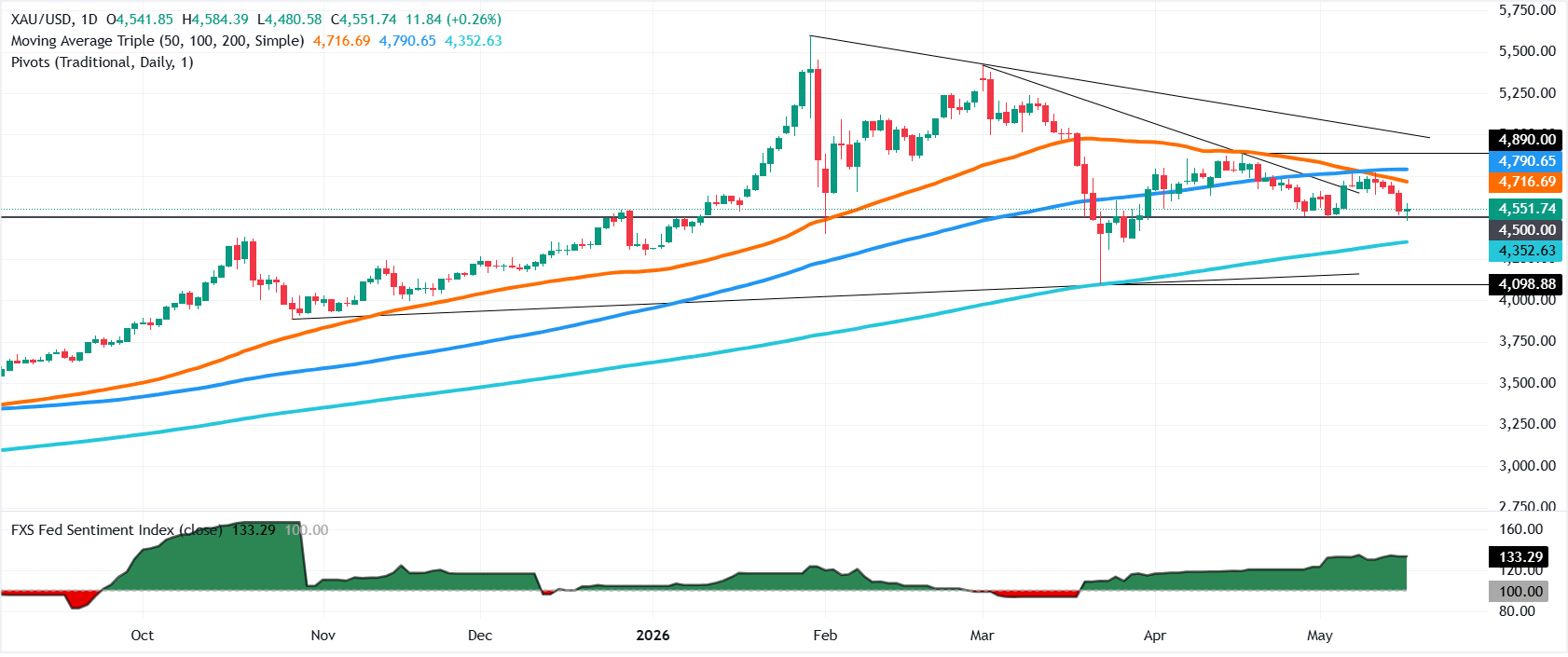
Gold continues to consolidate around $4,550 after diving to a seven-week low of $4,480. Momentum remains bearish as depicted in the Relative Strength Index (RSI), which stalled, opening the door for XAU to reclaim the $4,500 mark.
On the upside, the next area of interest would be the $4,600 mark. A breach of the latter will expose a resistance trendline, drawn from around mid-March’s high, at around $4,615-$4,625, followed by the 20-day Simple Moving Average (SMA) at $4,647. Once surpassed, the next stop would be $4,700 and the 50-day SMA at $,4716.
Downwards, XAU/USD first support is the $4,600? mark. Below this area, the next support would be the psychological $4,550 area ahead of the May 4 daily low of $4,500, followed by the day’s low of $4,481.
Gold FAQs
Gold has played a key role in human’s history as it has been widely used as a store of value and medium of exchange. Currently, apart from its shine and usage for jewelry, the precious metal is widely seen as a safe-haven asset, meaning that it is considered a good investment during turbulent times. Gold is also widely seen as a hedge against inflation and against depreciating currencies as it doesn’t rely on any specific issuer or government.
Central banks are the biggest Gold holders. In their aim to support their currencies in turbulent times, central banks tend to diversify their reserves and buy Gold to improve the perceived strength of the economy and the currency. High Gold reserves can be a source of trust for a country’s solvency. Central banks added 1,136 tonnes of Gold worth around $70 billion to their reserves in 2022, according to data from the World Gold Council. This is the highest yearly purchase since records began. Central banks from emerging economies such as China, India and Turkey are quickly increasing their Gold reserves.
Gold has an inverse correlation with the US Dollar and US Treasuries, which are both major reserve and safe-haven assets. When the Dollar depreciates, Gold tends to rise, enabling investors and central banks to diversify their assets in turbulent times. Gold is also inversely correlated with risk assets. A rally in the stock market tends to weaken Gold price, while sell-offs in riskier markets tend to favor the precious metal.
The price can move due to a wide range of factors. Geopolitical instability or fears of a deep recession can quickly make Gold price escalate due to its safe-haven status. As a yield-less asset, Gold tends to rise with lower interest rates, while higher cost of money usually weighs down on the yellow metal. Still, most moves depend on how the US Dollar (USD) behaves as the asset is priced in dollars (XAU/USD). A strong Dollar tends to keep the price of Gold controlled, whereas a weaker Dollar is likely to push Gold prices up.
Author

Christian Borjon Valencia
FXStreet
Markets analyst, news editor, and trading instructor with over 14 years of experience across FX, commodities, US equity indices, and global macro markets.
















