Gold slips toward $4,800 as Iran tensions lift yields and Oil
- Gold weakens as higher Oil prices and yields pressure bullion.
- Escalation around Hormuz keep traders focused on geopolitical headline risk.
- Markets now await Retail Sales, ADP data and Warsh’s hearing.

Gold (XAU/USD) price begins the week on a lower note as risk appetite deteriorated amid the US-Iran conflict escalating over the weekend, while steady US Treasury yields and a rally in Oil prices capped the yellow metal’s advance. At the time of writing, XAU/USD trades at $4,803, down 0.70%.
Bullion opens lower as war risks cap gains despite Fed bets
Over the weekend, Iran shut down the Strait of Hormuz, demanding the end of the US blockade, which impeded the sailing of Iran-flagged vessels. Meanwhile, the US seized an Iranian ship previously warned by the US Navy to go back to its departing port.
In the meantime, the US Vice President JD Vance will lead the US negotiating team, complemented by Steve Wytkoff and Jared Kushner. Regarding Iran, the New York Times reported that a delegation is planning to travel to Islamabad. However, Fars agency cited a source who denied that, and revealed that the negotiating team has no plans to travel to Pakistan.
US President Donald Trump said that it’s unlikely that he will extend the ceasefire, reiterating that it will expire on Wednesday evening, Washington time. Trump added that the blockade would remain until Iran signed a deal.
US Treasury yields are aiming higher, with the 10-year yield edging up nearly two basis points to 4.266%, a headwind for bullion prices, which touched five-day lows near $4,735 early this session.
Aside from this, the Federal Reserve (Fed) Chair nominee, Kevin Warsh, will tell lawmakers at his confirmation hearing Tuesday that he is “committed to ensuring that the conduct of monetary policy remains strictly independent,” according to his prepared opening statement obtained by Reuters.
Meanwhile, Fed officials entered their blackout period, as they prepare for the Fed’s monetary policy meeting on April 28-29. The markets expect the central bank to hold rates unchanged, yet they had priced in 14 basis points of easing towards the end of the year.
A scarce economic docket keeps traders waiting for the release of Retail Sales on Tuesday, along with Kevin Warsh’s hearing at the Senate. Further data is expected, with the release of the ADP Employment Change 4-week average.
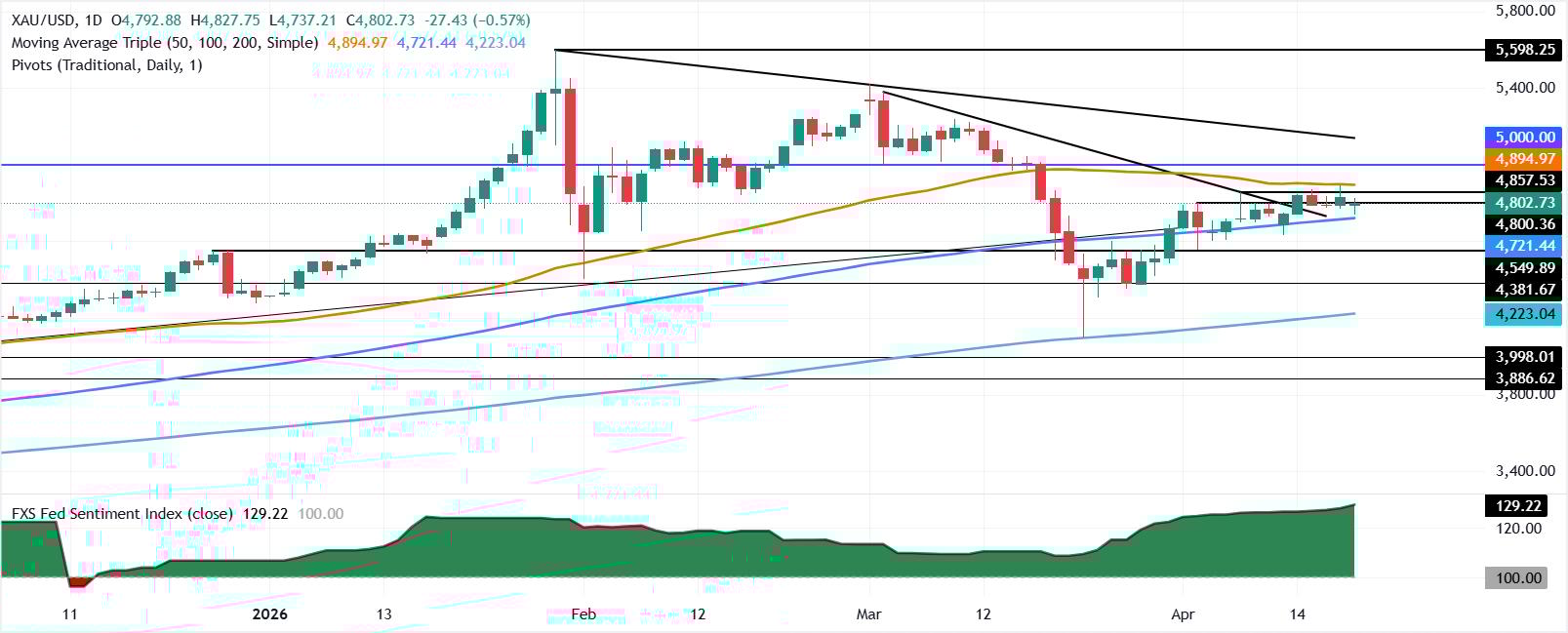
XAU/USD technical outlook: Gold consolidates around $4,800, tilted to the downside
Gold is poised to remain trading sideways as depicted by price action. Momentum, as shown by the Relative Strength Index (RSI), is flat in bullish territory, indicating a slight bias toward buyers, though it’s not as strong as expected.
Worth noting that Gold printed a higher high at $4,890 last Friday, while the RSI edged lower, a mild negative divergence, which could pave the way for a deeper retracement.
If XAU/USD ends Monday session below $4,800, expect a test of the 100-day Simple Moving Average (SMA) at $4,706. Further downside is seen at the 20-day SMA at $4,665.
Above, the first key resistance is $4,850, followed by the 50-day SMA at $4,890, which is shy of $4,900.
Gold FAQs
Gold has played a key role in human’s history as it has been widely used as a store of value and medium of exchange. Currently, apart from its shine and usage for jewelry, the precious metal is widely seen as a safe-haven asset, meaning that it is considered a good investment during turbulent times. Gold is also widely seen as a hedge against inflation and against depreciating currencies as it doesn’t rely on any specific issuer or government.
Central banks are the biggest Gold holders. In their aim to support their currencies in turbulent times, central banks tend to diversify their reserves and buy Gold to improve the perceived strength of the economy and the currency. High Gold reserves can be a source of trust for a country’s solvency. Central banks added 1,136 tonnes of Gold worth around $70 billion to their reserves in 2022, according to data from the World Gold Council. This is the highest yearly purchase since records began. Central banks from emerging economies such as China, India and Turkey are quickly increasing their Gold reserves.
Gold has an inverse correlation with the US Dollar and US Treasuries, which are both major reserve and safe-haven assets. When the Dollar depreciates, Gold tends to rise, enabling investors and central banks to diversify their assets in turbulent times. Gold is also inversely correlated with risk assets. A rally in the stock market tends to weaken Gold price, while sell-offs in riskier markets tend to favor the precious metal.
The price can move due to a wide range of factors. Geopolitical instability or fears of a deep recession can quickly make Gold price escalate due to its safe-haven status. As a yield-less asset, Gold tends to rise with lower interest rates, while higher cost of money usually weighs down on the yellow metal. Still, most moves depend on how the US Dollar (USD) behaves as the asset is priced in dollars (XAU/USD). A strong Dollar tends to keep the price of Gold controlled, whereas a weaker Dollar is likely to push Gold prices up.
Author

Christian Borjon Valencia
FXStreet
Markets analyst, news editor, and trading instructor with over 14 years of experience across FX, commodities, US equity indices, and global macro markets.