Gold steadies after soft US jobs data but heads for weekly loss
- Gold on the back foot, heads for weekly loss despite elevated Middle East geopolitical risks.
- Rising Oil price fuels inflation fears, prompting markets to scale back Fed interest rate cut bets.
- XAU/USD slips below the 50-SMA on the 4-hour chart, signalling weakening momentum.

Gold (XAU/USD) gains traction on Friday after trading under pressure for most of the day, with the US Dollar (USD) and Treasury yields easing as traders digest soft US Nonfarm Payrolls (NFP) data.
At the time of writing, XAU/USD is trading around $5,140 after bouncing off daily lows near $5,062.
US Nonfarm Payrolls fell by 92K in February, missing expectations for a 59K increase. Meanwhile, January’s reading was revised lower to 126K from 130K. The Unemployment Rate ticked up to 4.4% from 4.3% in the previous month.
US Retail Sales declined 0.2% in January, beating expectations for a 0.3% drop, following a 0% reading in December. Meanwhile, the Retail Sales Control Group, which feeds directly into GDP calculations, rose 0.3% during the month. Retail Sales excluding Autos remained unchanged at 0%, matching market expectations.
Gold under pressure as markets scale back Fed rate cut bets amid rising Oil prices
The yellow metal remains on track for its first weekly loss in five weeks, even as the conflict between the United States (US) and Iran shows no signs of de-escalation, keeping geopolitical risks elevated.
The war has entered its seventh day, with the US-Israeli forces intensifying airstrikes on Tehran. At the same time, Iran continues to launch retaliatory missile and drone attacks against US military bases across the Gulf.
However, Gold has struggled to attract safe-haven flows as investors increasingly focus on the potential economic fallout, with rising Oil price fueling global inflation concerns. Qatar’s Energy Minister Saad al-Kaabi has warned that a halt in Gulf energy exports could push crude prices as high as $150 per barrel.
This has prompted traders to scale back expectations for Federal Reserve (Fed) interest rate cuts, lending broader support to the US Dollar and Treasury yields while increasing the opportunity cost of holding the non-yielding metal, even as both eased slightly following the softer US jobs data.
Markets are now pricing in roughly a 35% chance of a 25 bps rate cut in June, down from more than 40% a week ago, according to the CME FedWatch Tool. Deutsche Bank noted that total easing priced in for 2026 has slipped to around 40 bps by December, the lowest level so far this year.
Technical analysis: XAU/USD stabilizes above $5,100
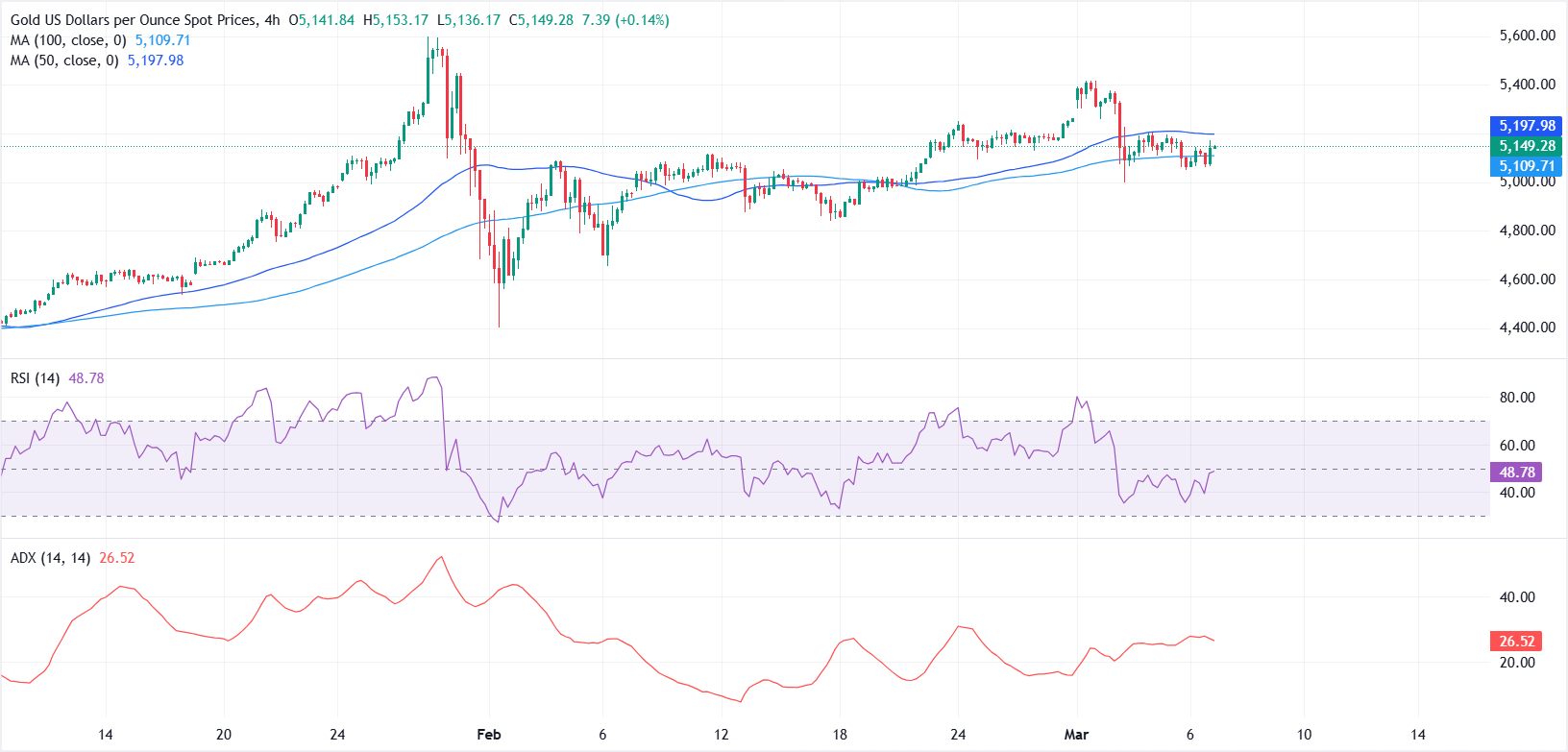
On the 4-hour chart, the near-term bias remains mildly bearish as the price slips below the 50-period Simple Moving Average (SMA) and holds marginally above the flatter 100-period SMA, indicating weakening bullish momentum after sellers emerged near the $5,400 level earlier this week.
The Relative Strength Index (RSI) has eased from overbought extremes toward the mid-40s, suggesting momentum has normalised rather than reversed. The Average Directional Index (ADX) near the mid-20s signals a moderate but fading trend, keeping the upside favoured but leaving the market vulnerable to corrective swings.
On the upside, immediate resistance emerges near the 50-period SMA around $5,200, with a sustained break above this barrier needed to revive bullish momentum.
On the downside, the $5,000-$5100 area serves as immediate support. A decisive break below this level could strengthen selling pressure, exposing the next downside targets near $4,850, followed by $4,650 and $4,400.
Gold FAQs
Gold has played a key role in human’s history as it has been widely used as a store of value and medium of exchange. Currently, apart from its shine and usage for jewelry, the precious metal is widely seen as a safe-haven asset, meaning that it is considered a good investment during turbulent times. Gold is also widely seen as a hedge against inflation and against depreciating currencies as it doesn’t rely on any specific issuer or government.
Central banks are the biggest Gold holders. In their aim to support their currencies in turbulent times, central banks tend to diversify their reserves and buy Gold to improve the perceived strength of the economy and the currency. High Gold reserves can be a source of trust for a country’s solvency. Central banks added 1,136 tonnes of Gold worth around $70 billion to their reserves in 2022, according to data from the World Gold Council. This is the highest yearly purchase since records began. Central banks from emerging economies such as China, India and Turkey are quickly increasing their Gold reserves.
Gold has an inverse correlation with the US Dollar and US Treasuries, which are both major reserve and safe-haven assets. When the Dollar depreciates, Gold tends to rise, enabling investors and central banks to diversify their assets in turbulent times. Gold is also inversely correlated with risk assets. A rally in the stock market tends to weaken Gold price, while sell-offs in riskier markets tend to favor the precious metal.
The price can move due to a wide range of factors. Geopolitical instability or fears of a deep recession can quickly make Gold price escalate due to its safe-haven status. As a yield-less asset, Gold tends to rise with lower interest rates, while higher cost of money usually weighs down on the yellow metal. Still, most moves depend on how the US Dollar (USD) behaves as the asset is priced in dollars (XAU/USD). A strong Dollar tends to keep the price of Gold controlled, whereas a weaker Dollar is likely to push Gold prices up.
Author

Vishal Chaturvedi
FXStreet
I am a macro-focused research analyst with over four years of experience covering forex and commodities market. I enjoy breaking down complex economic trends and turning them into clear, actionable insights that help traders stay ahead of the curve.














