Gold rallies rallies toward $3,650 on safe-haven demand and Fed easing bets
- Gold hits fresh record highs above $3,600 as safe-haven demand and Fed rate cut bets drive momentum.
- Markets fully price in a September Fed rate cut after weaker-than-expected NFP, with a 25 bps move seen as certain.
- Traders eye US PPI and CPI releases this week to gauge whether the Fed delivers a 25 bps rate cut or considers a larger one.

Gold (XAU/USD) begins the week on an impressive bullish note, soaring to fresh all-time highs above $3,600 per ounce on Monday. The move extends last week’s rally amid growing conviction that the Federal Reserve (Fed) will cut interest rates at its September monetary policy meeting, a shift markets now treat as a near certainty following a string of weak US labor market data. The yellow metal has already climbed about 38% so far this year, underscoring its strong appeal as investors flock to safe-haven assets.
At the time of writing, XAU/USD is trading around $3,635, pushing into uncharted territory as a broadly weaker US Dollar (USD) and expectations of imminent Fed monetary easing keep demand elevated. Last week’s economic releases confirmed that the US labor market is losing momentum. As the employment Nonfarm Payrolls (NFP) report showed on Friday, the US economy added just 22K jobs in August, far below the 75K forecast, while the Unemployment Rate climbed to 4.3%, its highest since late 2021. Fed Chair Jerome Powell, in his Jackson Hole remarks late in August, warned that “downside risks to employment are increasing,” describing the labor market as in a “curious kind of balance” where both supply and demand for workers are softening.
Moreover, broader sentiment continues to lend strong support to Gold. Global central banks continue to add to their reserves to diversify away from the US Dollar and Treasuries amid concerns over inflation, weakened confidence in policymakers, and threats to the Fed's independence. At the same time, geopolitical tensions and ongoing global trade frictions are adding to safe-haven demand, reinforcing Gold’s role as a store of value as it holds near record levels.
Market movers: Global risks mount as Fed rate cut bets cement
- The US Dollar Index (DXY), which tracks the Greenback against a basket of six major currencies, is stabilizing after Friday’s sell-off but remains under pressure. At the time of writing, the index is hovering around 97.50, near the lower end of the narrow range established since August.
- US Treasury yields tick lower for the fourth consecutive day on Monday, with the benchmark 10-year holding near 4.051%, its lowest level since April, and the 30-year trading around 4.714% its lowest since May. The rate-sensitive 2-year is also under pressure, hovering near 3.48%, reflecting firm expectations of Fed easing.
- Before the US jobs data, traders had fully priced in a 25 basis point (bps) rate cut at the Fed’s September 16-17 meeting. Following the weaker-than-expected NFP release, markets are now assigning about a 10% chance of a larger 50 bps interest rate cut, up from nearly zero a week ago, while the probability of a 25 bps cut remains near 90%, according to the CME FedWatch Tool. Futures pricing also suggests investors expect as many as three cuts in total by year-end.
- Political uncertainty in Japan has rattled markets after Prime Minister Shigeru Ishiba announced his resignation, triggering a leadership contest within the ruling party. The Japanese Yen (JPY) has come under renewed pressure, while Japanese government Bond yields have inched higher as investors await clarity on the fiscal and monetary stance of his successor.
- The French government is on the brink of collapse as Prime Minister François Bayrou faces a confidence vote later today around 17:00 GMT. Bayrou is seeking parliamentary backing for his fiscal plan that targets €44 billion in spending cuts for 2026, including freezes on pensions, benefits, and tax brackets, alongside strict caps on expenditure. If Bayrou loses the upcoming vote of confidence, President Emmanuel Macron can either appoint a new prime minister who has the support of a fragmented parliament or call snap parliamentary elections.
- Trade policy risk stayed in focus after US Treasury Secretary Scott Bessent said he is “confident” President Donald Trump’s tariff strategy will ultimately be upheld by the Supreme Court, but acknowledged the risks if the administration loses. In an interview with NBC on Sunday, Bessent warned that striking down the duties would force the Treasury to refund roughly half of the tariffs collected. He cautioned that if the case drags on until mid-2026, as much as $750 billion to $1 trillion in tariffs might have to be unwound, causing major disruption.
- A light US economic calendar this week puts the spotlight on inflation data, with the Producer Price Index (PPI) due Wednesday and the more critical Consumer Price Index (CPI) report on Thursday. With a September Fed rate cut seen as a done deal, these releases are the key risk events likely to influence whether policymakers opt for a standard 25 bps move or consider a larger cut.
Technical analysis: XAU/USD uptrend intact despite stretched RSI
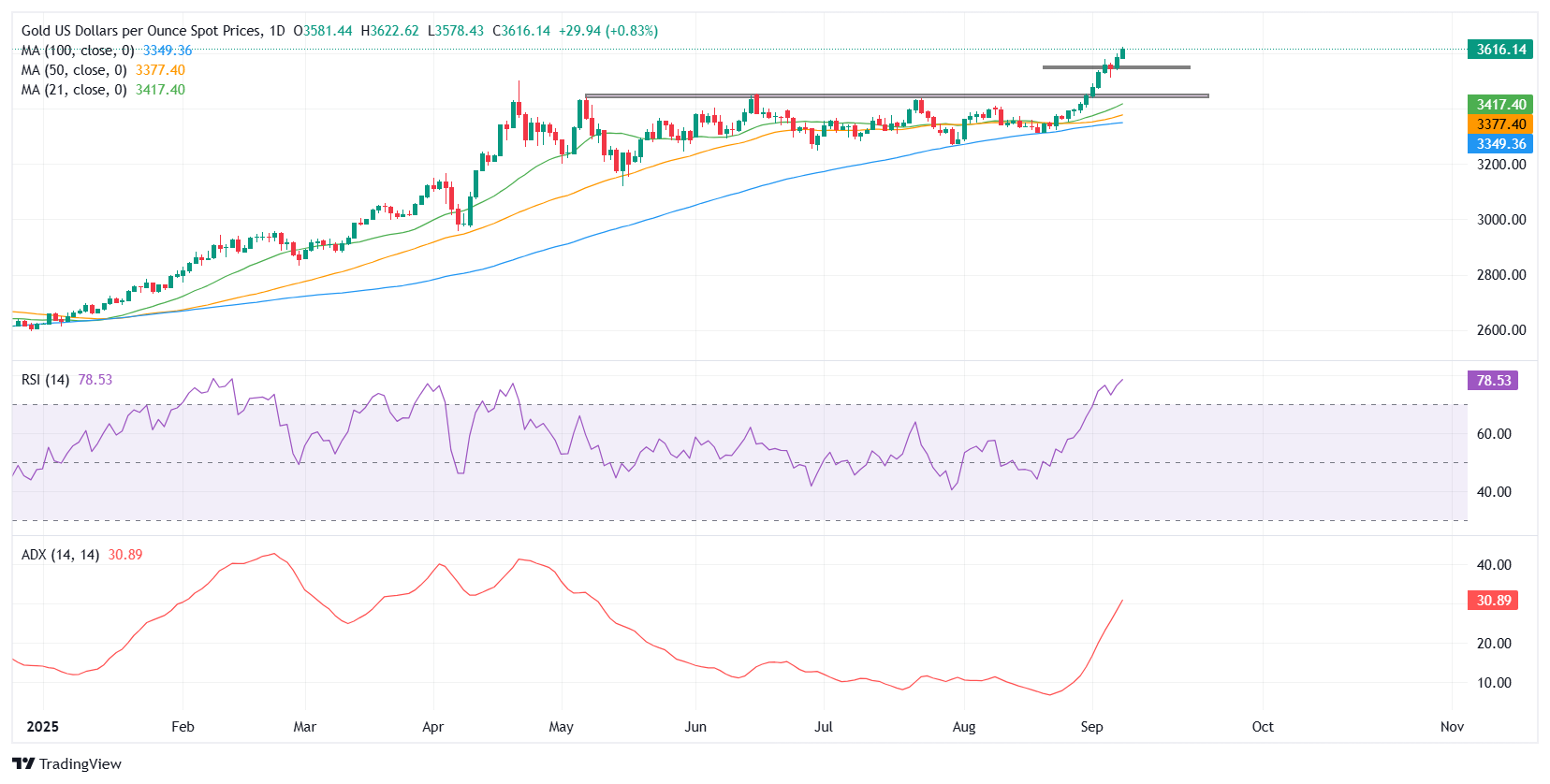
XAU/USD extends its bullish run on Monday, climbing to fresh all-time highs near $3,640 after breaking out of the $3,500 consolidation zone last week. The breakout beyond the $3,500 region has taken the metal into uncharted territory, keeping the broader bias firmly bullish as buyers remain in control.
The technical backdrop continues to favor the upside. Gold is trading well above its short-term and medium-term moving averages, reflecting strong underlying momentum. At the same time, the Relative Strength Index (RSI) remains deep in overbought territory, signaling that while the uptrend is intact, the risk of a corrective pullback cannot be ruled out. The Average Directional Index (ADX) above 30 further confirms the strength of the prevailing rally.
On the downside, the $3,550 level stands as immediate support should profit-taking emerge, followed by $3,500 as the next line of defense. On the upside, round numbers such as $3,650 and $3,700 remain the next target.
Gold FAQs
Gold has played a key role in human’s history as it has been widely used as a store of value and medium of exchange. Currently, apart from its shine and usage for jewelry, the precious metal is widely seen as a safe-haven asset, meaning that it is considered a good investment during turbulent times. Gold is also widely seen as a hedge against inflation and against depreciating currencies as it doesn’t rely on any specific issuer or government.
Central banks are the biggest Gold holders. In their aim to support their currencies in turbulent times, central banks tend to diversify their reserves and buy Gold to improve the perceived strength of the economy and the currency. High Gold reserves can be a source of trust for a country’s solvency. Central banks added 1,136 tonnes of Gold worth around $70 billion to their reserves in 2022, according to data from the World Gold Council. This is the highest yearly purchase since records began. Central banks from emerging economies such as China, India and Turkey are quickly increasing their Gold reserves.
Gold has an inverse correlation with the US Dollar and US Treasuries, which are both major reserve and safe-haven assets. When the Dollar depreciates, Gold tends to rise, enabling investors and central banks to diversify their assets in turbulent times. Gold is also inversely correlated with risk assets. A rally in the stock market tends to weaken Gold price, while sell-offs in riskier markets tend to favor the precious metal.
The price can move due to a wide range of factors. Geopolitical instability or fears of a deep recession can quickly make Gold price escalate due to its safe-haven status. As a yield-less asset, Gold tends to rise with lower interest rates, while higher cost of money usually weighs down on the yellow metal. Still, most moves depend on how the US Dollar (USD) behaves as the asset is priced in dollars (XAU/USD). A strong Dollar tends to keep the price of Gold controlled, whereas a weaker Dollar is likely to push Gold prices up.
Author

Vishal Chaturvedi
FXStreet
I am a macro-focused research analyst with over four years of experience covering forex and commodities market. I enjoy breaking down complex economic trends and turning them into clear, actionable insights that help traders stay ahead of the curve.

















