Gold price sticks to modest gains near multi-week high amid sustained safe-haven buying
- Gold price climbs to a fresh multi-week top on Monday as rising trade tensions underpin safe-haven demand.
- Reduced Fed rate cut bets continue to support the USD and act as a headwind for the non-yielding commodity.
- Traders might refrain from placing aggressive directional bets and opt to wait for US inflation figures.

Gold price (XAU/USD) sticks to positive bias for the fourth straight day and trades near a three-week high, above the $3,370 level during the first half of the European session on Monday. US President Donald Trump's new tariffs of 30% on products coming from the European Union (EU) and Mexico starting August 1 rattled global markets and turned out to be a key factor underpinning the safe-haven commodity. The intraday uptick, however, lacks follow-through, warranting some caution for bullish traders.
Traders have been scaling back their expectations for an immediate interest rate cut by the Federal Reserve (Fed) amid a still resilient US labor market. This, in turn, lifts the US Dollar (USD) to its highest level since June 25 at the start of a new week and could act as a headwind for the non-yielding Gold price. Traders might also opt to wait for the release of the latest US inflation figures for cues about the Fed's rate-cut path, which will influence the USD and provide a fresh impetus to the precious metal.
Daily Digest Market Movers: Gold price bulls retain control amid rising trade tensions
- The already weaker global risk sentiment takes another hit in reaction to US President Donald Trump's fresh tariff threats on two of the biggest trade partners – Mexico and the European Union. Trump informed European Commission President Ursula von der Leyen and Mexico’s President Claudia Sheinbaum in separate letters on Saturday, adding to a string of over 20 similar tariff notices issued since last Monday.
- The latest development tempers investors' appetite for riskier assets, which is evident from a generally weaker tone around the equity markets and might continue to act as a tailwind for the safe-haven Gold price. However, confusing signals over the Federal Reserve's near-term rate-cut path hold back the XAU/USD bulls from placing aggressive bets or building on the recent move up to a multi-week top.
- Minutes from the June 17-18 FOMC meeting showed that most policymakers remain worried about the risk of rising inflation on the back of Trump's aggressive trade policies and a still resilient US labor market. Moreover, only a couple of officials felt interest rates could be reduced as soon as this month. This assists the US Dollar to hold steady near a multi-week high and caps the non-yielding yellow metal.
- Investors now look to the release of the latest US consumer inflation figures for June on Tuesday, which will be followed by the US Producer Price Index (PPI) on Wednesday. The crucial data, along with speeches from influential FOMC members, would offer more cues about the Fed's policy outlook, amid bets for over 50 basis points worth of easing by December. This, in turn, will drive the USD demand.
- In the meantime, persistent uncertainty surrounding the implementation of Trump's erratic trade policies and their impact on the global economy should continue to benefit the traditional safe-haven precious metal.
Gold price seems poised to reclaim $3,400; 100-day SMA breakout remains in play
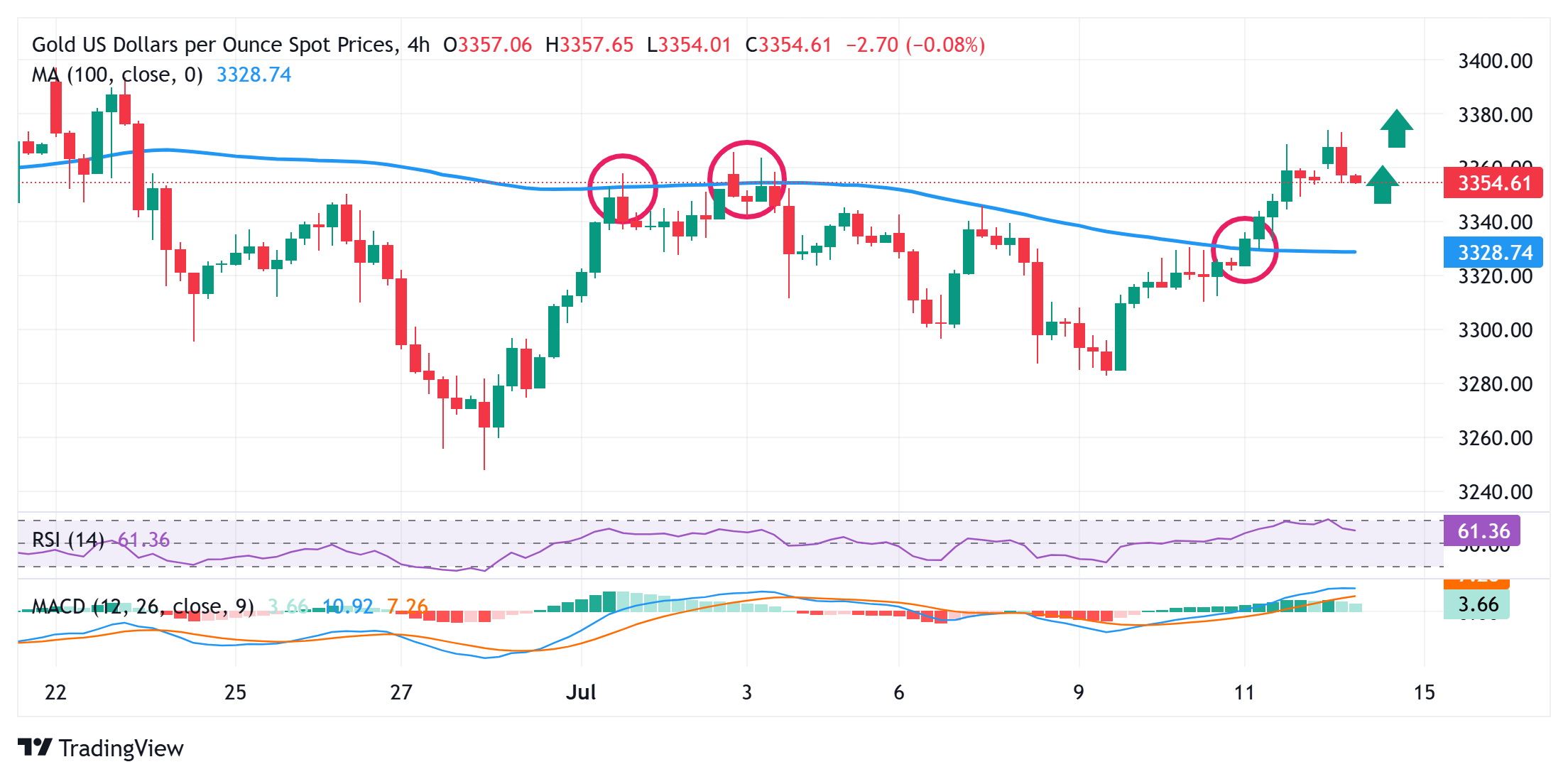
From a technical perspective, last week's sustained breakout through the 100-period Simple Moving Average (SMA) on the 4-hour chart and a subsequent move beyond the $3,358-3,360 supply zone was seen as a key trigger for the XAU/USD bulls. This, along with positive oscillators on hourly/daily charts, suggests that the path of least resistance for the Gold price is to the upside. Hence, some follow-through strength, towards reclaiming the $3,400 round-figure mark, looks like a distinct possibility.
On the flip side, the $3,240 horizontal zone now seems to protect the immediate downside and any further slide could be seen as a buying opportunity near the $3,326 region. This should help limit the downside for the Gold price near the $3,300 round figure. This is followed by the $3,283-3,282 region, or over a one-week low touched last Tuesday, which, if broken decisively, would make the XAU/USD pair vulnerable to a further acceleration of the fall towards the July swing low, around the $3,248-3,247 area.
Fed FAQs
Monetary policy in the US is shaped by the Federal Reserve (Fed). The Fed has two mandates: to achieve price stability and foster full employment. Its primary tool to achieve these goals is by adjusting interest rates. When prices are rising too quickly and inflation is above the Fed’s 2% target, it raises interest rates, increasing borrowing costs throughout the economy. This results in a stronger US Dollar (USD) as it makes the US a more attractive place for international investors to park their money. When inflation falls below 2% or the Unemployment Rate is too high, the Fed may lower interest rates to encourage borrowing, which weighs on the Greenback.
The Federal Reserve (Fed) holds eight policy meetings a year, where the Federal Open Market Committee (FOMC) assesses economic conditions and makes monetary policy decisions. The FOMC is attended by twelve Fed officials – the seven members of the Board of Governors, the president of the Federal Reserve Bank of New York, and four of the remaining eleven regional Reserve Bank presidents, who serve one-year terms on a rotating basis.
In extreme situations, the Federal Reserve may resort to a policy named Quantitative Easing (QE). QE is the process by which the Fed substantially increases the flow of credit in a stuck financial system. It is a non-standard policy measure used during crises or when inflation is extremely low. It was the Fed’s weapon of choice during the Great Financial Crisis in 2008. It involves the Fed printing more Dollars and using them to buy high grade bonds from financial institutions. QE usually weakens the US Dollar.
Quantitative tightening (QT) is the reverse process of QE, whereby the Federal Reserve stops buying bonds from financial institutions and does not reinvest the principal from the bonds it holds maturing, to purchase new bonds. It is usually positive for the value of the US Dollar.
Author

Haresh Menghani
FXStreet
Haresh Menghani is a detail-oriented professional with 10+ years of extensive experience in analysing the global financial markets.