Gold price rebounds as US Dollar’s rally stalls despite high Core PCE
- Core PCE rises to 3.4%, keeping Fed hawks alert.
- The US Dollar retreats from yearly highs, helping Gold reclaim $4,000.
- Lower Oil prices ease inflation fears after Hormuz reopening.

Gold (XAU/USD) price recovers on Thursday, up by almost 1% as the Greenback drops despite inflation data suggesting that a ‘higher-for-longer' scenario favors the Federal Reserve (Fed) holding rates steady, despite US President Donald Trump’s desires for lower interest rates. The XAU/USD pair trades at $4,028 after reaching a daily low of $3,963.
XAU/USD recovers as Dollar slips despite sticky inflation data
The US Core Personal Consumption Expenditures (PCE) Price Index rose as expected by 3.4% YoY in May, up from April’s 3.3%. Despite this, US Treasury yields dropped, as investors maintained expectations for at least one rate hike towards the end of the year, even though they are pricing in 30 basis points of tightening.
The US Dollar Index (DXY), which measures the Greenback's performance against six currencies, is down 0.19% to 101.39, below the yearly high of 101.80 reached on Wednesday.
Jobs data was solid as the number of Americans filing for unemployment benefits, known as Jobless Claims, dipped from 227K to 215K, below forecasts of 225K. US Durable Goods Orders plunged -4.5% YoY in May from a 8.5% increase in April.
Oil prices recoiled from record highs reached during the US-Iran conflict, as Washington and Tehran signed a deal aimed at bringing peace and reopening the Strait of Hormuz. Consequently, Western Texas Intermediate (WTI), the US crude Oil benchmark, is trading around $71.50 per barrel, up 2.40% on the day but down nearly 19% month-to-date.
This week, the US economic docket will feature Federal Reserve speakers and the University of Michigan (UoM) Consumer Sentiment final reading for June.
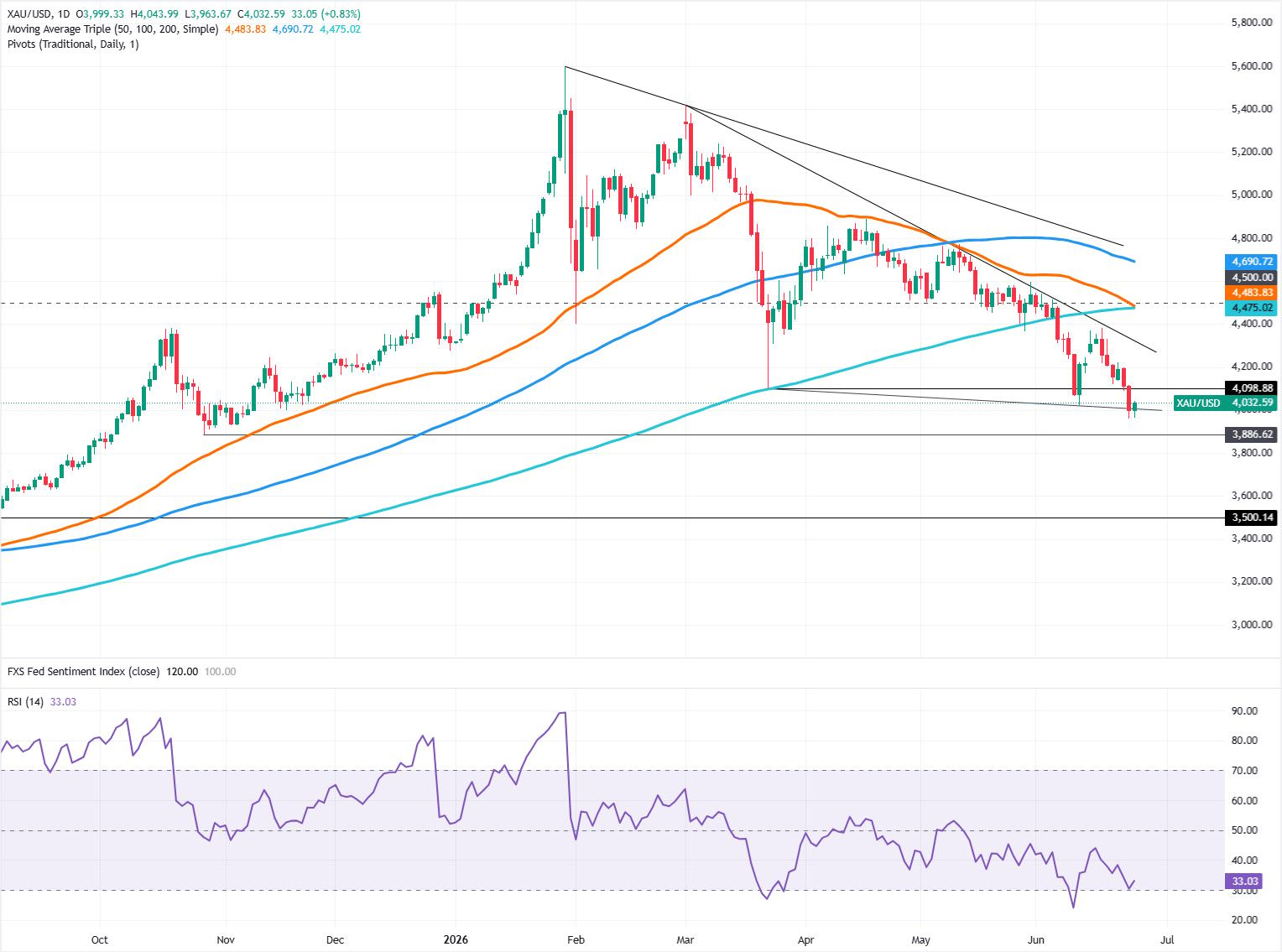
XAU/USD technical outlook: Gold recovers, but remains bearish below $4,100
The downtrend in Gold prices is set to continue, despite the ongoing recovery that drove XAU spot prices back above $4,000. Price action shows a successive series of lower highs and lower lows, cementing the bearish bias, but the trend shows signs of exhaustion.
On the other hand, the Relative Strength Index (RSI) bounced off the 30 oversold level, forming a higher low, hinting that there’s a positive divergence, with RSI achieving a successive series of higher lows, contrary to Gold prices.
On the upside, Gold must clear the $4,050 psychological level, followed by the March 23 daily low, now turned resistance, at $4,098. If those levels are taken out, the next area of interest would become the $4,200.
Downwards, XAU/USD might resume its downtrend once sellers drive Bullion prices below $4,000. On further weakness, the next support is the current year-to-date (YTD) low of $3,959, followed by the $3,900 milestone.
Gold FAQs
Gold has played a key role in human’s history as it has been widely used as a store of value and medium of exchange. Currently, apart from its shine and usage for jewelry, the precious metal is widely seen as a safe-haven asset, meaning that it is considered a good investment during turbulent times. Gold is also widely seen as a hedge against inflation and against depreciating currencies as it doesn’t rely on any specific issuer or government.
Central banks are the biggest Gold holders. In their aim to support their currencies in turbulent times, central banks tend to diversify their reserves and buy Gold to improve the perceived strength of the economy and the currency. High Gold reserves can be a source of trust for a country’s solvency. Central banks added 1,136 tonnes of Gold worth around $70 billion to their reserves in 2022, according to data from the World Gold Council. This is the highest yearly purchase since records began. Central banks from emerging economies such as China, India and Turkey are quickly increasing their Gold reserves.
Gold has an inverse correlation with the US Dollar and US Treasuries, which are both major reserve and safe-haven assets. When the Dollar depreciates, Gold tends to rise, enabling investors and central banks to diversify their assets in turbulent times. Gold is also inversely correlated with risk assets. A rally in the stock market tends to weaken Gold price, while sell-offs in riskier markets tend to favor the precious metal.
The price can move due to a wide range of factors. Geopolitical instability or fears of a deep recession can quickly make Gold price escalate due to its safe-haven status. As a yield-less asset, Gold tends to rise with lower interest rates, while higher cost of money usually weighs down on the yellow metal. Still, most moves depend on how the US Dollar (USD) behaves as the asset is priced in dollars (XAU/USD). A strong Dollar tends to keep the price of Gold controlled, whereas a weaker Dollar is likely to push Gold prices up.
Author

Christian Borjon Valencia
FXStreet
Markets analyst, news editor, and trading instructor with over 14 years of experience across FX, commodities, US equity indices, and global macro markets.