Gold Price Forecast: XAU/USD corrects to near $4,620 in countdown to US PCE Inflation data
- Gold price retreats from its three-month high of $4,697 amid caution ahead of the US PCE Price Index data for July.
- Investors also await Fed Chair Warsh’s commentary at the Jackson Hole Symposium.
- Market experts believe Fed’s Warsh to face a difficult balancing act at the Symposium.


Gold price (XAU/USD) is down 0.75% to near $4,620 during the European trading session on Wednesday. The precious metal corrects as the rally pauses after posting a fresh three-month high at $4,697 the previous day, with investors turning cautious ahead of the United States (US) Personal Consumption Expenditure Price Index (PCE) data for July at 12:30 GMT and Federal Reserve (Fed) Chairman Kevin Warsh’s commentary at the Jackson Hole Symposium.
The US core PCE inflation, which is closely tracked by Federal Reserve (Fed) officials, is expected to have remained steady at 3.3% Year-on-Year (YoY), with monthly figures rising at a 0.2% pace, faster than the June reading of 0.1%.
Investors will pay close attention to the US PCE Inflation data to get fresh cues regarding the Federal Reserve’s (Fed) monetary policy outlook.
Signs of US inflationary pressures remaining steady might ease Fed’s interest rate hike expectations further, which receded significantly this month, following the release of the weak Nonfarm Payrolls (NFP) data for July.
Warsh’s Jackson Hole speech seen as key Fed credibility test amid long-bond jitters
Strategists at DBS flag Fed Chairman Kevin Warsh’s upcoming Jackson Hole keynote on Friday, August 28, as “the most important event this week,” but stress that the gathering is “viewed more as a credibility event rather than a rate-signalling one.” They note that “the past two days’ decline in the 30Y yield offers only a reprieve, not a resolution,” even as US Treasury Secretary Scott Bessent’s decision to expand long-bond buybacks “seeks to calm markets.” Against this backdrop, DBS argues that “Warsh faces a difficult balancing act: defending the Fed’s independence and price-stability mandate while providing greater clarity on the Fed’s reaction function without abandoning his preference for less forward guidance.”
Gold Technical Analysis
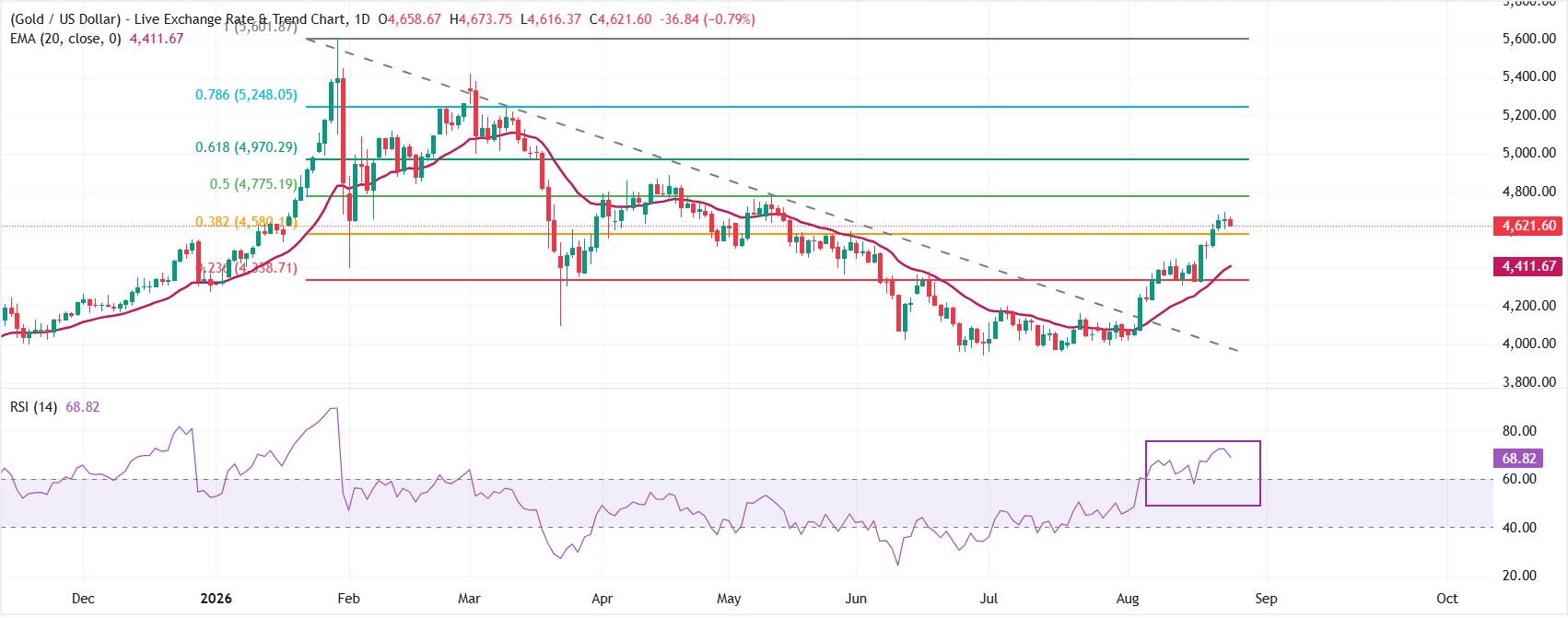
In the daily chart, XAU/USD trades at $4,621.08, maintaining a bullish near-term bias as spot holds well above the 20-period Exponential Moving Average (EMA) at $4,411.62 and the 23.6% Fibonacci retracement at $4,338.71. The metal is also trading just over the 38.2% retracement at $4,580.10, suggesting buyers remain in control after the latest surge, while the Relative Strength Index (RSI) at 68.77 flirts with overbought territory, hinting that upside momentum is strong but increasingly stretched.
On the topside, initial resistance is located at the 50.0% Fibonacci retracement at $4,775.19, followed by the 61.8% level at $4,970.29, with higher hurdles aligning at the 78.6% retracement at $5,248.05 and the cycle high reference at $5,601.87. On the downside, immediate support is seen at the 38.2% retracement at $4,580.10, ahead of the 20-period EMA at $4,411.62, while a deeper pullback would expose the 23.6% Fibonacci retracement at $4,338.71 as the next notable demand area.
(The technical analysis of this story was written with the help of an AI tool. Know more.)
Gold FAQs
Gold has played a key role in human’s history as it has been widely used as a store of value and medium of exchange. Currently, apart from its shine and usage for jewelry, the precious metal is widely seen as a safe-haven asset, meaning that it is considered a good investment during turbulent times. Gold is also widely seen as a hedge against inflation and against depreciating currencies as it doesn’t rely on any specific issuer or government.
Central banks are the biggest Gold holders. In their aim to support their currencies in turbulent times, central banks tend to diversify their reserves and buy Gold to improve the perceived strength of the economy and the currency. High Gold reserves can be a source of trust for a country’s solvency. Central banks added 1,136 tonnes of Gold worth around $70 billion to their reserves in 2022, according to data from the World Gold Council. This is the highest yearly purchase since records began. Central banks from emerging economies such as China, India and Turkey are quickly increasing their Gold reserves.
Gold has an inverse correlation with the US Dollar and US Treasuries, which are both major reserve and safe-haven assets. When the Dollar depreciates, Gold tends to rise, enabling investors and central banks to diversify their assets in turbulent times. Gold is also inversely correlated with risk assets. A rally in the stock market tends to weaken Gold price, while sell-offs in riskier markets tend to favor the precious metal.
The price can move due to a wide range of factors. Geopolitical instability or fears of a deep recession can quickly make Gold price escalate due to its safe-haven status. As a yield-less asset, Gold tends to rise with lower interest rates, while higher cost of money usually weighs down on the yellow metal. Still, most moves depend on how the US Dollar (USD) behaves as the asset is priced in dollars (XAU/USD). A strong Dollar tends to keep the price of Gold controlled, whereas a weaker Dollar is likely to push Gold prices up.
Author
Sagar Dua
FXStreet
Sagar Dua is associated with the financial markets from his college days. Along with pursuing post-graduation in Commerce in 2014, he started his markets training with chart analysis.