Gold jumps as suspected Yen intervention crushes US Dollar as Fed bets ease
- Gold rallies as suspected Yen intervention drives Dollar sharply lower.
- Softer US GDP and PCE data ease Fed hike bets.
- Warsh’s vague guidance keeps long-end yield premium elevated.

Gold price advances some 0.92% on Thursday after the US Dollar drops following a suspected intervention in the foreign exchange markets, with the Japanese Yen hitting a near two-month high versus the Greenback. The XAU/USD trades at $4,100 after bouncing off the low of the day (LOD) at $4,028.
XAU/USD climbs above $4,100 as Dollar weakness, softer growth and reduced Fed hike odds support Bullion
The Greenback tumbles nearly 0.90% as the US Dollar Index (DXY), which measures the buck’s value against a basket of six currencies, exchanges hands at 99.90. Speculation that Japanese authorities intervened in the FX markets boosted the precious metal to a five-day high of $4,126.
US inflation came as expected, according to the Bureau of Economic Analysis. The Fed’s preferred inflation gauge, the Core Personal Consumption Expenditures (PCE) Price Index in June, ticked lower from 3.4% to 3.3% YoY as expected. The headline PCE slowed from 4.1% to 3.7% YoY, as expected.
Other data showed that the US economy grew more slowly than expected, according to the Commerce Department. The Gross Domestic Product (GDP) for Q2 2026 missed forecasts of 2.1% growth, coming in at 1.5%, due to a widening trade deficit.
Last Wednesday, the Fed held rates unchanged, though the decision was not unanimous. A 9-3 vote split revealed that three Fed Regional Bank Presidents dissented in favour of a 25-basis-point rate hike.
US jobless claims increased below estimates last week, hinting that the labour market remains solid.
Also, the new Fed Chair, Kevin Warsh, emphatically stated that tackling inflation is the priority, though he dodged questions about how the Fed will do its job. The lack of clarity and forward guidance pushed the premium on the US 30-year bond yield to a level last seen in 2007 near 5.21%.
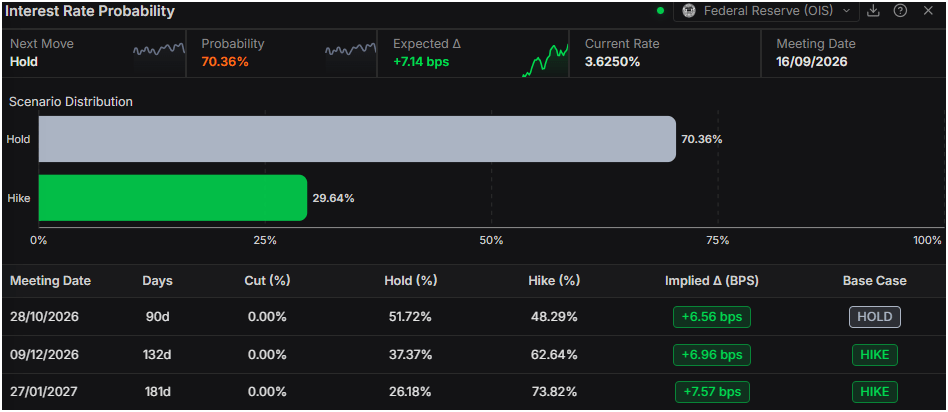
Money markets trimmed their Fed-hawkish bets for September. Instead, the odds of a rate hike are a slim, 30%, while the chances of a hold have risen sharply to 70%, according to Prime Terminal data.
However, the resumption of hostilities in the Gulf War could lead to higher energy prices. West Texas Intermediate (WTI), the US Crude benchmark, is down 1% during the day at $83.59, but is up nearly 20% in July so far.
On Friday, the US economic docket will feature University of Michigan Consumer Sentiment.
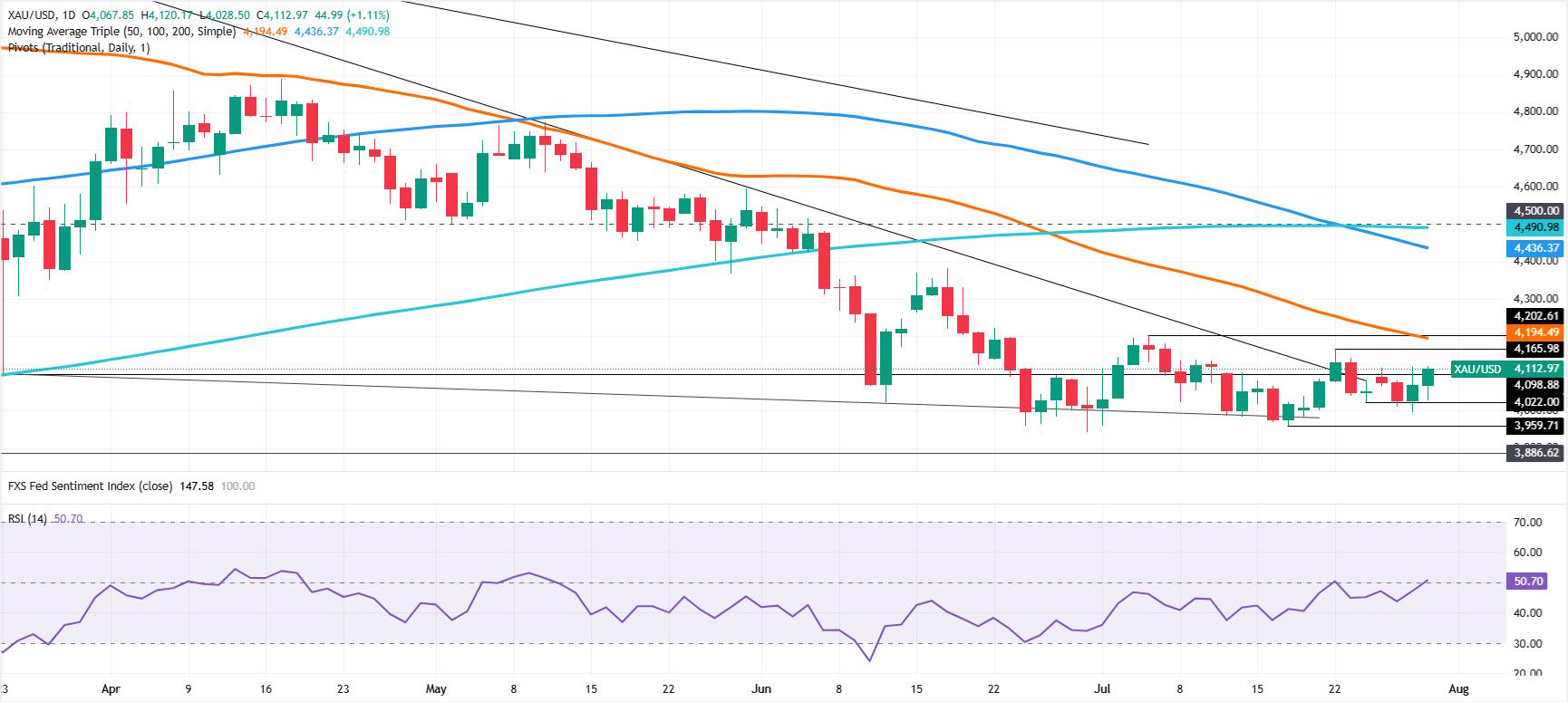
XAU/USD technical outlook: Gold recovers $4,100, eyes on $4,150
Gold’s price continues to trade sideways, despite registering two days of solid gains, clearing the $4,100 mark. Momentum turned bullish as the Relative Strength Index (RSI) pierced above the 50 neutral level, an indication that buyers are moving in.
For a bullish continuation, buyers must clear the July 22 daily high at $4,165, which would open the path to test the 50-day Simple Moving Average (SMA) at $4,194. Above sits the July 6 peak at $4,202.
Downward, the first XAU/USD support is $4,100. A breach of the latter will expose the July 24 (LOD) at $4,022. This comes ahead of the psychological $4,000 level and then the June 17 daily low at $3,959.
Gold FAQs
Gold has played a key role in human’s history as it has been widely used as a store of value and medium of exchange. Currently, apart from its shine and usage for jewelry, the precious metal is widely seen as a safe-haven asset, meaning that it is considered a good investment during turbulent times. Gold is also widely seen as a hedge against inflation and against depreciating currencies as it doesn’t rely on any specific issuer or government.
Central banks are the biggest Gold holders. In their aim to support their currencies in turbulent times, central banks tend to diversify their reserves and buy Gold to improve the perceived strength of the economy and the currency. High Gold reserves can be a source of trust for a country’s solvency. Central banks added 1,136 tonnes of Gold worth around $70 billion to their reserves in 2022, according to data from the World Gold Council. This is the highest yearly purchase since records began. Central banks from emerging economies such as China, India and Turkey are quickly increasing their Gold reserves.
Gold has an inverse correlation with the US Dollar and US Treasuries, which are both major reserve and safe-haven assets. When the Dollar depreciates, Gold tends to rise, enabling investors and central banks to diversify their assets in turbulent times. Gold is also inversely correlated with risk assets. A rally in the stock market tends to weaken Gold price, while sell-offs in riskier markets tend to favor the precious metal.
The price can move due to a wide range of factors. Geopolitical instability or fears of a deep recession can quickly make Gold price escalate due to its safe-haven status. As a yield-less asset, Gold tends to rise with lower interest rates, while higher cost of money usually weighs down on the yellow metal. Still, most moves depend on how the US Dollar (USD) behaves as the asset is priced in dollars (XAU/USD). A strong Dollar tends to keep the price of Gold controlled, whereas a weaker Dollar is likely to push Gold prices up.
Author

Christian Borjon Valencia
FXStreet
Markets analyst, news editor, and trading instructor with over 14 years of experience across FX, commodities, US equity indices, and global macro markets.