Gold holds range as US-Iran talks in focus, Oil-driven inflation caps gains
- Gold holds within a multi-week range as traders await clarity on US-Iran talks.
- Oil-driven inflation risks support a steady Fed outlook, limiting Gold upside.
- Technically, XAU/USD remains range-bound between 50-day and 100-day SMAs.

Gold (XAU/USD) everses earlier gains on Thursday, though it remains confined within a multi-week range as traders refrain from placing strong directional bets while awaiting clearer signals on US-Iran peace talks. XAU/USD is trading around $4,790 at the time of writing, after reaching an intraday high of $4,838, with a modest recovery in the US Dollar (USD) acting as a headwind.
Optimism builds around US-Iran talks
Markets remain cautiously optimistic that a deal could be reached to end the US-Iran war after US President Donald Trump indicated that negotiations could resume this week after last weekend’s talks in Islamabad failed to produce a breakthrough.
However, Gulf and European officials see a US-Iran deal taking up to six months to finalize, according to a Bloomberg report. They are also urging an extension of the current ceasefire over that period and calling for the immediate reopening of the Strait of Hormuz to restore energy flows, warning that prolonged disruption could risk triggering a global food crisis.
Separately, Iran is moving to formalize its control over the Strait of Hormuz, with state media reporting that any planned transit tolls would be paid via Iranian banks, underscoring the country’s push to tighten its grip on a key global Oil chokepoint.
Meanwhile, diplomatic efforts led by Pakistan continue. A senior Iranian official said on Thursday that “the visit by Pakistan’s army chief has helped narrow differences in some areas,” adding that “there are now greater hopes for a ceasefire extension and a second round of talks.” Although “fundamental disagreements over nuclear issues persist.”
Gold outlook tied to US-Iran developments and Oil prices
While diplomacy has improved risk sentiment, the situation remains far from resolved. A possible US-Iran deal remains a key variable for Gold, which is currently trading around 10% below its peak since the war began, as Oil-driven inflation risks fueled expectations that central banks, particularly the Federal Reserve (Fed), may need to raise interest rates.
Although Crude prices have eased from recent highs, reviving some Fed rate-cut bets, they remain elevated as supply through the Strait of Hormuz continues to face significant disruption amid a dual blockade by US forces and Iran. This keeps inflation concerns in focus, reinforcing expectations that the Fed will likely keep interest rates unchanged in the near term.
If tensions ease further and Oil prices decline, it could help reduce inflation pressure and lessen the burden on central banks, which might in turn support Gold.
St. Louis Fed President Alberto Musalem said that “supply shocks are placing the Fed’s inflation and employment targets at risk,” adding that “the current rate range is likely appropriate for some time.” He further noted that “the Oil shock is probably feeding into core inflation, which could remain near 3% through the end of the year.”
Technical analysis: XAU/USD consolidates below 50-day SMA
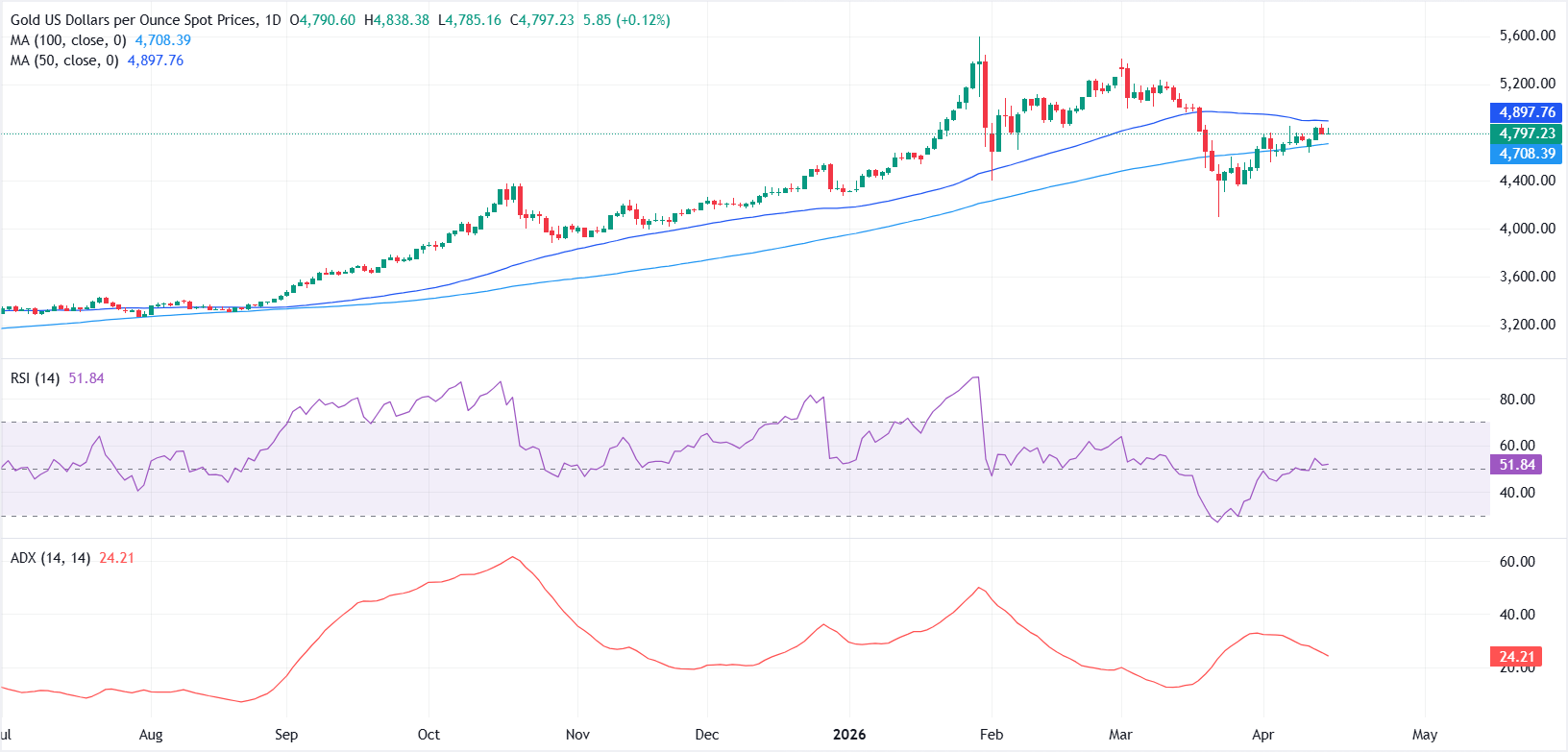
From a technical perspective, the daily chart shows that the metal remains under pressure below the 50-day Simple Moving Average (SMA), currently near $4,897, which acts as immediate overhead resistance. Meanwhile, the 100-day SMA near $4,708 provides immediate support, keeping price action range-bound.
The 14-period Relative Strength Index (RSI) around 51 has recovered toward neutral territory, while the Average Directional Index (ADX) near 24 suggests a modest but not particularly strong underlying trend as price consolidates below its primary short-term average.
On the downside, a sustained break below the 100-day SMA would signal a breakdown of the recent range and increase bearish pressure. Conversely, a daily close back above the 50-day SMA would be needed to ease immediate downside pressure and signal that bulls are regaining control.
Inflation FAQs
Inflation measures the rise in the price of a representative basket of goods and services. Headline inflation is usually expressed as a percentage change on a month-on-month (MoM) and year-on-year (YoY) basis. Core inflation excludes more volatile elements such as food and fuel which can fluctuate because of geopolitical and seasonal factors. Core inflation is the figure economists focus on and is the level targeted by central banks, which are mandated to keep inflation at a manageable level, usually around 2%.
The Consumer Price Index (CPI) measures the change in prices of a basket of goods and services over a period of time. It is usually expressed as a percentage change on a month-on-month (MoM) and year-on-year (YoY) basis. Core CPI is the figure targeted by central banks as it excludes volatile food and fuel inputs. When Core CPI rises above 2% it usually results in higher interest rates and vice versa when it falls below 2%. Since higher interest rates are positive for a currency, higher inflation usually results in a stronger currency. The opposite is true when inflation falls.
Although it may seem counter-intuitive, high inflation in a country pushes up the value of its currency and vice versa for lower inflation. This is because the central bank will normally raise interest rates to combat the higher inflation, which attract more global capital inflows from investors looking for a lucrative place to park their money.
Formerly, Gold was the asset investors turned to in times of high inflation because it preserved its value, and whilst investors will often still buy Gold for its safe-haven properties in times of extreme market turmoil, this is not the case most of the time. This is because when inflation is high, central banks will put up interest rates to combat it. Higher interest rates are negative for Gold because they increase the opportunity-cost of holding Gold vis-a-vis an interest-bearing asset or placing the money in a cash deposit account. On the flipside, lower inflation tends to be positive for Gold as it brings interest rates down, making the bright metal a more viable investment alternative.
Author

Vishal Chaturvedi
FXStreet
I am a macro-focused research analyst with over four years of experience covering forex and commodities market. I enjoy breaking down complex economic trends and turning them into clear, actionable insights that help traders stay ahead of the curve.














