Gold holds above $4,700 as Hormuz tensions revive USD demand
- WSJ report fuels concerns over renewed US-Iran hostilities.
- Fed officials warn inflation risks could keep rates elevated.
- Traders await Friday’s NFP report for fresh US Dollar direction.

Gold (XAU/USD) edges higher on Thursday during the North American session amid heightened tensions in the Middle East due to rumors that the US is looking to restart Project Freedom. At the time of writing, XAU/USD trades at $4,705 after reaching a daily high of $4,764.
XAU/USD rises as Project Freedom rumors revive geopolitical risk
Recently, the Wall Street Journal (WSJ) reported that the White House is relaunching Project Freedom to ensure the safe passage of commercial vessels through the Strait of Hormuz. Later, a US official told Al Jazeera that reports about preparations to resume the operation were incorrect. Further data showed that Saudi Arabia and Kuwait lifted restrictions on US military use of their bases and airspace, opening the door for re-engaging hostilities between the US and Iran.
Bullion prices recoiled from a daily high of $4,764 toward the $4,700 mark, as Oil prices recovered some ground. In the meantime, the US Dollar Index (DXY), which tracks the buck’s performance against six currencies, is modestly up 0.04% at 98.05, due to Iran’s war remarks.
US Initial Jobless Claims for the week ending May 2 increased to 200K, compared to the previous figure of 190K and lower than the expected 205K. While these figures provide some support for the US Dollar, the currency's performance remains closely tied to developments in the Middle East conflict.
Earlier, the US Challenger Job Cuts rose from 60.62K in March to 83.687K in April, according to Challenger, Grey & Christmas.
Aside from economic data, Federal Reserve (Fed) officials crossed the wires. Cleveland’s Fed Beth Hammack stated that rates “will be on hold for quite some time,” adding that businesses are getting concerned that “an inflationary mindset is starting to become entrenched in people’s minds.”
Mary Daly from the San Francisco Fed shifted to a neutral-to-hawkish stance, saying she was committed to bringing inflation back to the Fed’s 2% goal. Daly noted that policy is “slightly restrictive,” and that it could exert downward pressure on prices if the US-Iran conflict resolves.
At the same time, Minneapolis Fed President Neel Kashkari said inflation is too high and that he is optimistic about AI.
Money markets had priced in no interest rate cuts by the Federal Reserve in 2026, according to Prime Terminal data.
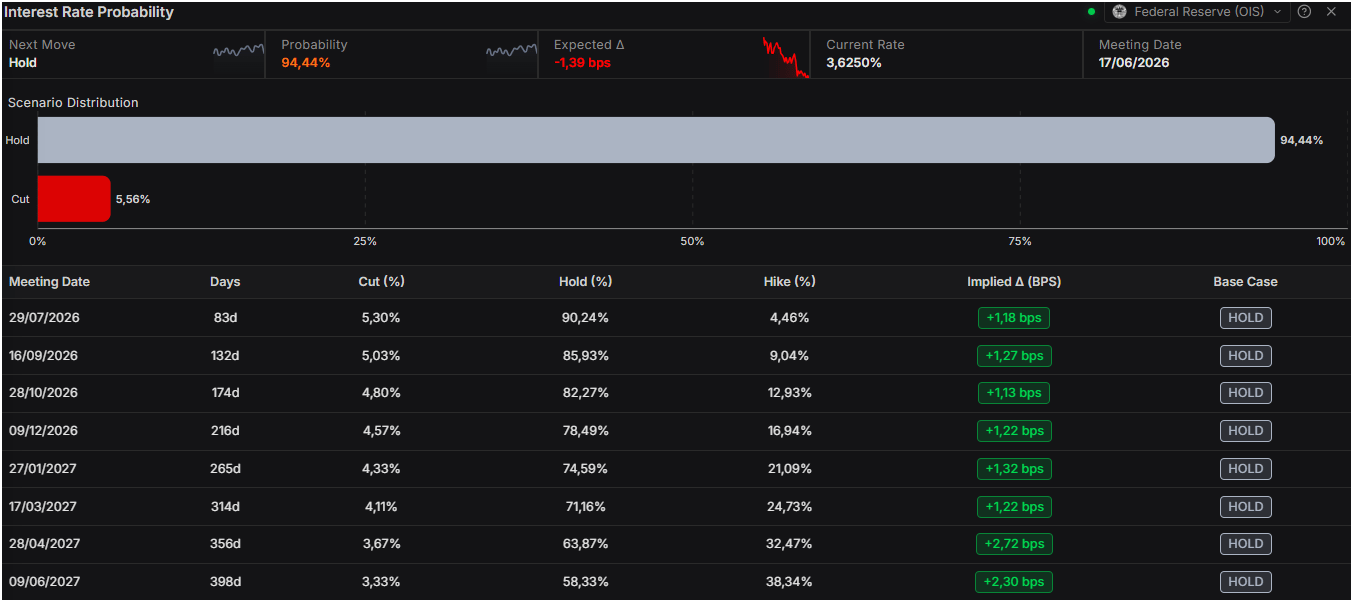
An escalation of the conflict could prompt traders to price in an inflationary shock due to higher Oil and natural gas prices. Hence, further downside in Gold is expected, as major central banks are expected to keep rates steady.
Market participants are now focusing on upcoming speeches by Federal Reserve officials and the release of Nonfarm Payrolls data this Friday, with projections indicating an increase of 62K jobs in April.
XAU/USD technical outlook: Gold faces key resistance at around $4,760
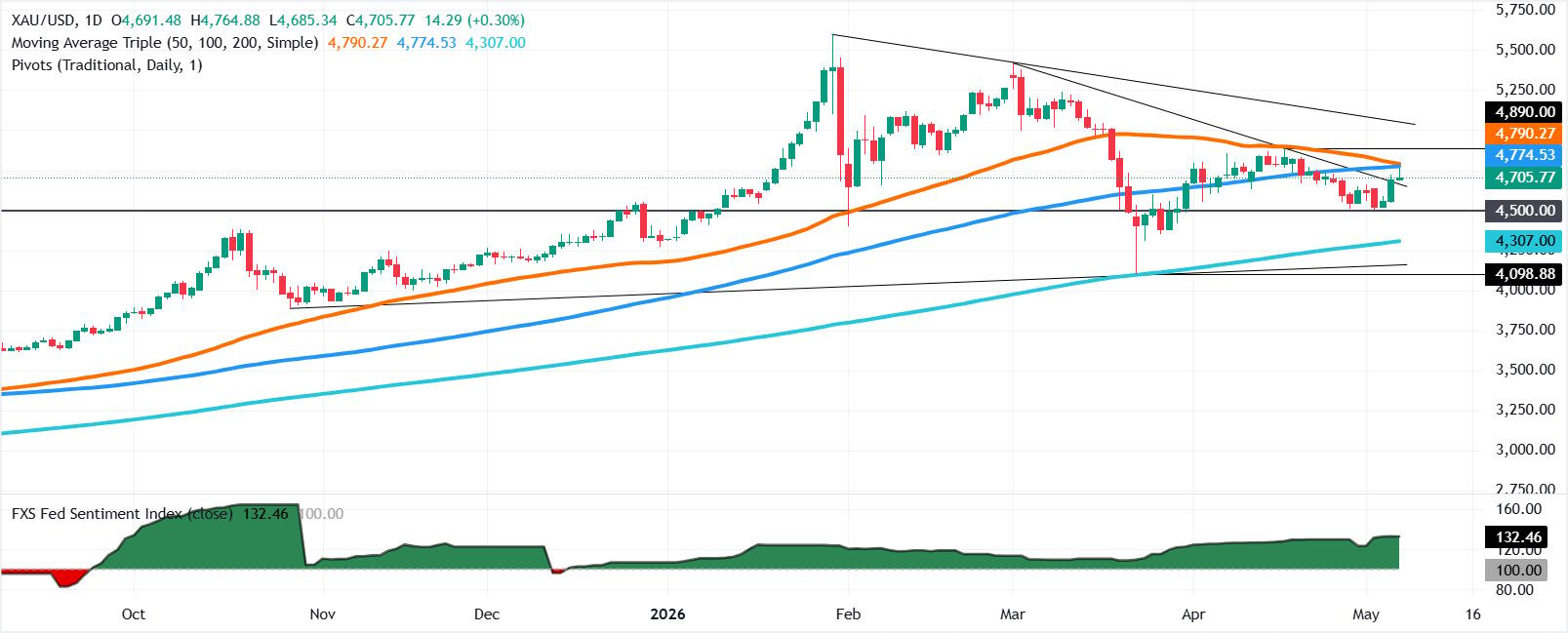
Gold prices have rebounded, surpassing the $4,650 psychological threshold and signalling potential for further appreciation, with buyers focusing on the $4,700 level. The Relative Strength Index (RSI) shifted bullishly, supporting prospects for additional short-term gains.
For XAU/USD, initial resistance lies at a descending trendline between $4,700 and $4,715. Should this barrier be exceeded, the next level of resistance is the 100-day Simple Moving Average (SMA) at $4,764. A continuation of the uptrend would target the $4,800 level, which lies above the 50-day SMA at $4,790.
On the downside, immediate support for XAU/USD is positioned at $4,650. If this level is breached, focus will shift to $4,600 ahead of the May 4 swing low at $4,500. Once hurdled, the next stop would be the March 26 daily low of $4,351, before approaching the 200-day SMA at $4,276.
Gold FAQs
Gold has played a key role in human’s history as it has been widely used as a store of value and medium of exchange. Currently, apart from its shine and usage for jewelry, the precious metal is widely seen as a safe-haven asset, meaning that it is considered a good investment during turbulent times. Gold is also widely seen as a hedge against inflation and against depreciating currencies as it doesn’t rely on any specific issuer or government.
Central banks are the biggest Gold holders. In their aim to support their currencies in turbulent times, central banks tend to diversify their reserves and buy Gold to improve the perceived strength of the economy and the currency. High Gold reserves can be a source of trust for a country’s solvency. Central banks added 1,136 tonnes of Gold worth around $70 billion to their reserves in 2022, according to data from the World Gold Council. This is the highest yearly purchase since records began. Central banks from emerging economies such as China, India and Turkey are quickly increasing their Gold reserves.
Gold has an inverse correlation with the US Dollar and US Treasuries, which are both major reserve and safe-haven assets. When the Dollar depreciates, Gold tends to rise, enabling investors and central banks to diversify their assets in turbulent times. Gold is also inversely correlated with risk assets. A rally in the stock market tends to weaken Gold price, while sell-offs in riskier markets tend to favor the precious metal.
The price can move due to a wide range of factors. Geopolitical instability or fears of a deep recession can quickly make Gold price escalate due to its safe-haven status. As a yield-less asset, Gold tends to rise with lower interest rates, while higher cost of money usually weighs down on the yellow metal. Still, most moves depend on how the US Dollar (USD) behaves as the asset is priced in dollars (XAU/USD). A strong Dollar tends to keep the price of Gold controlled, whereas a weaker Dollar is likely to push Gold prices up.
Author

Christian Borjon Valencia
FXStreet
Markets analyst, news editor, and trading instructor with over 14 years of experience across FX, commodities, US equity indices, and global macro markets.


![How Wall Street rigs the game [Video]](https://editorial.fxsstatic.com/images/i/market-chaos-01.jpg)