Gold edges higher as Hormuz delays, US CPI keep traders cautious
- Gold gains as Hormuz reopening delay keeps geopolitical risks elevated.
- US CPI and PPI data could reshape Fed tightening bets.
- Rising Oil prices cap bullion upside despite softer labor data.

Gold (XAU/USD) price edges up at the beginning of the week as the reopening of the Strait of Hormuz faces delays due to demands from Iran to the US, and is capped by the modest strength of the Greenback, with traders eyeing the release of crucial US inflation data. At the time of writing, the XAU/USD pair trades at $4,352, up 0.50%, after bouncing off daily lows of $4,316.
XAU/USD holds above $4,350 as investors weigh Oil-driven inflation risks, Fed bets and upcoming US data
The US Dollar Index (DXY), which measures the performance of the buck against a basket of peers, is up 0.14% at 99.75 as market participants continue to digest the US and Japanese interventions in the FX markets.
Last week, a softer-than-expected Nonfarm Payrolls report showed that the jobs market remains in a low-hiring, low-firing mode, as said by Richmond Fed President Thomas Barkin. The US economy slashed 23K jobs, missing forecasts for an 80K increase, and the May and June numbers were revised downward. Although the data sparked a trimming of Fed hawkish bets, it's just one reading, and now eyes turn to the release of US inflation figures.
July’s Consumer Price Index (CPI) is expected to ease from 3.5% to 3.4% YoY. Core CPI, which excludes volatile items, is projected to tick lower from 2.6% to 2.5% YoY. A day after this, on Thursday, the Producer Price Index is also projected to ease.
On the same day, Initial Jobless Claims for the week ending August 8 are expected to rise from 199K to 201K. Due to the weaker-than-expected NFP, claims will be closely watched by investors, who are also looking for signs of weakness in the labor market that could prevent the Fed from cutting interest rates, even though inflation remains stubbornly high.
So far, money markets have priced in 22 basis points of tightening by the Federal Reserve towards the end of 2026, up from 17 basis points expected last Friday, according to Prime Terminal data.
Aside from this, geopolitics continued to move the needle, including the exacerbated rally in Oil prices, a headwind for the yellow metal. West Texas Intermediate (WTI), the US crude benchmark, is up nearly 6% to $81.54 per barrel as talks for a reopening of Hormuz continue, but progress has slowed after Iran said the US should agree to Tehran’s demands.
Iran’s demands are that there should be an end to hostilities, a halt to military actions, withdrawal of US forces, compensation for war damages, lifting of sanctions and release of frozen assets. If met, the reopening of the Strait of Hormuz could be faster.
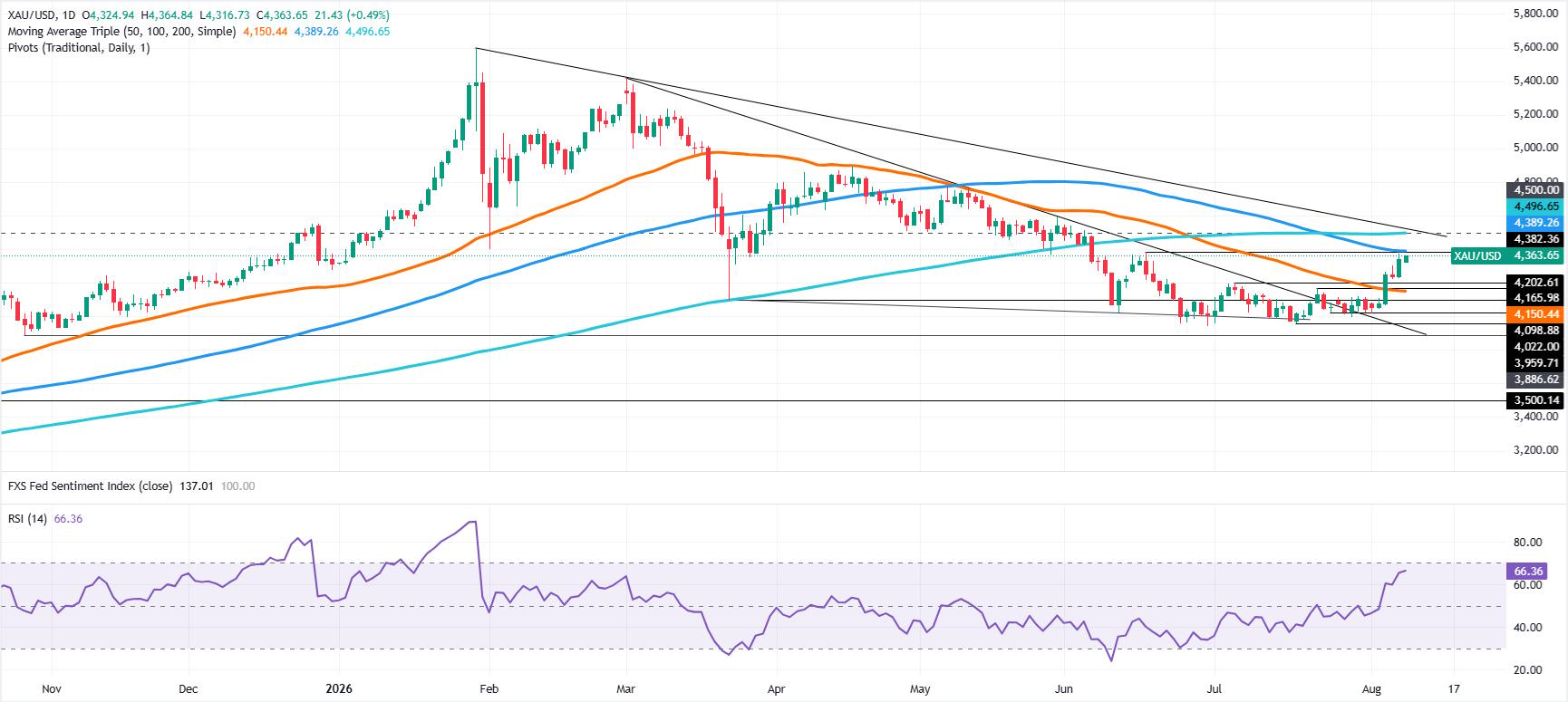
XAU/USD price forecast: Gold faces 100-day SMA as bulls target $4,500
Gold price advance continued, but as of writing, it remains below the 100-day Simple Moving Average (SMA) at $4,389, seen as crucial for buyers if they would like to conquer higher prices.
Momentum is bullish, as indicated by the Relative Strength Index (RSI), which confirms further upside. Hence, the path of least resistance is tilted to the upside. If XAU/USD clears the 100-day SMA, this clears the path to challenge the $4,400 psychological level. Above lies the 200-day SMA at $4,498, followed by the $4,500 milestone.
On the downside, initial support is at the July 6 high, now at $4,202. If this level fails, the next support levels are the 50-day SMA at $4,150 and $4,100.
Gold FAQs
Gold has played a key role in human’s history as it has been widely used as a store of value and medium of exchange. Currently, apart from its shine and usage for jewelry, the precious metal is widely seen as a safe-haven asset, meaning that it is considered a good investment during turbulent times. Gold is also widely seen as a hedge against inflation and against depreciating currencies as it doesn’t rely on any specific issuer or government.
Central banks are the biggest Gold holders. In their aim to support their currencies in turbulent times, central banks tend to diversify their reserves and buy Gold to improve the perceived strength of the economy and the currency. High Gold reserves can be a source of trust for a country’s solvency. Central banks added 1,136 tonnes of Gold worth around $70 billion to their reserves in 2022, according to data from the World Gold Council. This is the highest yearly purchase since records began. Central banks from emerging economies such as China, India and Turkey are quickly increasing their Gold reserves.
Gold has an inverse correlation with the US Dollar and US Treasuries, which are both major reserve and safe-haven assets. When the Dollar depreciates, Gold tends to rise, enabling investors and central banks to diversify their assets in turbulent times. Gold is also inversely correlated with risk assets. A rally in the stock market tends to weaken Gold price, while sell-offs in riskier markets tend to favor the precious metal.
The price can move due to a wide range of factors. Geopolitical instability or fears of a deep recession can quickly make Gold price escalate due to its safe-haven status. As a yield-less asset, Gold tends to rise with lower interest rates, while higher cost of money usually weighs down on the yellow metal. Still, most moves depend on how the US Dollar (USD) behaves as the asset is priced in dollars (XAU/USD). A strong Dollar tends to keep the price of Gold controlled, whereas a weaker Dollar is likely to push Gold prices up.
Author

Christian Borjon Valencia
FXStreet
Markets analyst, news editor, and trading instructor with over 14 years of experience across FX, commodities, US equity indices, and global macro markets.