Gold crashes below $4,900 as hot PPI, Oil spike fuel USD rally
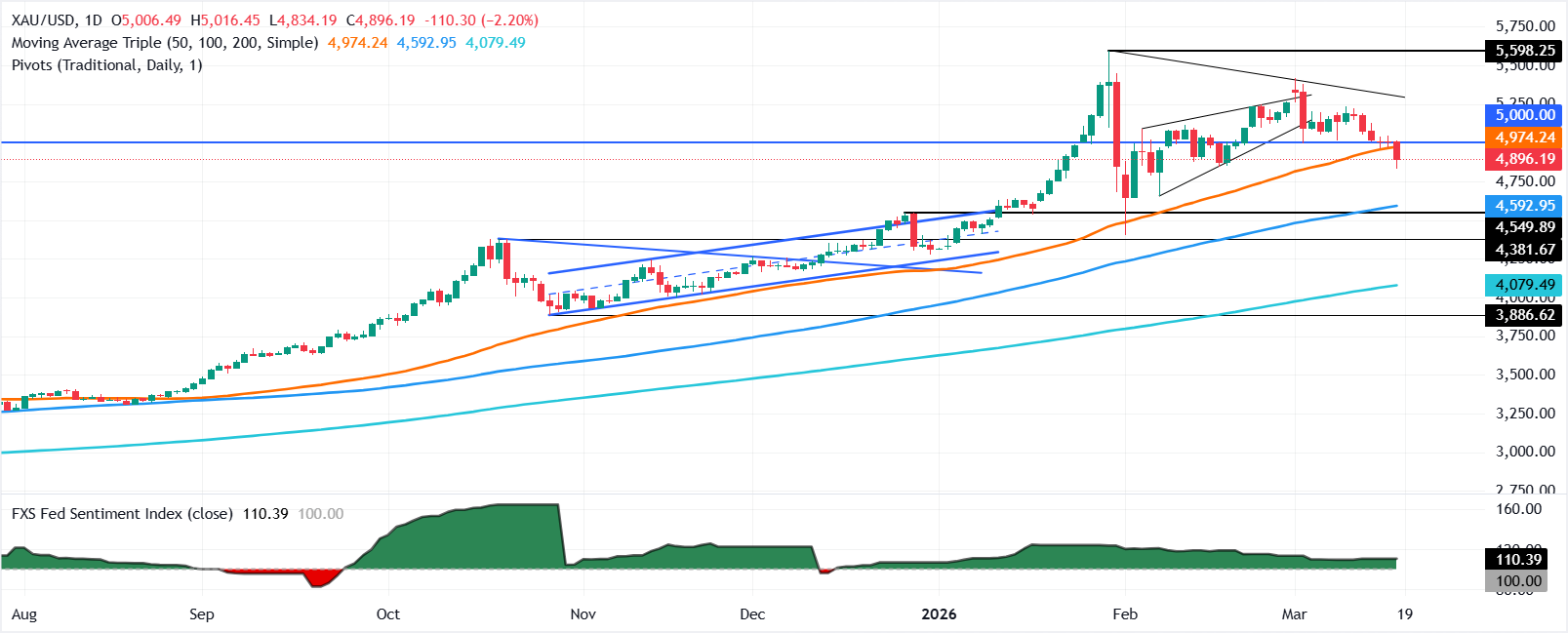
- XAU/USD plunges to $4,878, breaking below the 50-day SMA at $4,961.
- US PPI jumps to 3.4% YoY while core rises to 3.9%, reducing Fed easing bets.
- Oil near $96 boosts DXY to 99.84 as Middle East tensions escalate.

Gold (XAU/USD) tumbles by more than 2.20% on Wednesday as tensions in the Middle East rise and US inflation edges up, which could deter the Federal Reserve from easing policy. At the time of writing, the XAU/USD trades at $4,878 after hitting a daily high of $5,016.
Bullion sinks as rising US yields, inflation fears dent Fed cut expectations
Price action shows the yellow metal is under pressure as it fell below the 50-day Simple Moving Average (SMA) at $4,961. Conversely, the US Dollar Index (DXY), which measures the buck's performance against six other currencies, rose 0.29% to 99.84, due to its close correlation with Oil prices.
Before Wall Street opened, Israel revealed an attack on Iran's Pars gas field facilities. This prompted a reaction by Tehran, which threatened to strike the enemy's infrastructure and warned that energy installations would be targeted "in the coming hours." This event pushed Western Texas Intermediate (WTI), the US Crude Oil benchmark, up by 0.72% to $96.64 per barrel.
The US economic docket featured February's Producer Price Index (PPI), which came in hotter than expected, reducing the chances of a Federal Reserve rate cut in 2026. The PPI in February expanded to 3.4% YoY, missed the forecast and January's 2.9% reading. Core PPI, which excludes volatile items, jumped from 3.5% to 3.9% YoY for the same period.
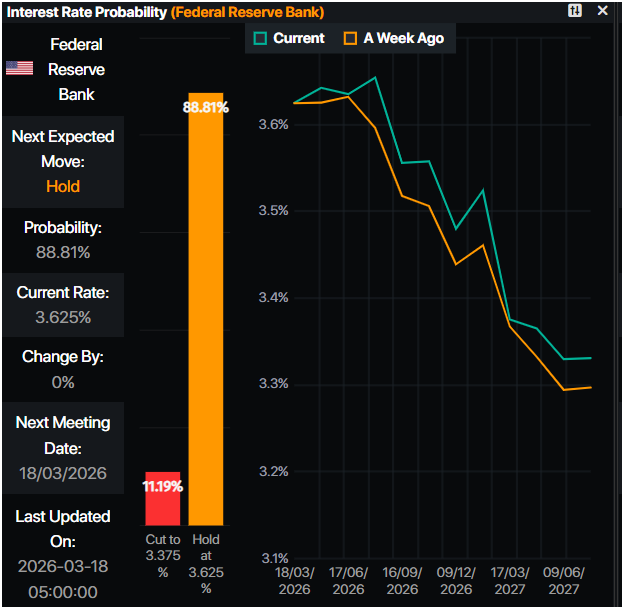
After the data, money markets seem less convinced that the Fed will cut rates at all in 2026. As of writing, the swaps markets priced 18.5 basis points of easing towards the end of the year, fueled by high energy prices sparked by the Middle East conflict.
Recently, Factory Orders for January showed weakness, rising 0.1% MoM after an upwardly revised -0.4% drop in the previous month, the US Commerce Department reported.
Looking forward, traders are bracing for the Federal Reserve's policy announcement. The US central bank will likely keep rates steady as it shares its economic forecasts for the year. Investors will also pay close attention to the "dot-plot," which shows how Fed officials predict interest rates will move.
Following the release, traders' eyes would be on the Fed Chair Jerome Powell's press conference.
XAU/USD Price Forecast: Poised to test lower prices if it cracks $4,800
Gold's technical picture remains bullish-biased, but in the short term, the breach of the 50-day SMA opened the door to a fall below $4,900.
Momentum, as measured by the Relative Strength Index (RSI), shows that bears are gathering some steam, as it has continued to drop deep into oversold territory.
For a bullish resumption, Gold buyers must clear the 50-day SMA at $4,961 before testing the $5,000 milestone. If breached, the next area of interest would be the $5,100 figure, followed by the March 10 high at $5,238.
Gold FAQs
Gold has played a key role in human’s history as it has been widely used as a store of value and medium of exchange. Currently, apart from its shine and usage for jewelry, the precious metal is widely seen as a safe-haven asset, meaning that it is considered a good investment during turbulent times. Gold is also widely seen as a hedge against inflation and against depreciating currencies as it doesn’t rely on any specific issuer or government.
Central banks are the biggest Gold holders. In their aim to support their currencies in turbulent times, central banks tend to diversify their reserves and buy Gold to improve the perceived strength of the economy and the currency. High Gold reserves can be a source of trust for a country’s solvency. Central banks added 1,136 tonnes of Gold worth around $70 billion to their reserves in 2022, according to data from the World Gold Council. This is the highest yearly purchase since records began. Central banks from emerging economies such as China, India and Turkey are quickly increasing their Gold reserves.
Gold has an inverse correlation with the US Dollar and US Treasuries, which are both major reserve and safe-haven assets. When the Dollar depreciates, Gold tends to rise, enabling investors and central banks to diversify their assets in turbulent times. Gold is also inversely correlated with risk assets. A rally in the stock market tends to weaken Gold price, while sell-offs in riskier markets tend to favor the precious metal.
The price can move due to a wide range of factors. Geopolitical instability or fears of a deep recession can quickly make Gold price escalate due to its safe-haven status. As a yield-less asset, Gold tends to rise with lower interest rates, while higher cost of money usually weighs down on the yellow metal. Still, most moves depend on how the US Dollar (USD) behaves as the asset is priced in dollars (XAU/USD). A strong Dollar tends to keep the price of Gold controlled, whereas a weaker Dollar is likely to push Gold prices up.
Author

Christian Borjon Valencia
FXStreet
Markets analyst, news editor, and trading instructor with over 14 years of experience across FX, commodities, US equity indices, and global macro markets.