Gold climbs above $4,050 as markets lean dovish ahead of US data
- Gold rises 0.36% as weak risk appetite and soft US data lift the metal above key levels.
- Investors boost December Fed easing bets despite hawkish rhetoric, awaiting FOMC Minutes and Thursday’s NFP.
- Goldman Sachs says China’s central bank resumed purchases, supporting expectations for near-term upside.

Gold (XAU/USD) advances modestly during Tuesday’s North American session as the Greenback also remains bid and risk appetite deteriorates amid fears of an economic slowdown. At the time of writing, XAU/USD trades at $4,058, up 0.36%.
XAU/USD supported by safe-haven demand and renewed Chinese central bank buying
Economic data releases are beginning to hit the wires with Initial Jobless Claims for the week ended October 18 reaching 232K. Also, Factory Orders In August fared slightly above estimates, but data was ignored by Bullion traders, which pushed the yellow metal above $4,050.
The data prompted investors to price in additional easing by the Federal Reserve (Fed) on the December’s meeting, even though most of the officials remained hawkish. Up next, the Meeting Minutes of the Federal Open Market Committee (FOMC) would provide clues about how split is the central bank about the upcoming monetary policy decision.
The US docket will feature Nonfarm Payrolls on Thursday, widely expected for investors.
Aside from this, Goldman Sachs revealed that China’s central bank resumed its purchases of Gold. They commented that China might continue its buying spree in November, an indication that the yellow metal could rally in the short term.
Daily market movers: Gold surges despite a firm US Dollar
- The Dollar holds firm as depicted by the US Dollar Index (DXY). The DXY, which tracks the buck’s performance versus six currencies, is up 0.10% at 99.63. Contrarily, US Treasury yields are steady with the 10-year US Treasury note yield standing at 4.13%. US real yields — which correlate inversely to Gold prices — are also unchanged at 1.85%.
- Richmond Fed’s Thomas Barkin said the dual mandate is in balance, with upside risks on inflation and downside risks on the labor market. He emphasized that the lack of official data makes their work difficult to assess where the Fed stands.
- US Initial Jobless Claims rose to 232K in the week ending October 18, an indication of moderate weakness in the jobs market. Factory Orders rebounded in August, revealed the Commerce Department. Orders rose by 1.4% up from July’s 1.3% decline, aligned with economists’ estimates.
- Fed’s Governor Waller was dovish, qualified the labor market as “weak,” adding that inflation expectations are well anchored and that core inflation is close to the Fed’s 2% target.
- Gold’s rally could extend after Goldman Sachs revealed that China added an estimated 15 tons of XAU to its reserves in September. Bank analysts estimated that central banks worldwide bought 64 tons in September, tripled August’s purchases.
- Markets now see a 50% chance for a rate cut at the December meeting, up from 46% earlier in the day but lower than 67% last week, the CME FedWatch Tool showed.
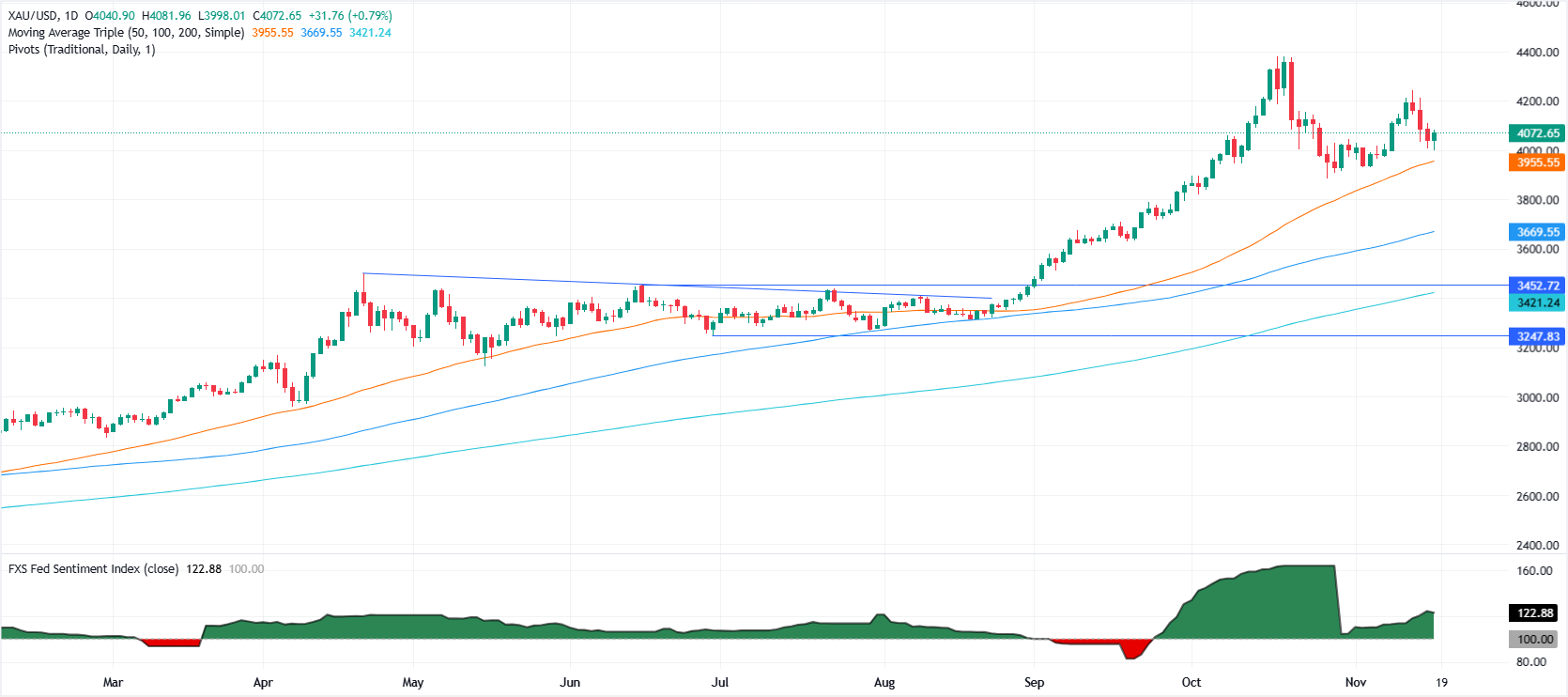
Technical outlook: Gold hovers around $4,050, eyes on $4,100
Gold’s broader uptrend remains intact as prices bounce from the 20-day Simple Moving Average (SMA) near $4,046. A daily close above this level could pave the way for a move toward $4,100, with scope for retesting the $4,200 barrier afterward.
However, a failure to sustain gains above $4,050 would leave XAU/USD vulnerable to a pullback toward $4,000, followed by a potential test of the October 28 low near $3,886.
Gold FAQs
Gold has played a key role in human’s history as it has been widely used as a store of value and medium of exchange. Currently, apart from its shine and usage for jewelry, the precious metal is widely seen as a safe-haven asset, meaning that it is considered a good investment during turbulent times. Gold is also widely seen as a hedge against inflation and against depreciating currencies as it doesn’t rely on any specific issuer or government.
Central banks are the biggest Gold holders. In their aim to support their currencies in turbulent times, central banks tend to diversify their reserves and buy Gold to improve the perceived strength of the economy and the currency. High Gold reserves can be a source of trust for a country’s solvency. Central banks added 1,136 tonnes of Gold worth around $70 billion to their reserves in 2022, according to data from the World Gold Council. This is the highest yearly purchase since records began. Central banks from emerging economies such as China, India and Turkey are quickly increasing their Gold reserves.
Gold has an inverse correlation with the US Dollar and US Treasuries, which are both major reserve and safe-haven assets. When the Dollar depreciates, Gold tends to rise, enabling investors and central banks to diversify their assets in turbulent times. Gold is also inversely correlated with risk assets. A rally in the stock market tends to weaken Gold price, while sell-offs in riskier markets tend to favor the precious metal.
The price can move due to a wide range of factors. Geopolitical instability or fears of a deep recession can quickly make Gold price escalate due to its safe-haven status. As a yield-less asset, Gold tends to rise with lower interest rates, while higher cost of money usually weighs down on the yellow metal. Still, most moves depend on how the US Dollar (USD) behaves as the asset is priced in dollars (XAU/USD). A strong Dollar tends to keep the price of Gold controlled, whereas a weaker Dollar is likely to push Gold prices up.
Author

Christian Borjon Valencia
FXStreet
Markets analyst, news editor, and trading instructor with over 14 years of experience across FX, commodities, US equity indices, and global macro markets.