Gold braces for volatility amid recovery in bond yields, higher oil prices
- Gold price trades flat at around $4,140 after recovering its slight early losses.
- Signs of recovery in US bond yields and higher oil prices to keep the Gold price under pressure.
- Investors keenly await Meta's Q3 earnings scheduled for Wednesday.

Gold price (XAU/USD) flattens at around $4,140 in the Asian trade on Tuesday after a slightly weak opening performance. The precious metal has remained in a tight range between $4,063.55 and $4,227.53 for almost three weeks as the upside has remained capped due to rising oil prices, while a recovery in demand for United States (US) bonds offered support.
However, the outlook of the Gold price appears to be dampening again as Treasury Yields have shown signs of recovery, with US hyperscalers set to report their Q3 earnings in near time.
As of writing, 10-year US Treasury Yields hold on to Monday’s gains at around 5.15%. Theoretically, higher yields on US-backed assets diminish the appeal of non-yielding assets, such as Gold.
What to expect from Q3 earnings of US hyperscalers
The US Q3 earnings season has kicked off and Meta will one of five hyperscalers, which will be the first to report its quarterly performance on Wednesday. Microsoft, Amazon and Google are scheduled to report their Q3 results next week.
According to Goldman Sachs, Meta is one of five AI hyperscalers expected to increase combined capital expenditure to about $1.2 trillion next year, Reuters reports.
Such a case would accelerate US Treasury yields, making growth a compelling bet for investors compared to traditional assets.
US Treasury Yields were under pressure in the past few weeks, as market experts started doubting the sustainability of continued investments by hyperscalers in building data centres.
Analysts at Deutsche Bank highlighted that, against the backdrop of mounting AI-related growth concerns, fixed income markets saw a notable flight to safety, with these worries helping to “drive a decent rally for sovereign bonds.” In particular, they point out that the “US 10yr Treasury yield” was “down 16.5bps last week (+1.5bps on Friday) to 5.07%,” underscoring the extent of the move as investors reassessed the growth outlook and rotated into government paper.
Oil price rises amid high risk premium due to Middle East risks
The oil prices have gained almost 15% in the past two weeks from their recent lows of $86.32. At press time, the WTI Oil price trades slightly higher at around $98.45. Market participants continue to offer risk premium to oil prices amid ongoing conflicts in the Middle East.
Reports showing that Iran could extend the scope of blockade to the Bab al-Mandeb Strait and the Suez Canal, and is prepared for retaliation against US-Israel attacks have prompted fears of energy supply risks.
A secretary of Iran’s Supreme National Security Council, Mohsen Rezaei, warned this weekend that Tehran has prepared a new retaliation plan for any renewed US-Israeli attack.
Fed moves into blackout period
The blackout period for Federal Reserve (Fed) policymakers ahead of the monetary policy announcement has started. So far we know, several Fed officials have stressed on bringing inflation down to the 2% target, but have not indicated any urgency for another interest rate hike.
The CME FedWatch tool also shows traders are confident that the Fed will leave interest rates unchanged in October and raise them in December.
Gold Technical Analysis
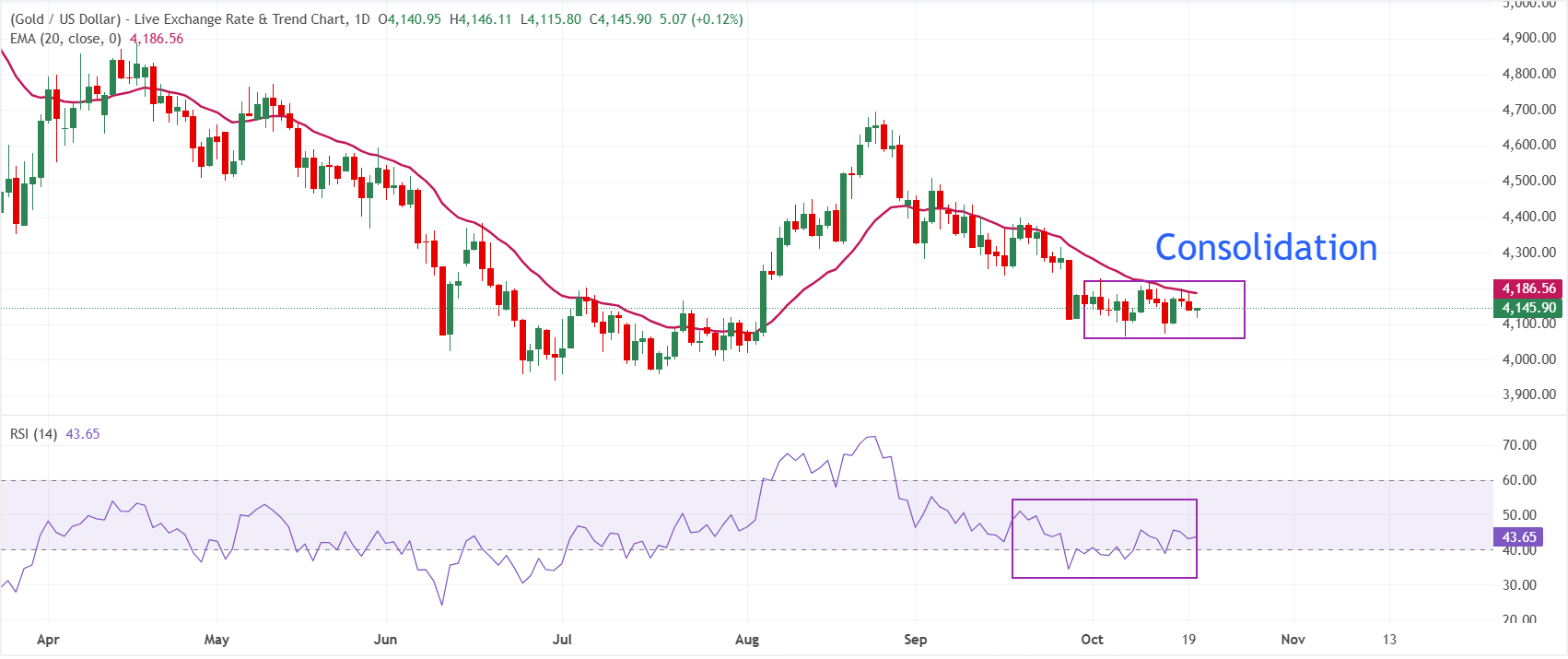
In the daily chart, XAU/USD trades at $4,146.00, keeping a bearish near-term bias as it holds beneath the 20-day Exponential Moving Average (EMA) at $4,186.57. The metal has retreated from recent highs and now sits below this key dynamic barrier, suggesting that rallies are being capped by overhead supply. The Relative Strength Index (RSI) at 43.66 stays below the midline, hinting at still-negative, though not oversold, momentum.
On the topside, immediate resistance is defined by the 20-day EMA at $4,186.57, and a daily close above this level would be needed to ease downside pressure and open the way for a more sustained recovery towards $4,300. On the downside, the psychological level of $4,000 is expected to remain key support for the precious metal.
(The technical analysis of this story was written with the help of an AI tool. Know more.)
Gold FAQs
Gold has played a key role in human’s history as it has been widely used as a store of value and medium of exchange. Currently, apart from its shine and usage for jewelry, the precious metal is widely seen as a safe-haven asset, meaning that it is considered a good investment during turbulent times. Gold is also widely seen as a hedge against inflation and against depreciating currencies as it doesn’t rely on any specific issuer or government.
Central banks are the biggest Gold holders. In their aim to support their currencies in turbulent times, central banks tend to diversify their reserves and buy Gold to improve the perceived strength of the economy and the currency. High Gold reserves can be a source of trust for a country’s solvency. Central banks added 1,136 tonnes of Gold worth around $70 billion to their reserves in 2022, according to data from the World Gold Council. This is the highest yearly purchase since records began. Central banks from emerging economies such as China, India and Turkey are quickly increasing their Gold reserves.
Gold has an inverse correlation with the US Dollar and US Treasuries, which are both major reserve and safe-haven assets. When the Dollar depreciates, Gold tends to rise, enabling investors and central banks to diversify their assets in turbulent times. Gold is also inversely correlated with risk assets. A rally in the stock market tends to weaken Gold price, while sell-offs in riskier markets tend to favor the precious metal.
The price can move due to a wide range of factors. Geopolitical instability or fears of a deep recession can quickly make Gold price escalate due to its safe-haven status. As a yield-less asset, Gold tends to rise with lower interest rates, while higher cost of money usually weighs down on the yellow metal. Still, most moves depend on how the US Dollar (USD) behaves as the asset is priced in dollars (XAU/USD). A strong Dollar tends to keep the price of Gold controlled, whereas a weaker Dollar is likely to push Gold prices up.
Author

Sagar Dua
FXStreet
Sagar Dua is associated with the financial markets from his college days. Along with pursuing post-graduation in Commerce in 2014, he started his markets training with chart analysis.