GBP/USD Price Forecast: Resumes downside after testing Triangle breakdown zone
- GBP/USD slumps to near 1.3150 as Fed interest rate hike bets strengthen the US Dollar.
- The Fed is expected to deliver at least one interest rate hike this year.
- Investors seek fresh cues regarding the UK fiscal policy outlook.
The British Pound (GBP) trades 0.38% lower at around 1.3150 against the US Dollar (USD) during the European trading session on Wednesday. The GBP/USD pair faces intense selling pressure as the US Dollar outperforms due to hawkish Federal Reserve (Fed) bets.
At press time, the US Dollar Index (DXY), which gauges the Greenback’s value against six major currencies, trades 0.3% higher to near 101.70, the highest level seen in over a year.
According to the CME FedWatch tool, there is an almost 86% chance that the Fed will deliver at least one interest rate hike by the year-end.
Hawkish Fed bets are prompted by consistently rising both headline and core Consumer Price Index (CPI) in the past few months.
On the United Kingdom (UK) front, investors seek fresh cues regarding the fiscal policy outlook after Prime Minister (PM) Keir Starmer’s resignation. So far, Greater Manchester Mayor Andy Burnham has been recognized as a potential replacement for UK PM Starmer since the Labour Party suffered a major defeat in local elections in May.
GBP/USD technical analysis
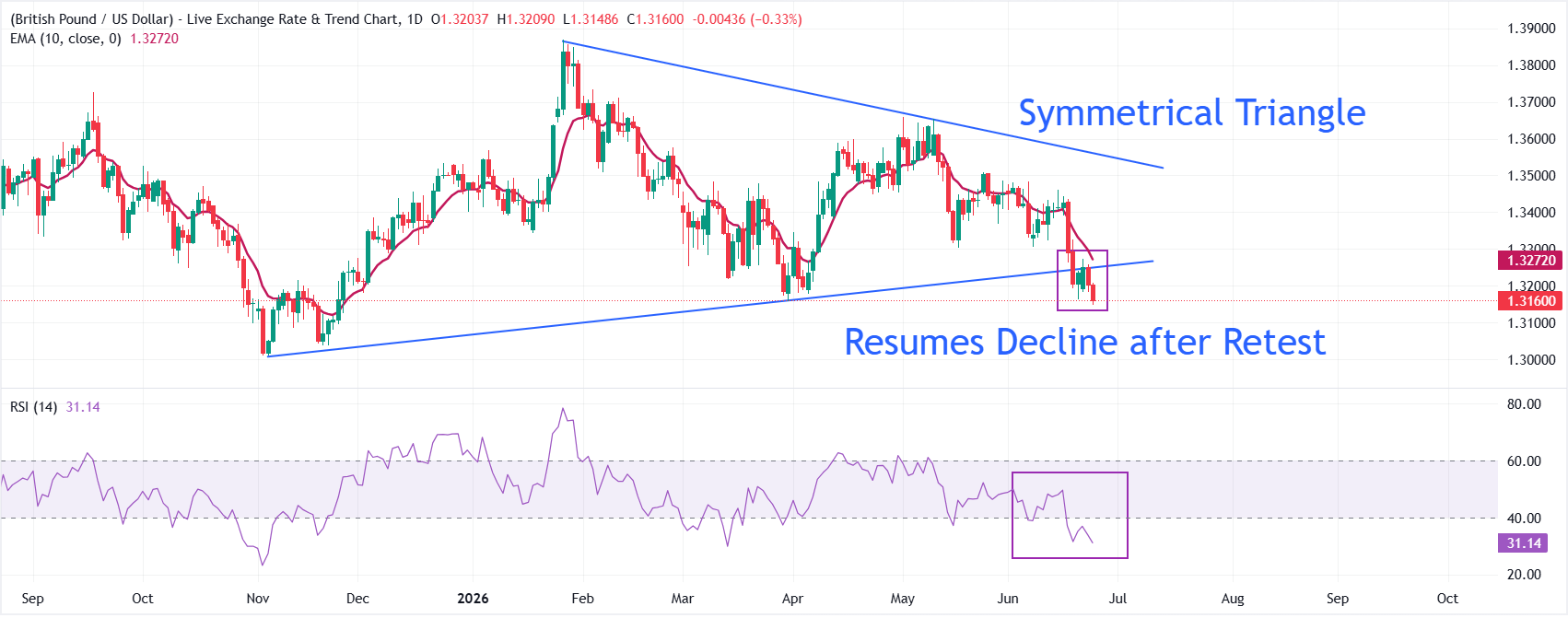
GBP/USD trades lower at around 1.3150, extending its slide below former structural supports and keeping a clear bearish near-term bias. Spot now holds under the broken rising trend-line support of the Symmetrical Triangle formation around 1.3251 and the 10-day exponential moving average (EMA) at 1.3272, which together frame a nearby supply zone capping rebounds within the broader descending trend.
The Relative Strength Index (14) hovers just above oversold territory near 31, hinting that bearish momentum remains dominant even if short-lived bounces cannot be ruled out.
On the topside, initial resistance is seen at the reclaimed-bearish trend-line level near 1.3251, followed by the 10-day EMA at 1.3272; a daily close back above this cluster would be needed to ease immediate downside pressure.
On the downside, the pair is expected to find support near the November 21 low at 1.3038, followed by the psychological support at 1.3000.
(The technical analysis of this story was written with the help of an AI tool.)
Fed FAQs
Monetary policy in the US is shaped by the Federal Reserve (Fed). The Fed has two mandates: to achieve price stability and foster full employment. Its primary tool to achieve these goals is by adjusting interest rates. When prices are rising too quickly and inflation is above the Fed’s 2% target, it raises interest rates, increasing borrowing costs throughout the economy. This results in a stronger US Dollar (USD) as it makes the US a more attractive place for international investors to park their money. When inflation falls below 2% or the Unemployment Rate is too high, the Fed may lower interest rates to encourage borrowing, which weighs on the Greenback.
The Federal Reserve (Fed) holds eight policy meetings a year, where the Federal Open Market Committee (FOMC) assesses economic conditions and makes monetary policy decisions. The FOMC is attended by twelve Fed officials – the seven members of the Board of Governors, the president of the Federal Reserve Bank of New York, and four of the remaining eleven regional Reserve Bank presidents, who serve one-year terms on a rotating basis.
In extreme situations, the Federal Reserve may resort to a policy named Quantitative Easing (QE). QE is the process by which the Fed substantially increases the flow of credit in a stuck financial system. It is a non-standard policy measure used during crises or when inflation is extremely low. It was the Fed’s weapon of choice during the Great Financial Crisis in 2008. It involves the Fed printing more Dollars and using them to buy high grade bonds from financial institutions. QE usually weakens the US Dollar.
Quantitative tightening (QT) is the reverse process of QE, whereby the Federal Reserve stops buying bonds from financial institutions and does not reinvest the principal from the bonds it holds maturing, to purchase new bonds. It is usually positive for the value of the US Dollar.
Author

Sagar Dua
FXStreet
Sagar Dua is associated with the financial markets from his college days. Along with pursuing post-graduation in Commerce in 2014, he started his markets training with chart analysis.