GBP/JPY treads water near 181.00 ahead of early Tuesday's BoJ rate call
- GBP/JPY is splashing around familiar levels as BoJ rate call looms ahead on Tuesday.
- BoJ watchers will be keeping a close eye on BoJ Governor Ueda for any hawkish hints.
- Near-term UK inflation is expected to tick up, but print a slight decline over the year.

The GBP/JPY tested back into the 181.00 handle on Monday, but remains caught in a tight near-term range as Guppy traders buckle down for a Tuesday showing from the Bank of Japan (BoJ) and Wednesday's final print of UK Consumer Price Index (CPI) inflation to wrap up 2023.
The Bank of Japan (BoJ) is broadly expected to maintain their negative rate policy, keeping the Japanese central bank’s main reference rate pinned just below zero at -0.1%. BoJ Governor Kazuo Ueda rocked JPY markets in early December after taking an unusually hawkish stance, hinting at the eventual end of negative rates.
BoJ Preview: Forecasts from 11 major banks, little need to rush into making policy changes
With markets heading into the year-end slowdown, Odds of normalization from the BoJ are functionally zero, but investors will be keeping a close eye on any additional hints from BoJ Governor Ueda about a possible timeline on policy tightening.
The UK will follow up the BoJ on Wednesday with one last inflation update for 2023. UK Consumer Price Index (CPI) inflation is expected to show a steady easing in the annualized figures, with YoY CPI forecast through November expected to ease back from 4.6% to 4.4%. Despite a forecast easing in long-term inflation, the near end of the curve is expected to tick upwards, with November’s CPI inflation expected to post a 0.2% increase from October’s reading.
UK Producer Price Index (PPI) figures are also slated to print at 07:00 GMT on Tuesday, and both input and output prices at the production level of the economy are expected to see declines.
UK PPI - Output is expected to decline from 0.1% to -0.1%, while PPI - Inputs are forecast to shed nearly a full percent MoM in November from 0.4% to -0.6%.
UK Retail Price Index figures are also expected on Tuesday, and markets are expecting near-term retail price growth to rebound from -0.2% to 0.3% in November, while the YoY figure is forecast to slip back slightly from 6.1% to 5.8%.
One last UK Gross Domestic Product (GDP) update for the year will round out the economic calendar for the GBP/JPY on Friday, with UK economic growth forecast to hold at a flat 0.0% for the third quarter as the UK economy tips closer towards a recession.
GBP/JPY Technical Outlook
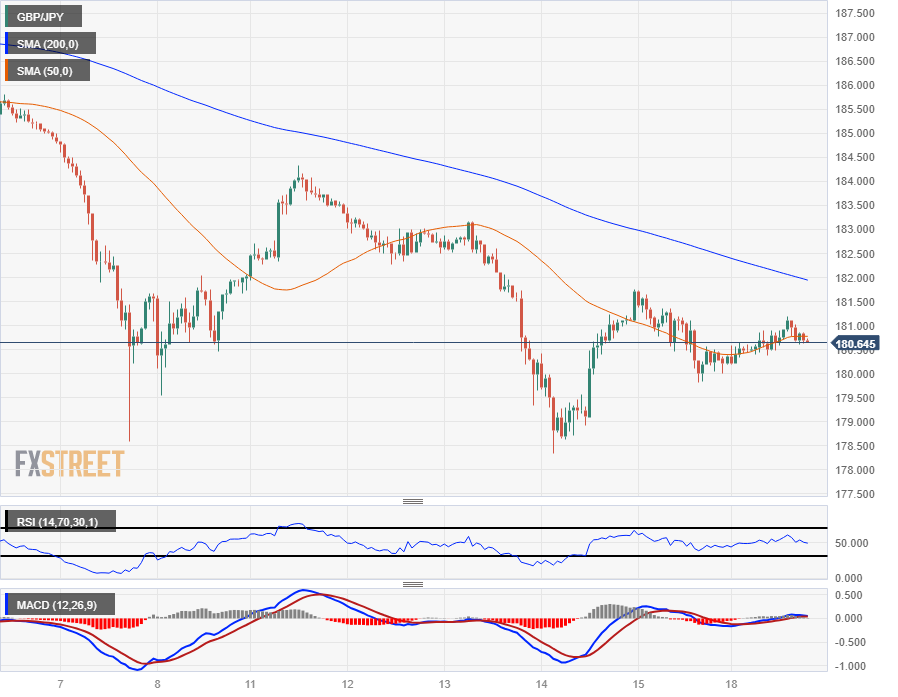
The GBP/JPY has seen momentum drain away heading into the new trading week, with intraday bids hammered to the 50-hour Simple Moving Average (SMA), with near-term prices capped by the 200-hour descending into 182.00.
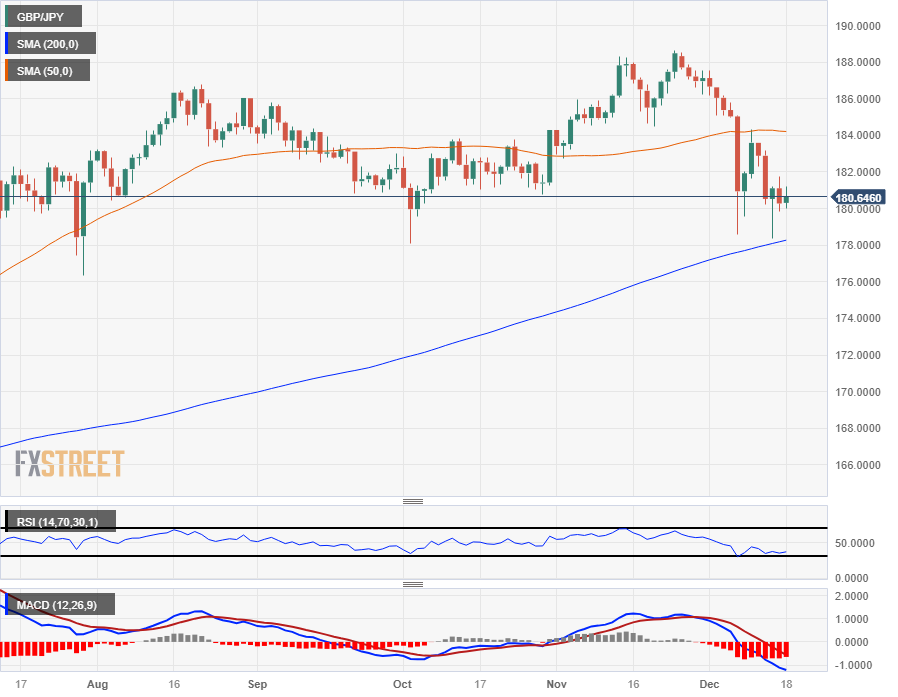
Last week saw a brief decline into a four-month low of 178.35, with bids catching technical support from the 200-day SMA rising through 178.00 and Guppy traders dragging the pair back above the 180.00 major handle.
GBP/JPY Hourly Chart
GBP/JPY Daily Chart
GBP/JPY Technical Levels
Author

Joshua Gibson
FXStreet
Joshua joins the FXStreet team as an Economics and Finance double major from Vancouver Island University with twelve years' experience as an independent trader focusing on technical analysis.















