GBP/JPY Price Forecast: Evening star threatens 216.00 support
- GBP/JPY fades 217.00 breakout, forming potential evening star.
- Break below 216.00 exposes 50-day and 100-day SMAs.
- Bulls must reclaim 217.00 to refocus 218.00 and 218.69.


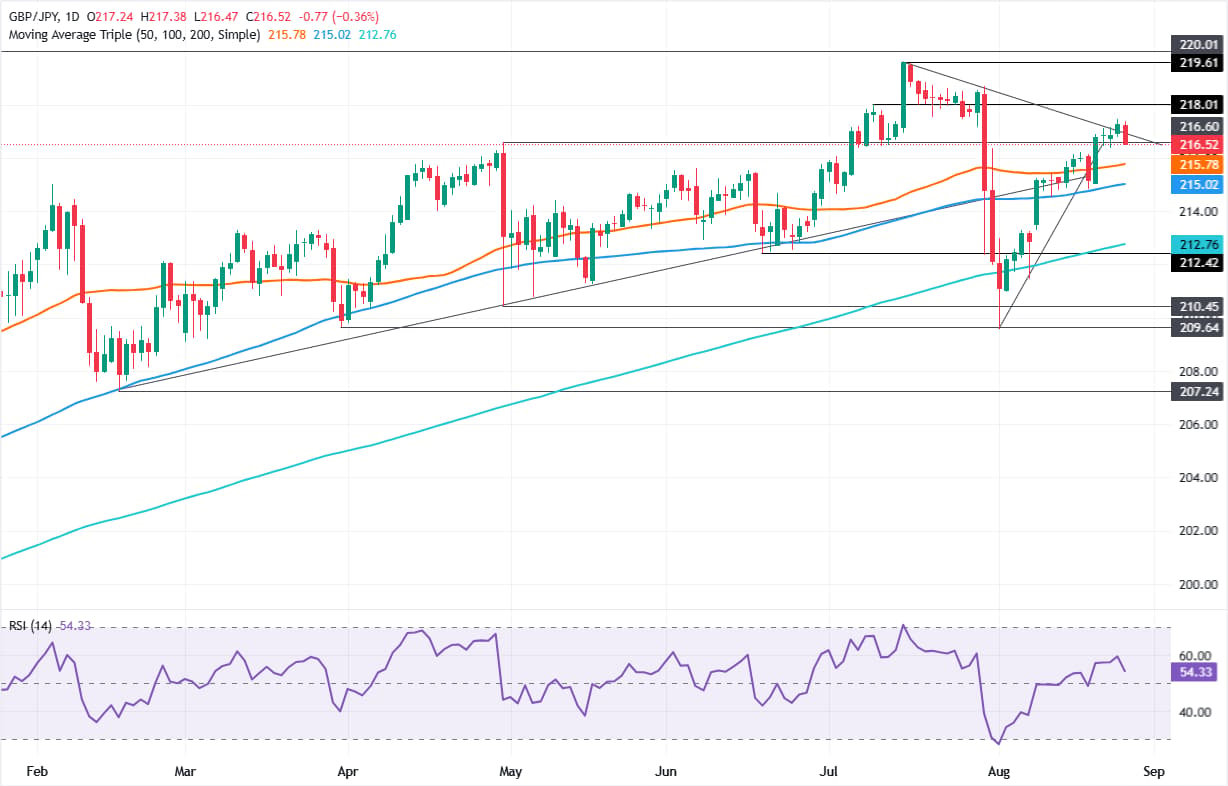
The GBP/JPY failed to sustain the 217.00 breakout, reversing to the 216.50 area as traders faded the move, exacerbating the decline to current exchange rates. At the time of writing, the cross-pair exchanges hands with losses of 0.36%.
GBP/JPY Price Forecast: Technical Outlook
Price action shows GBP/JPY making a U-turn, opening the door to further downside. A three-candle chart pattern suggests the formation of a bearish chart pattern, the ‘evening star.’ This usually forms during a false breakout, meaning that in the short-term, the path of least resistance is down.
The first support is the psychological 216.50 and 216.00 levels. A breach of the latter will expose the 50-day Simple Moving Average (SMA) at 215.78, followed by the 100-day SMA at 215.02.
On the other hand, if GBP/JPY reclaims 217.00, the next stop would be 218.00. Once cleared, next lie the July 30 highs at 218.69 and 219.00.
GBP/JPY Price Chart – Daily
Japanese Yen FAQs
The Japanese Yen (JPY) is one of the world’s most traded currencies. Its value is broadly determined by the performance of the Japanese economy, but more specifically by the Bank of Japan’s policy, the differential between Japanese and US bond yields, or risk sentiment among traders, among other factors.
One of the Bank of Japan’s mandates is currency control, so its moves are key for the Yen. The BoJ has directly intervened in currency markets sometimes, generally to lower the value of the Yen, although it refrains from doing it often due to political concerns of its main trading partners. The BoJ ultra-loose monetary policy between 2013 and 2024 caused the Yen to depreciate against its main currency peers due to an increasing policy divergence between the Bank of Japan and other main central banks. More recently, the gradually unwinding of this ultra-loose policy has given some support to the Yen.
Over the last decade, the BoJ’s stance of sticking to ultra-loose monetary policy has led to a widening policy divergence with other central banks, particularly with the US Federal Reserve. This supported a widening of the differential between the 10-year US and Japanese bonds, which favored the US Dollar against the Japanese Yen. The BoJ decision in 2024 to gradually abandon the ultra-loose policy, coupled with interest-rate cuts in other major central banks, is narrowing this differential.
The Japanese Yen is often seen as a safe-haven investment. This means that in times of market stress, investors are more likely to put their money in the Japanese currency due to its supposed reliability and stability. Turbulent times are likely to strengthen the Yen’s value against other currencies seen as more risky to invest in.
Author
Christian Borjon Valencia
FXStreet
Markets analyst, news editor, and trading instructor with over 14 years of experience across FX, commodities, US equity indices, and global macro markets.