|

Fresenius Medical Care (FME Stock) provides a long-term opportunity

Fresenius Medical Care is a German healthcare company. It is one of the four divisions of Fresenius SE & Co. KGaA. The company provides kidney dialysis services and treats end-stage renal disease. Today, it has a 38% share of the dialysis market in the US. Fresenius Medical Care operates 45 production sites, mainly in the US, Germany, and Japan. Founded in 1996 and headquartered in Bad Homburg vo rder Höhe, Germany, Fresenius Medical Care is a part of the DAX40 index. One can trade it under the ticker $FME at XETRA.

Fresenius Medical Care monthly Elliott Wave analysis 10.18.2021

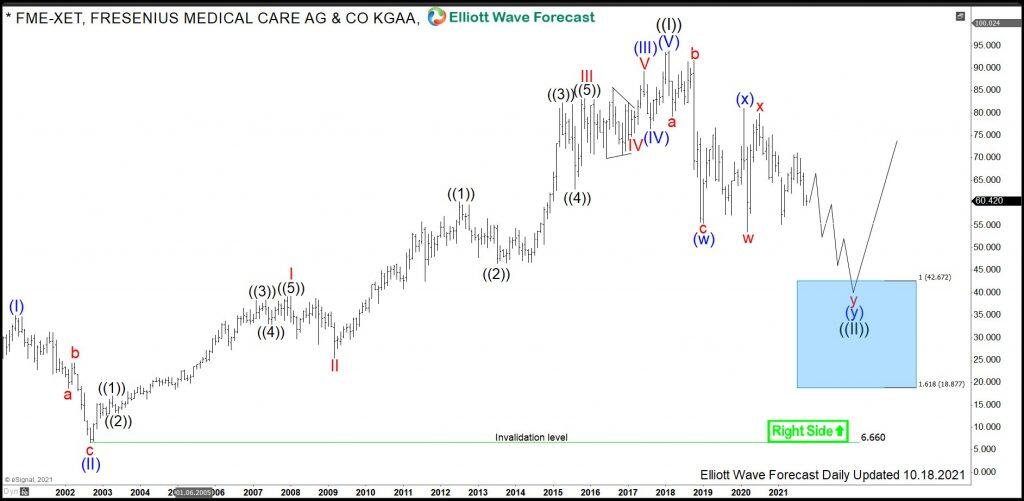
The monthly chart below shows the Fresenius Medical Care stock $FME traded at XETRA. From all-time lows, the stock price has developed an Elliott wave motive wave pattern. The cycle up in black wave ((I)) being of grand supercycle degree has ended by printing its top at all-time highs in February 2018 at 93.82. Within the grand supercycle ((I)), the blue wave (III) of supercycle degree is an impulse showing an extension as related to the waves (I) and (V).

From the February 2018 high, a consolidation has started and is still in progress. First, a cycle lower in 3 waves has ended in January 2019. Then, from the 55.44 low a rally has failed to make a new high. After 3 waves of blue wave (x) ending in February 2020 at 81.10, $FME has broken below 55.44 low. As a matter of fact, this has opened a bearish sequence. As a consequence, while the price holds below 81.10, one should expect $FME to trade lower into the 42.67-18.87 area.

Investors and traders can buy Fresenius medical care from 42.67-18.87 areas expecting a long-term rally to the new highs. The target in the black wave ((III)) will be towards 136-194 areas in case of reaction from the 42.67 level. 
FME

Author

Elliott Wave Forecast Team

Elliott Wave Forecast Team

ElliottWave-Forecast.com

More from Elliott Wave Forecast Team
Share:

Editor's Picks

AUD/USD breaks 0.7000 as RBA inflation warning fuels two-week high

The Australian Dollar registers solid gains versus the Greenback, climbing above 0.7000 and hitting a two-week high of 0.7017 as broad US Dollar weakness pushes AUD/USD above 0.7000 amid a light economic docket in both Australia and the US.

USD/JPY flatlines near 158.50 as markets seek direction

USD/JPY steadies around 158.50 in the Asian trading hours on Tuesday. Traders prefer to wait on the sidelines ahead of Japan’s National Consumer Price Index inflation data later on Friday. Meanwhile, elevated US bond yields provide some support to the US Dollar against the Japanese Yen.

Gold just failed at $4,150. This is the next stop

Gold prices trade without a clear direction on Tuesday, hovering around the $4,170 region per troy ounce and still struggling to regain upside traction following Monday’s pullback. In the meantime, lower US Treasury yields and a marked pullback in the US Dollar come in tandem with the yellow metal’s price action.

 Bitcoin resumes Nasdaq correlation as macro pressures threaten $82,500 support

Bitcoin's (BTC) correlation with the Nasdaq is rising again after last week's decline alongside tech stocks, even as macro pressures place the $82,500 support at risk. In a report on Tuesday, K33 Research highlighted that Bitcoin has resumed its correlation with the tech-heavy Nasdaq after last week's price movements.

SpaceX's earnings don't matter. What they unlock does

The Elon Musk-founded SpaceX reports third-quarter results after Tuesday's session. The figure that decides the next month for the stock isn't in them. On Thursday, the second full trading day after the release, up to 1.3 billion shares held by employees and early investors become eligible for sale.

The US Dollar fell. Gold didn't rally. That tells you everything
Gold (XAU/USD) is struggling to capitalize on a weaker US Dollar (USD), after repeatedly failing to establish itself above the $4,200 level. The precious metal remains confined to a relatively narrow trading range despite a combination of developments that would normally support higher prices.