For the Canadian Dollar, the trade war beats the data
- USD/CAD trades at 14-month highs as the Canadian Dollar leads losses among the majors.
- A hotter-than-expected May inflation report failed to lift the currency.
- Trade-war pressure and a firm US Dollar are overriding supportive domestic data.

A hot inflation print and a rebound in Crude Oil ought to be a recipe for a stronger commodity currency, which makes the Canadian Dollar's slide to fresh 14-month lows all the more telling. USD/CAD pushed to a session high near 1.4200 on Monday before easing back toward 1.4150, leaving the Loonie as the weakest of the majors. The textbook drivers point one way and the currency is going the other, because the forces that move it now sit south of the border, not in Ottawa.
Hot inflation, cold reception
Statistics Canada's May report was unambiguously firm. Headline Consumer Price Index (CPI) inflation accelerated to 3.2% YoY, above the 3.0% consensus and up from 2.8% the prior month, while the monthly pace jumped to 1.0%. Core measures firmed as well, which matters because Governor Tiff Macklem has spent recent meetings warning that the real danger is energy costs bleeding into wages and services, the so-called second-round effects that would force the Bank of Canada (BoC) to abandon its patience. On paper, this print nudges the next move toward a hike rather than a cut. The market's reaction was the tell: the Loonie caught a brief bid as the number crossed the wires, tagging the session low near 1.4150 before that move was faded inside the hour.
The petro-currency link breaks down
The bounce in Crude Oil should, in theory, be doing some of the work the inflation surprise is not. The Canadian Dollar has historically traded as a petro-currency; in a normal cycle, the rebound in Brent and WTI after Iran moved to re-close the Strait of Hormuz over the weekend would lend the Loonie support. That link has quietly broken down. Higher energy prices now read as a stagflationary tax on an economy already absorbing United States tariffs, rather than a clean terms-of-trade windfall. The same geopolitical premium that lifts Crude Oil also drives safe-haven demand into the US Dollar, swamping any benefit to the Canadian side.
Everything that matters is American
The forces setting the Loonie's direction are largely external. A hawkish Federal Reserve (Fed) is the anchor, with US rates held at 3.75% and policymakers signalling scope for further tightening, a stance that keeps the Dollar firm against almost everything. Layered on top is the trade conflict: tariffs and unresolved questions around the continental trade pact have left Canadian growth stalling, with output contracting slightly in the first quarter. That weakness is exactly why the BoC cannot simply lean into a hot inflation print the way another central bank might. Macklem's bind is that hiking into a tariff-hit, barely-growing economy risks tipping it over, while standing pat lets inflation expectations drift. The hot CPI sharpens that dilemma without resolving it. A currency caught in that vice does not rally on one data point.
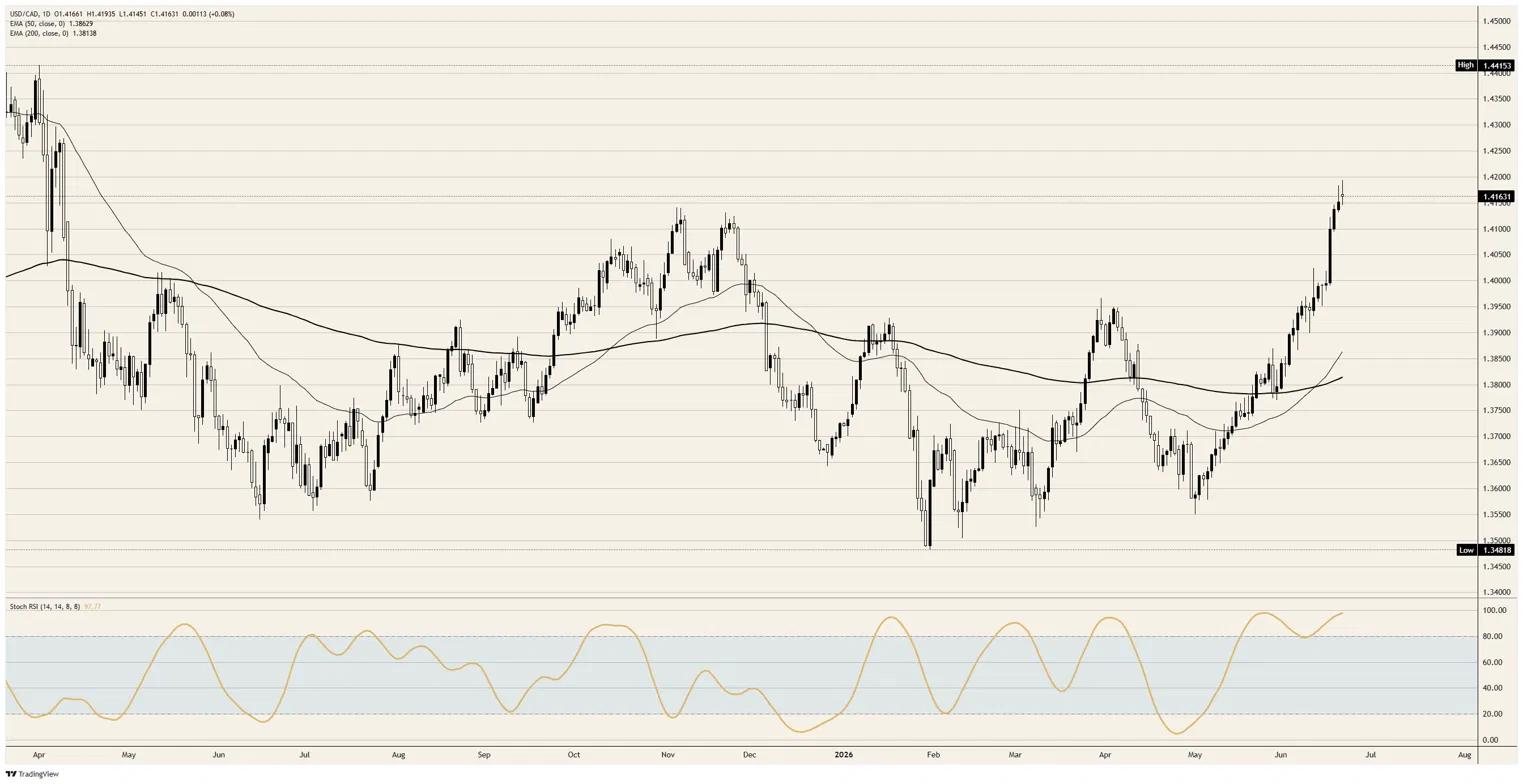
Resistance: The session high near 1.4200 is the immediate barrier; a sustained break there exposes 1.4250 and then the April 2025 spike zone around 1.4400. Daily momentum is stretched, with the Stochastic Relative Strength Index (Stoch RSI) pinned near the top of its range. A push through 1.4200 likely needs a fresh catalyst rather than momentum alone.
Support: The session low close to 1.4150 is the first floor, ahead of the 1.4100 round level and the psychological 1.4000 mark, which roughly aligns with the prior breakout. The 50-day Exponential Moving Average (EMA) sits far below near 1.3850, a measure of how stretched this move has become.
Bias: Higher while 1.4000 holds, with pullbacks the preferred entries rather than chases. The trend, the rate gap, and the trade backdrop all push the same way, while the overbought signal argues for consolidation, not reversal. That favours buying dips toward 1.4100 over chasing the highs. The near-term risks sit on the calendar: Macklem speaks Tuesday at 13:00 GMT; the United States releases its core Personal Consumption Expenditures Price Index (PCE) on Thursday at 12:30 GMT. Either could extend the move or trigger the overdue pause. A daily close back below 1.4000 would be the signal that the Loonie has finally found a floor.
USD/CAD daily chart
Canadian Dollar FAQs
The key factors driving the Canadian Dollar (CAD) are the level of interest rates set by the Bank of Canada (BoC), the price of Oil, Canada’s largest export, the health of its economy, inflation and the Trade Balance, which is the difference between the value of Canada’s exports versus its imports. Other factors include market sentiment – whether investors are taking on more risky assets (risk-on) or seeking safe-havens (risk-off) – with risk-on being CAD-positive. As its largest trading partner, the health of the US economy is also a key factor influencing the Canadian Dollar.
The Bank of Canada (BoC) has a significant influence on the Canadian Dollar by setting the level of interest rates that banks can lend to one another. This influences the level of interest rates for everyone. The main goal of the BoC is to maintain inflation at 1-3% by adjusting interest rates up or down. Relatively higher interest rates tend to be positive for the CAD. The Bank of Canada can also use quantitative easing and tightening to influence credit conditions, with the former CAD-negative and the latter CAD-positive.
The price of Oil is a key factor impacting the value of the Canadian Dollar. Petroleum is Canada’s biggest export, so Oil price tends to have an immediate impact on the CAD value. Generally, if Oil price rises CAD also goes up, as aggregate demand for the currency increases. The opposite is the case if the price of Oil falls. Higher Oil prices also tend to result in a greater likelihood of a positive Trade Balance, which is also supportive of the CAD.
While inflation had always traditionally been thought of as a negative factor for a currency since it lowers the value of money, the opposite has actually been the case in modern times with the relaxation of cross-border capital controls. Higher inflation tends to lead central banks to put up interest rates which attracts more capital inflows from global investors seeking a lucrative place to keep their money. This increases demand for the local currency, which in Canada’s case is the Canadian Dollar.
Macroeconomic data releases gauge the health of the economy and can have an impact on the Canadian Dollar. Indicators such as GDP, Manufacturing and Services PMIs, employment, and consumer sentiment surveys can all influence the direction of the CAD. A strong economy is good for the Canadian Dollar. Not only does it attract more foreign investment but it may encourage the Bank of Canada to put up interest rates, leading to a stronger currency. If economic data is weak, however, the CAD is likely to fall.
Author

Joshua Gibson
FXStreet
Joshua joins the FXStreet team as an Economics and Finance double major from Vancouver Island University with twelve years' experience as an independent trader focusing on technical analysis.