Experts agree: Weak Dollar backs near-term upside in EUR/USD
- The Euro posts a fresh three-month high at 1.1710 against the US Dollar.
- The US Treasury plan to pace up its long-maturing bond-buying operations and receded hawkish Fed bets have weighed on the US Dollar.
- The ECB is widely expected to raise interest rates at the September meeting.

The Euro (EUR) trades 0.21% higher at around 1.1710 against the US Dollar (USD) during the European trading session on Friday, the highest level seen in over three months. The major currency pair climbs higher as the US Dollar (USD) underperforms due to multiple headwinds, notably United States (US) Treasury Department’s decision to double down on its bond-buying operations and receded hawkish Federal Reserve (Fed) bets.
At press time, the US Dollar Index (DXY), which gauges the Greenback’s value against six major currencies, is down 0.17% to near 98.67. The USD Index attracts slight bids after revisiting the fresh three-month low at 98.56 posted the previous day.
US Dollar Price Today
The table below shows the percentage change of US Dollar (USD) against listed major currencies today. US Dollar was the weakest against the Australian Dollar.
| USD | EUR | GBP | JPY | CAD | AUD | NZD | CHF | |
|---|---|---|---|---|---|---|---|---|
| USD | -0.20% | -0.13% | -0.19% | -0.35% | -0.66% | -0.55% | -0.16% | |
| EUR | 0.20% | 0.07% | -0.02% | -0.18% | -0.47% | -0.34% | 0.04% | |
| GBP | 0.13% | -0.07% | -0.09% | -0.24% | -0.51% | -0.42% | -0.02% | |
| JPY | 0.19% | 0.02% | 0.09% | -0.15% | -0.46% | -0.37% | 0.04% | |
| CAD | 0.35% | 0.18% | 0.24% | 0.15% | -0.31% | -0.19% | 0.19% | |
| AUD | 0.66% | 0.47% | 0.51% | 0.46% | 0.31% | 0.10% | 0.50% | |
| NZD | 0.55% | 0.34% | 0.42% | 0.37% | 0.19% | -0.10% | 0.41% | |
| CHF | 0.16% | -0.04% | 0.02% | -0.04% | -0.19% | -0.50% | -0.41% |
The heat map shows percentage changes of major currencies against each other. The base currency is picked from the left column, while the quote currency is picked from the top row. For example, if you pick the US Dollar from the left column and move along the horizontal line to the Japanese Yen, the percentage change displayed in the box will represent USD (base)/JPY (quote).
Euro support builds as ING flags benign Dollar decline
Analysts at ING observe that EUR/USD "remains well supported," with the pair benefiting from what they describe as a "benign decline in the Dollar that tends to float all boats." They add that, while "not that anyone is expecting it," any move toward "true US fiscal consolidation" would matter for the currency outlook, as "the combination of tighter fiscal policy and looser monetary policy would be Dollar-negative."
Dollar seen vulnerable as Fed faces pressure to cut rates in 2027
Analysts at Commerzbank argue that the Dollar is likely to come under renewed pressure once the war with Iran ends, as they do not expect the Fed to deliver the rate hikes currently priced by markets. Instead, they foresee the Fed "embark on pronounced and ultimately excessive interest rate cuts again in 2027, also because of the political pressure." Commerzbank adds that the Dollar is "vulnerable because it is significantly overvalued based on purchasing power parity," reinforcing their view that the currency will face downside risks over the medium term.
While comments from financial markets suggest that hopes of a prolong Fed’s wait mode to keep the US Dollar under pressure, firm expectations that the European Central Bank (ECB) will raise interest rates in September is strengthening the Euro.
Analysts at DBS highlight that EUR has been the “prime beneficiary of USD weakness,” with EUR/USD having “rallied towards 1.17” as the Dollar remains under pressure. They note that the latest inflation data have reinforced the Euro’s appeal, with the Eurozone’s July CPI “coming in line with expectations,” as both “headline and core inflation matched consensus of 2.9% y/y and 2.5% y/y respectively.”
DBS argues that this inflation backdrop “has entrenched expectations of an ECB rate hike for Sep,” pointing out that “markets [are] pricing in a 26bps hike with over 90% probability.” By contrast, they see the policy outlook across the Atlantic as opaquer: “on the other hand, the Fed’s next rate move is less clear given recent economic data softness, and upcoming mid-term elections in November,” leaving the Dollar on a weaker footing against the Euro.
EUR/USD Technical Analysis
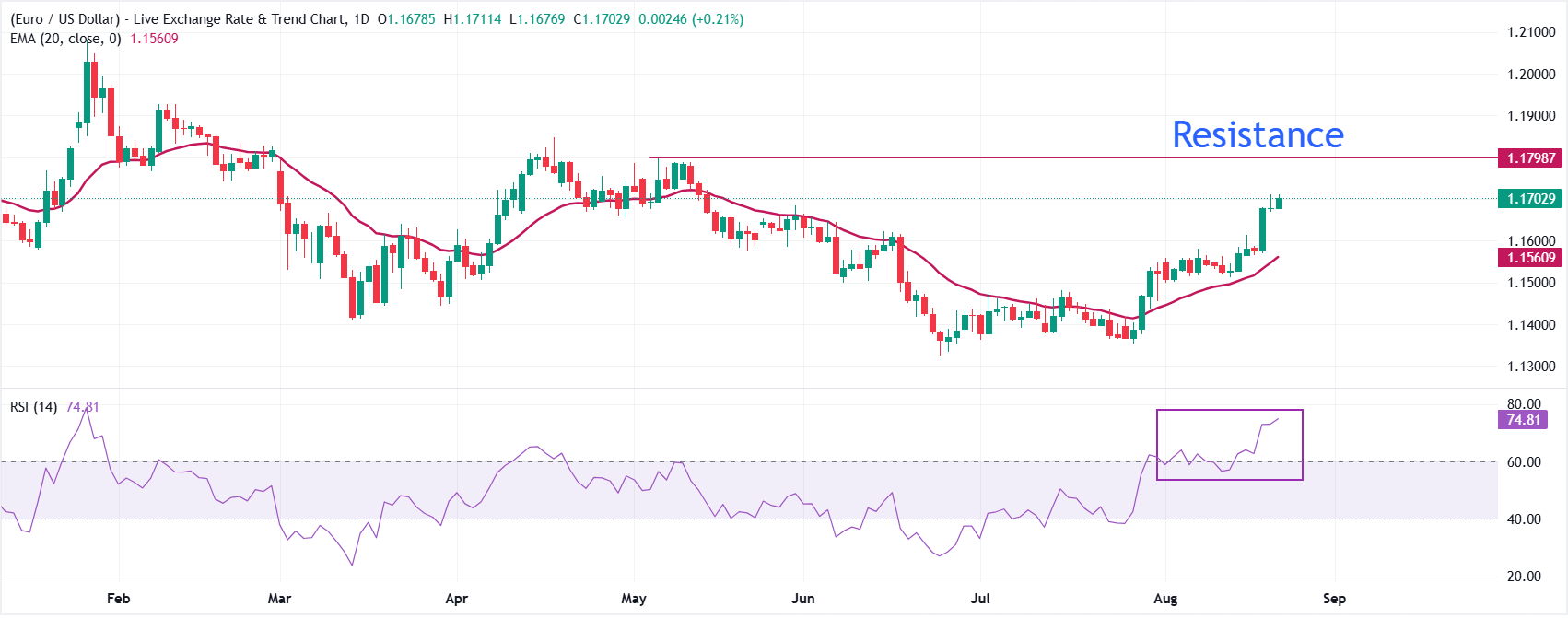
In the daily chart, EUR/USD trades at 1.1703, extending its advance well above the 20-period Exponential Moving Average (EMA) at 1.1561 and reinforcing a bullish near-term bias as price holds above this dynamic support. The Relative Strength Index (14) at 74.8 pushes deeper into overbought territory, suggesting that while buyers remain in control, upside momentum could be prone to pauses or brief corrective pullbacks.
On the downside, immediate support emerges at the recent pivot around 1.1703, followed by the 20-period EMA near 1.1561, which should act as a structural floor on a deeper retracement. Looking up, EUR/USD could extend its upside towards the May high near 1.1800.
(The technical analysis of this story was written with the help of an AI tool. Know more.)
US Dollar FAQs
The US Dollar (USD) is the official currency of the United States of America, and the ‘de facto’ currency of a significant number of other countries where it is found in circulation alongside local notes. It is the most heavily traded currency in the world, accounting for over 88% of all global foreign exchange turnover, or an average of $6.6 trillion in transactions per day, according to data from 2022. Following the second world war, the USD took over from the British Pound as the world’s reserve currency. For most of its history, the US Dollar was backed by Gold, until the Bretton Woods Agreement in 1971 when the Gold Standard went away.
The most important single factor impacting on the value of the US Dollar is monetary policy, which is shaped by the Federal Reserve (Fed). The Fed has two mandates: to achieve price stability (control inflation) and foster full employment. Its primary tool to achieve these two goals is by adjusting interest rates. When prices are rising too quickly and inflation is above the Fed’s 2% target, the Fed will raise rates, which helps the USD value. When inflation falls below 2% or the Unemployment Rate is too high, the Fed may lower interest rates, which weighs on the Greenback.
In extreme situations, the Federal Reserve can also print more Dollars and enact quantitative easing (QE). QE is the process by which the Fed substantially increases the flow of credit in a stuck financial system. It is a non-standard policy measure used when credit has dried up because banks will not lend to each other (out of the fear of counterparty default). It is a last resort when simply lowering interest rates is unlikely to achieve the necessary result. It was the Fed’s weapon of choice to combat the credit crunch that occurred during the Great Financial Crisis in 2008. It involves the Fed printing more Dollars and using them to buy US government bonds predominantly from financial institutions. QE usually leads to a weaker US Dollar.
Quantitative tightening (QT) is the reverse process whereby the Federal Reserve stops buying bonds from financial institutions and does not reinvest the principal from the bonds it holds maturing in new purchases. It is usually positive for the US Dollar.
Author

Sagar Dua
FXStreet
Sagar Dua is associated with the financial markets from his college days. Along with pursuing post-graduation in Commerce in 2014, he started his markets training with chart analysis.
















